
3D Block Puzzles for Kids — Free Castle Keep 3D 6+
 New from Dad4Kids
Clean YouTube for kids
For families with traditional values, hand-picked by parents.
Open →
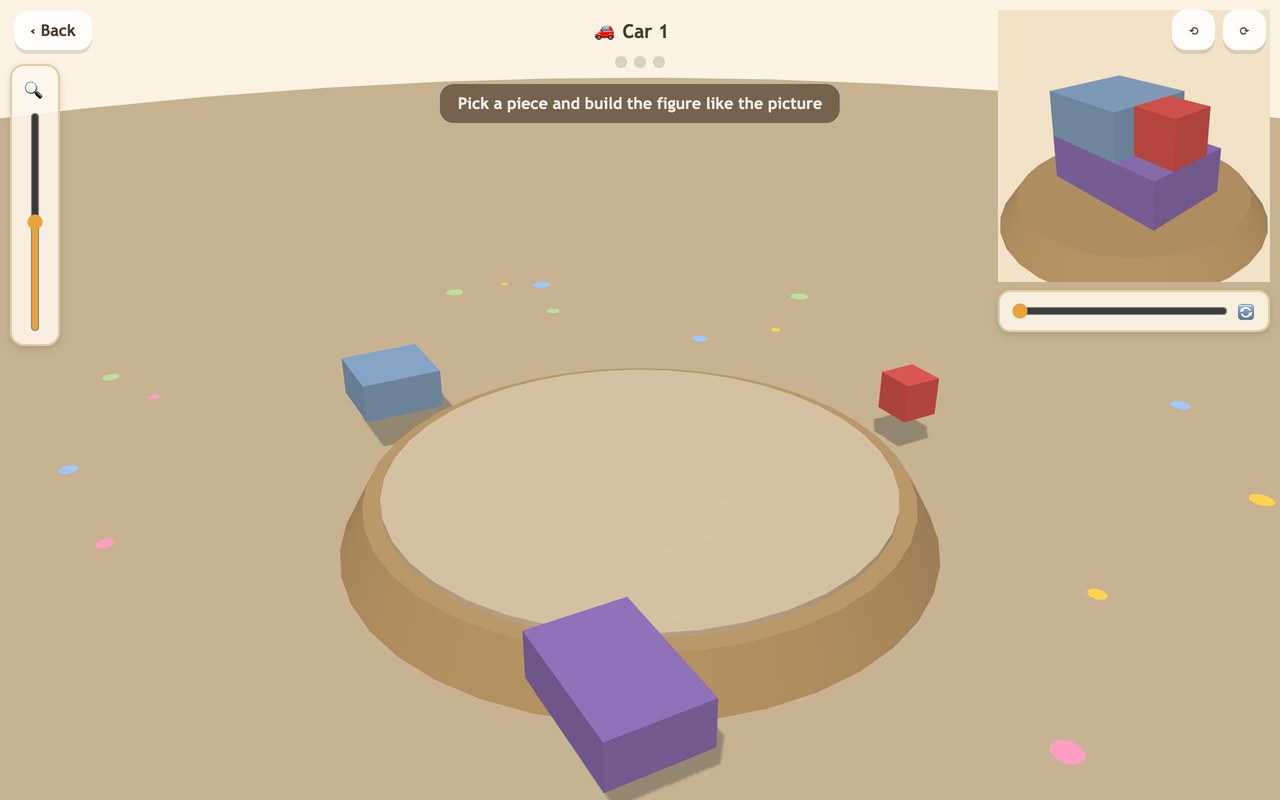
Castle Keep 3D is a set of 3D block puzzles for kids that takes spatial puzzles into the third dimension: the child builds REAL structures from polycube blocks. A translucent blueprint shows the target; every block must be rotated in space (three axes!) and placed so the structure is filled exactly — no holes, no leftovers.
120 always-solvable levels across six chapters grow from flat 2-piece platforms to full 3×3×3 cubes, pyramids and gatehouses. Finish a build and the flag rises over your fortress.
How to play
Tap a block in the tray, rotate it with the X/Y/Z buttons, then drag it onto the glowing blueprint — a green ghost shows where it will land. Tap a placed block to take it back. Turn the camera with a finger or the ⟲⟳ buttons. The hint places one correct block and clears mistakes in its way.
What your child learns
Builds true 3D mental rotation, spatial visualisation, planning and error recovery.
The science behind the games
Every Dad4Kids game is built on one simple truth: children want to play, not study — so we turn learning into a game worth replaying. The method draws on peer-reviewed research in game-based learning, motivation, and how memory works.
- Tokac et al. (2019). Effects of game-based learning on students' mathematics achievement: A meta-analysis. Journal of Computer Assisted Learning.
- Alotaibi (2024). Game-based learning in early childhood education: a systematic review and meta-analysis. Frontiers in Psychology.
- Lampropoulos & Sidiropoulos (2024). Impact of gamification on students' learning outcomes and academic performance: a meta-analysis. Education Sciences.
- Taylor & Boyer (2019). Play-based learning: evidence-based research to improve children's learning experiences. Early Childhood Education Journal.
- Gottfried (1990). Academic intrinsic motivation in young elementary school children. Journal of Educational Psychology.
- Yang et al. (2018). Enhancing learning and retrieval of new information: a review of the forward testing effect. npj Science of Learning.
FAQ
Is every level solvable?
Yes — levels are generated by carving a finished structure into pieces and machine-verified.
What age is it for?
6+. The first chapter is flat and teaches the controls; height and rotations arrive gradually.
Is it free?
Yes — free, no ads, in your browser. Best on a tablet.
More free games for kids

By Evgeny Arsentiev, PhD · Last updated: September 2026