
Chaturanga Chess Online — the Indian Ancestor of Chess 6+
 New from Dad4Kids
Clean YouTube for kids
For families with traditional values, hand-picked by parents.
Open →
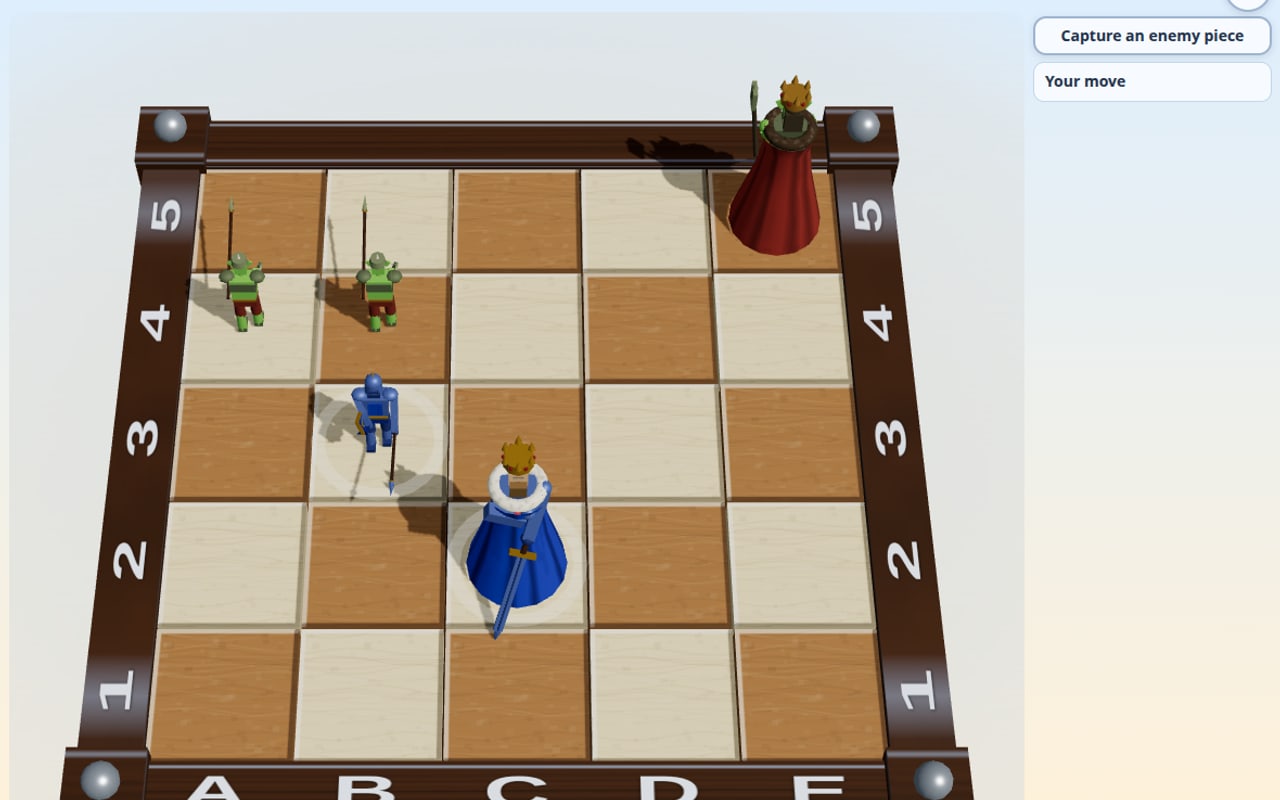
Chaturanga chess is a board game you play, not the yoga pose of the same name: it is the Indian game of the 6th century that all modern chess grew out of, and its four arms of the army — infantry, cavalry, elephants and chariots — are what gave it the name.
The pieces are deliberately weaker than the chess ones you know. The counsellor crawls one square diagonally instead of ruling the board like a queen, the elephant jumps exactly two squares diagonally over whatever stands between, and only the chariot is long-range. Nobody wins by rushing one strong piece out — you have to build a plan.
How to play
- Tap your piece, then tap one of the squares the game lights up for it.
- Learn one piece at a time: the foot soldier, the chariot, the horse, the jumping elephant, the counsellor.
- Capture by moving onto an enemy square — the foot soldier is the exception and takes diagonally.
- Win by checkmating the enemy raja, exactly as in chess.
What your child learns
- Planning several moves ahead, because no single piece can decide the game alone
- Reading a jump: the elephant flies over the square between, so blocking it does not work
- Coordinating weak pieces into one attack instead of hunting for a quick blow
- Where chess came from — the same board, an older and slower army
The science behind the games
Every Dad4Kids game is built on one simple truth: children want to play, not study — so we turn learning into a game worth replaying. The method draws on peer-reviewed research in game-based learning, motivation, and how memory works.
- Prins et al. (2013). “Braingame Brian”: toward an executive function training program with game elements. Games for Health Journal.
- Tokac et al. (2019). Effects of game-based learning on students' mathematics achievement: A meta-analysis. Journal of Computer Assisted Learning.
- Alotaibi (2024). Game-based learning in early childhood education: a systematic review and meta-analysis. Frontiers in Psychology.
- Lampropoulos & Sidiropoulos (2024). Impact of gamification on students' learning outcomes and academic performance: a meta-analysis. Education Sciences.
- Taylor & Boyer (2019). Play-based learning: evidence-based research to improve children's learning experiences. Early Childhood Education Journal.
- Gottfried (1990). Academic intrinsic motivation in young elementary school children. Journal of Educational Psychology.
FAQ
Is chaturanga the same thing as the yoga pose?
How do the pieces move?
Does a foot soldier become a queen at the far end?
Is it harder or easier than chess?
What is in the 80 levels?
More free games for kids
By Evgeny Arsentiev, PhD · Last updated: September 2026