
Listening Games for Kids — Free Castle Commander 7+
 New from Dad4Kids
Clean YouTube for kids
For families with traditional values, hand-picked by parents.
Open →
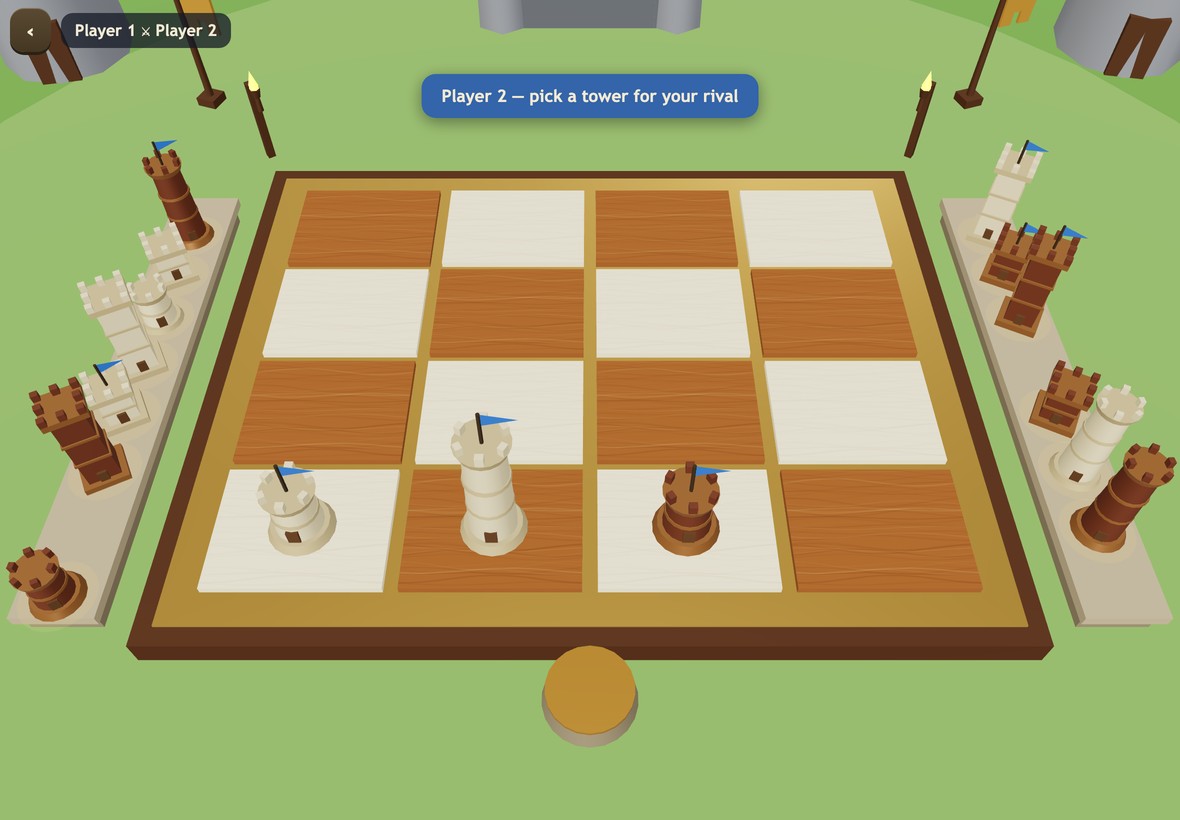
Castle Commander is one of those listening games for kids where the whole castle gets built from spoken orders. Every mission is voiced: “Place the blue tower next to the gate. Put the bridge where the safe ford sparkles.” The child drags real 3D pieces onto a living diorama — and then the kingdom tests the layout: goblins charge, villagers flee a flood, a bakery catches fire, a supply cart sets off along the new road.
Correct placement visibly saves the day; a misplaced bridge strands the villagers on the bank — no punishment, just a clear consequence and another try. After three attempts the game shows the solution and explains why the position mattered. Listening carefully is the superpower here: nobody wins by tapping fast.
How to play
Listen to the briefing (replay is limited on harder levels), drag pieces from the supply tray onto the map with one finger, then press DONE. The kingdom simulates the result: siege, crossing, fire, festival or supply run. Earn stars, open 20 regions per age track, and train weak skills in special practice worlds. A parent dashboard shows progress across listening, spatial words, map directions, memory and route planning.
What your child learns
Ages 7–8: left/right, in front/behind, between, on top, counting and colours. Ages 9–10: compass directions, both sides, closer/farther, conditions (“if the enemy camp is in the west…”), roads cell by cell, memory levels without replays. Ages 11–12: coordinates like D4, symmetry, equal distances, double conditions and route planning. The game quietly adapts: concepts a child confuses appear more often until they stick.
The science behind the games
Every Dad4Kids game is built on one simple truth: children want to play, not study — so we turn learning into a game worth replaying. The method draws on peer-reviewed research in game-based learning, motivation, and how memory works.
- Prins et al. (2013). “Braingame Brian”: toward an executive function training program with game elements. Games for Health Journal.
- Tokac et al. (2019). Effects of game-based learning on students' mathematics achievement: A meta-analysis. Journal of Computer Assisted Learning.
- Alotaibi (2024). Game-based learning in early childhood education: a systematic review and meta-analysis. Frontiers in Psychology.
- Lampropoulos & Sidiropoulos (2024). Impact of gamification on students' learning outcomes and academic performance: a meta-analysis. Education Sciences.
- Taylor & Boyer (2019). Play-based learning: evidence-based research to improve children's learning experiences. Early Childhood Education Journal.
- Gottfried (1990). Academic intrinsic motivation in young elementary school children. Journal of Educational Psychology.
FAQ
What are good listening games for kids besides this one?
Any game that rewards understanding over speed helps — but Castle Commander goes further: it hides real spatial vocabulary (left/right, compass directions, coordinates) inside every spoken instruction, so listening practice doubles as map-reading practice.
Does the game need reading?
No — every instruction is spoken aloud with a friendly voice. Subtitles can be switched on or off, and narration speed has a slow mode.
Is the siege scary?
Not at all: cartoon goblins get bounced back by arrows with sparkles and run away giggling. No one gets hurt — the castle simply proves the layout works.
More free games for kids
By Evgeny Arsentiev, PhD · Last updated: September 2026