
Nine Men's Morris Online — Mill: Fortress Siege 7+
 New from Dad4Kids
Clean YouTube for kids
For families with traditional values, hand-picked by parents.
Open →
Nine men's morris — also called Mill, Merrills or Merels — is one of the oldest strategy games on Earth: boards are carved into Roman rooftops and medieval cathedral seats. Each player has nine pieces; three in a row along a line is a mill, and every mill lets you remove an enemy piece.
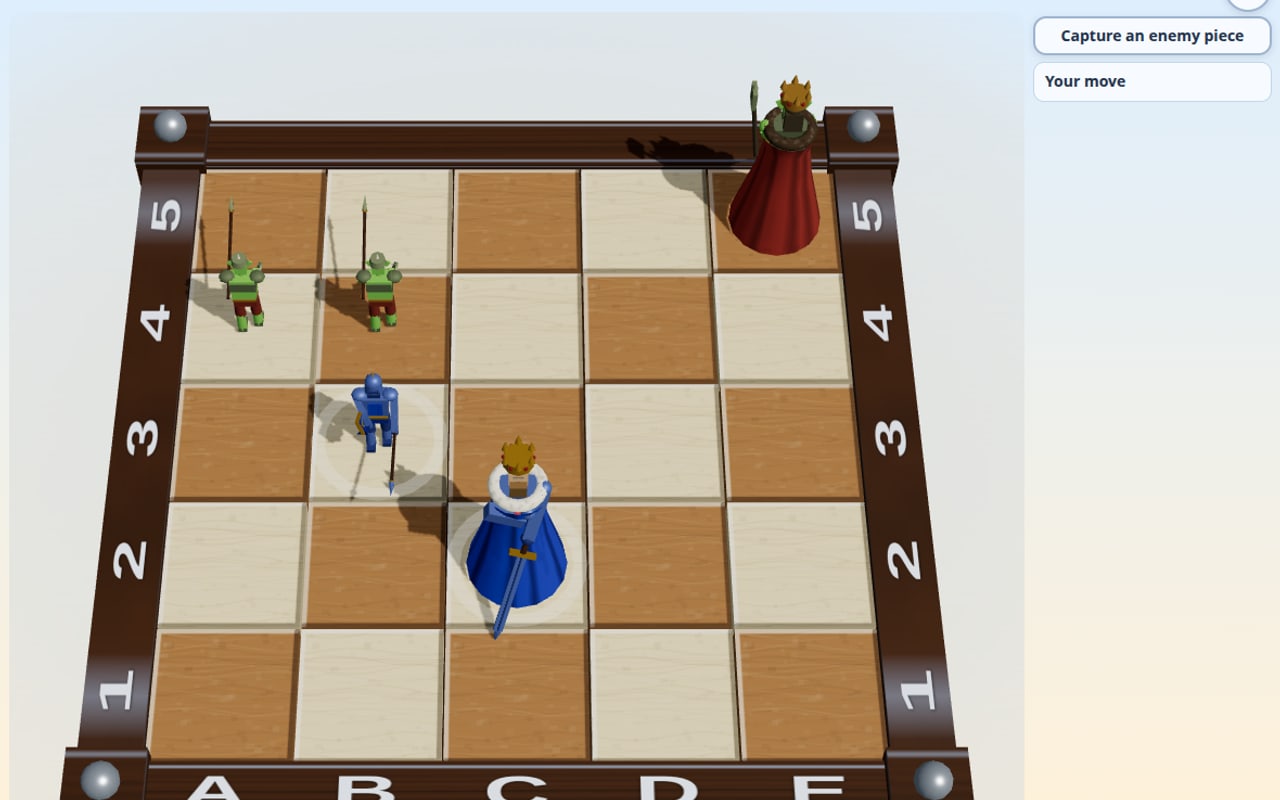
Here the board is a ring of fortress walls: steel knights against a tusked orc horde. Warriors march onto the posts, a mill flashes and an attack is called, and the last army standing holds the fortress.
Three phases teach three different skills: placing (build threats), moving (open and close a mill — the 'running mill' trick), and flying with three pieces left (jump anywhere). No dice, no luck.
How to play
Tap a free post to place a warrior; once all nine are down, tap a warrior and then a linked post to move. Form three in a line — targets light up, pick which enemy to remove. Pieces inside an enemy mill are protected while others remain.
Voiced rules on the live board, a ladder of rivals that get stronger, and the choice of side: knights move first, the horde enters from the far wall.
What your child learns
Mill is a planning game in three acts. Children learn to build a double threat (two lines that share a post), to time a mill so it can open and close every other move, and to count pieces — when a rival drops to three, everything changes. It is chess-style thinking without the chess rulebook.
The science behind the games
Every Dad4Kids game is built on one simple truth: children want to play, not study — so we turn learning into a game worth replaying. The method draws on peer-reviewed research in game-based learning, motivation, and how memory works.
- Prins et al. (2013). “Braingame Brian”: toward an executive function training program with game elements. Games for Health Journal.
- Tokac et al. (2019). Effects of game-based learning on students' mathematics achievement: A meta-analysis. Journal of Computer Assisted Learning.
- Alotaibi (2024). Game-based learning in early childhood education: a systematic review and meta-analysis. Frontiers in Psychology.
- Lampropoulos & Sidiropoulos (2024). Impact of gamification on students' learning outcomes and academic performance: a meta-analysis. Education Sciences.
- Taylor & Boyer (2019). Play-based learning: evidence-based research to improve children's learning experiences. Early Childhood Education Journal.
- Gottfried (1990). Academic intrinsic motivation in young elementary school children. Journal of Educational Psychology.
FAQ
What is a mill?
Three of your warriors in a straight line along the walls. Every new mill lets you remove one enemy warrior — that is how the game is won.
Why can't I take that piece?
Warriors standing in an enemy mill are protected as long as the enemy has other warriors outside a mill. The rule is voiced when it happens.
What happens with three pieces left?
A player down to three warriors may 'fly' — move to any free post. It is the last-chance rule of the classic game, and the tutorial shows it.
Is it luck or skill?
Pure skill: everything is visible, and the better plan wins.
More free games for kids
By Evgeny Arsentiev, PhD · Last updated: September 2026