
Atomic Chess — Play Free Online, Every Capture Explodes 7–13
 New from Dad4Kids
Clean YouTube for kids
For families with traditional values, hand-picked by parents.
Open →
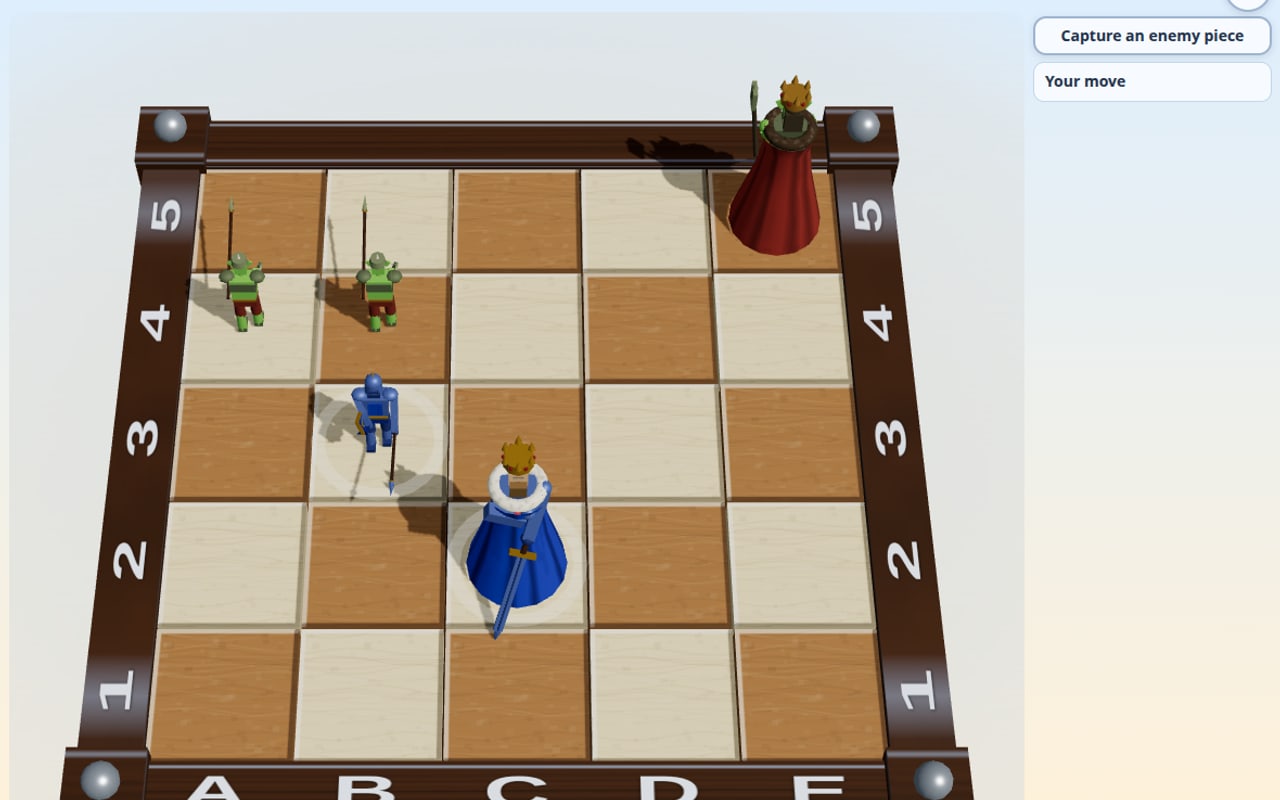
Atomic chess keeps every ordinary chess rule and adds one enormous consequence: a capture explodes. The captured piece dies, the capturing piece dies with it, and every piece standing on the eight squares around them dies too. Pawns are the exception — a pawn only dies if it was the one captured.
You win by blowing up the king, not by mating it
An explosion that catches the enemy king ends the game immediately, which is why games are short and sharp. Two rules keep it sane: your king may never capture anything, because it would blow itself up, and no move is legal if it would destroy your own king in the blast. Everything else is fair.
Every piece is a bomb, including yours
The moment you learn this variant is when you realise that taking a free pawn next to your own queen costs you the queen. Children get it in about two moves and then start looking at the board completely differently: not 'what can I take' but 'what is standing next to what'. Pieces bunched together become a liability instead of a fortress.
An honest word about the computer opponent
The bot understands explosions and will not walk into obvious ones, but it looks only a couple of moves ahead in this variant — the tree of consequences after each blast is enormous. It is a fair opponent for a child and a beatable one for a strong player. Room-code play against a friend is the sterner test.
More chess to try
Every one of these is the same board and the same pieces with one rule changed, and each has its own page: Chess960, Duck Chess, King of the Hill, Three-Check, Crazyhouse, Antichess, Atomic Chess and Fog of War. If you would rather start with the ordinary rules, our chess for kids teaches them from the first move.
How to play
All ordinary chess rules apply, plus one: every capture explodes. The captured piece, the capturing piece and every piece on the eight squares around them are destroyed — only pawns survive a blast, unless the pawn was the piece captured. Your king may never capture anything, and no move is legal if the explosion would destroy your own king. You win by blowing up the enemy king; that instant finish instead of checkmate is the difference from ordinary chess.
Drag a piece or tap it and tap where it should go — legal squares light up, and a move the rules forbid simply will not happen. The computer takes the other side, and it plays this variant rather than ordinary chess: its evaluation is rewritten for the rule that changed. You can also play a person instead: press the two-player button, share the room code, and the other browser joins the same game — this variant included.
What your child learns
Consequences that spread. In ordinary chess a capture affects two squares; here it affects nine, and a child has to picture the whole neighbourhood before touching anything. That is real spatial calculation with a very short feedback loop — get it wrong and your own queen vanishes in front of you. It also teaches a lesson that transfers well beyond chess: the value of a move depends on everything standing around it, not just on the piece you take.
The science behind the games
Every Dad4Kids game is built on one simple truth: children want to play, not study — so we turn learning into a game worth replaying. The method draws on peer-reviewed research in game-based learning, motivation, and how memory works.
- Prins et al. (2013). “Braingame Brian”: toward an executive function training program with game elements. Games for Health Journal.
- Tokac et al. (2019). Effects of game-based learning on students' mathematics achievement: A meta-analysis. Journal of Computer Assisted Learning.
- Alotaibi (2024). Game-based learning in early childhood education: a systematic review and meta-analysis. Frontiers in Psychology.
- Lampropoulos & Sidiropoulos (2024). Impact of gamification on students' learning outcomes and academic performance: a meta-analysis. Education Sciences.
- Taylor & Boyer (2019). Play-based learning: evidence-based research to improve children's learning experiences. Early Childhood Education Journal.
- Gottfried (1990). Academic intrinsic motivation in young elementary school children. Journal of Educational Psychology.
FAQ
How does atomic chess work?
Pieces move exactly as in normal chess, but any capture triggers an explosion on the captured square: both pieces involved die, and so does every non-pawn piece on the eight adjacent squares. You win by destroying the opponent's king.
Can the king capture in atomic chess?
No, never — a capture explodes the capturing piece, so a king that captured would destroy itself. That single restriction changes endgames completely: two kings can stand next to each other quite safely.
Do pawns explode?
Pawns near the blast survive; only the pawn that was actually captured dies. This makes pawn chains surprisingly tough and means a wall of pawns is a genuinely good shelter for a king.
Is there checkmate in atomic chess?
Ordinary checkmate still ends the game, but most games finish with an explosion instead — and you may never make a move that would blow up your own king, even to capture something valuable.
Does it work on a tablet?
Yes. Tap a piece, then tap the square you want — the same as dragging with a mouse. The board turns to fit the screen in both orientations.
More free games for kids
By Evgeny Arsentiev, PhD · Last updated: September 2026