
KenKen Puzzles Online — Sum Cages for Kids 6+
 New from Dad4Kids
Clean YouTube for kids
For families with traditional values, hand-picked by parents.
Open →
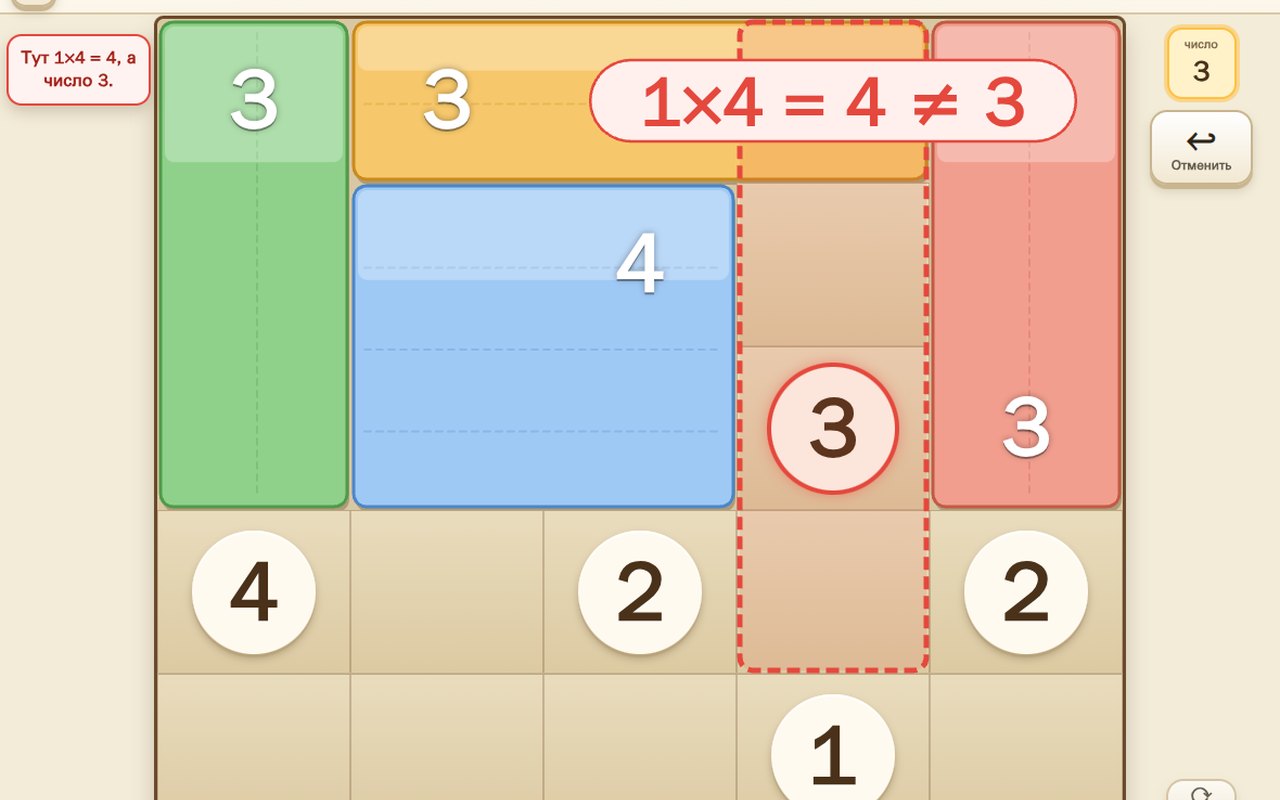
KenKen puzzles (also called Calcudoku or Mathdoku) are sudoku with arithmetic inside: a grid where every row and column holds each number once, cut into outlined cages, and each cage shows a target and a sign — '6+' means the two numbers add to six, '12×' means they multiply to twelve.
Here it is Sum Cages: 500 puzzles from a 3×3 with plus only up to 6×6 with no signs at all, where the child has to work out which operation fits. Every puzzle is machine-checked to have exactly one solution, so it is always solvable by reasoning, never by guessing.
No timer, no lives, no hints that give the answer away: the board only marks a real rule break — two equal numbers in a row, a cage that already overshoots its target.
How to play
Tap a cell, then a number on the big keypad; tap again to erase. Switch on the pencil to jot candidate numbers into a cell. The first puzzle is a voiced lesson on the live board, and every new sign gets a one-time card before it appears.
Big Undo is always at hand; Restart asks first, so a whole board is never lost to a slip of the finger.
What your child learns
Each cage is a tiny arithmetic problem — 'which two numbers from 1 to 4 make 5?' — solved hundreds of times in a row without feeling like drill. Children practise addition and subtraction facts, then multiplication and division, and on top of that learn to reason: 'this cell cannot be 3, because 3 is already in this column'. Number facts and logical deduction in one game.
The science behind the games
Every Dad4Kids game is built on one simple truth: children want to play, not study — so we turn learning into a game worth replaying. The method draws on peer-reviewed research in game-based learning, motivation, and how memory works.
- Prins et al. (2013). “Braingame Brian”: toward an executive function training program with game elements. Games for Health Journal.
- Tokac et al. (2019). Effects of game-based learning on students' mathematics achievement: A meta-analysis. Journal of Computer Assisted Learning.
- Alotaibi (2024). Game-based learning in early childhood education: a systematic review and meta-analysis. Frontiers in Psychology.
- Lampropoulos & Sidiropoulos (2024). Impact of gamification on students' learning outcomes and academic performance: a meta-analysis. Education Sciences.
- Taylor & Boyer (2019). Play-based learning: evidence-based research to improve children's learning experiences. Early Childhood Education Journal.
- Gottfried (1990). Academic intrinsic motivation in young elementary school children. Journal of Educational Psychology.
FAQ
Is this the same as KenKen?
Same rules — KenKen is a trademark of a puzzle company, so the game is called Sum Cages here. The puzzles work exactly the same way.
Does the game show which numbers are right?
No. It only marks a broken rule — a repeated number in a row or column, or a cage whose sum is already too big. Whether a number is correct you find out by finishing the grid, like on paper.
Which grades is it for?
3×3 with addition suits a six-year-old; 5×5 and 6×6 with multiplication and division are a real challenge for 3rd–5th graders.
Is every puzzle solvable?
Yes: every one of the 500 puzzles was verified by a solver to have exactly one solution.
More free games for kids
By Evgeny Arsentiev, PhD · Last updated: September 2026