
Battle Chess for Kids — Free Chess Game Where the Pieces Fight 5–10
 New from Dad4Kids
Clean YouTube for kids
For families with traditional values, hand-picked by parents.
Open →
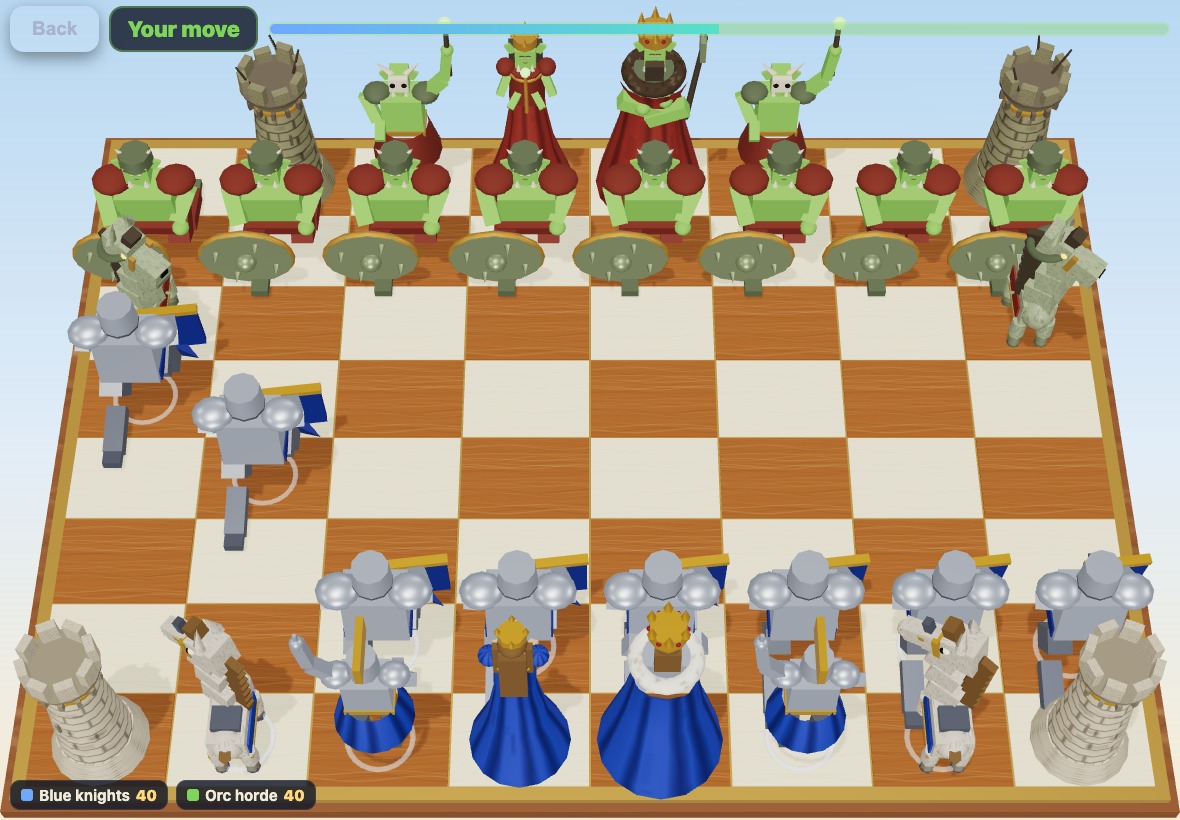
Battle chess is ordinary chess with one difference you can see: when a piece takes another, the two of them actually fight for the square. This one is free, runs in a browser and is built for children — choose your army, choose your rival's army, and play. Nothing to install, no account, no ads. It is our own original game — not affiliated with, sponsored by or endorsed by the owner of the classic 1988 title of the same name.
Three armies, and you pick both sides
Blue knights: men-at-arms, horses and a crowned king. The orc horde: tusks, axes and drums. The undead legion: bone warriors out of the cold crypts. The child picks their own army first and then the one they will face — and the two are never the same colour, so the board always reads at a glance. The pieces are sculpted figures rather than tokens: gold crown on the king, silver on the queen, a stone tower for the rook.
All the rules, not a cut-down set
This is real chess on 8×8 with everything grown-ups play: castling both ways — and never out of check or through a square under attack — en passant, promotion with a choice of piece, check and checkmate. The draws are in too: stalemate, a draw when neither side has enough material to mate, and the fifty-move rule. Nothing was removed to make it easier for a child; instead the board shows what is legal.
The rival grows with the child
Three opponents on three big cards. Troll Cub moves almost at random and hangs pieces — for the very first games. Warlord looks two moves ahead and gives an even, honest fight. Grandmaster Stonebrow calculates deeply and hardly ever slips. After that the rival quietly tunes itself to the player: win and it hardens, lose and it eases off, and none of that is ever announced on screen.
How to play
Click or tap one of your pieces and every square it may reach lights up — green dots are quiet moves, red rings are captures. Tap a square and the piece goes there. An illegal move costs nothing: the game answers «not there — try another square» and leaves the piece where it stood, and it will not let you walk into leaving your own king under attack. A red glow around your king means he is in check and has to be saved before anything else. When a pawn reaches the far edge the game asks what it becomes: a short tap takes the queen, holding the square opens the full choice. Progress and your armies are remembered on your own device.
What your child learns
Chess is the cheapest thinking-ahead trainer ever invented, and the part children actually learn first is consequences: I go here, he goes there, and now my knight is gone. Two things in this version speed that up. The board shows the legal squares instead of a grown-up reciting the rules, so how each piece moves is learned by looking. And because a capture is played out as a short fight, a five-year-old sees straight away that taking a piece costs something — the first step towards counting an exchange before making it. The full rule set matters for the same reason: a child who learns chess with castling and en passant in it never has to un-learn a simplified version later.
More chess: three player chess on one wide board for three armies, 4 player chess on a cross-shaped board where four sides fight at once, and viking chess (hnefatafl), the thousand-year-old game of escape and siege. Child does not know how the pieces move yet? Start with Kingdom Chess, which teaches one piece at a time.
The science behind the games
Every Dad4Kids game is built on one simple truth: children want to play, not study — so we turn learning into a game worth replaying. The method draws on peer-reviewed research in game-based learning, motivation, and how memory works.
- Prins et al. (2013). “Braingame Brian”: toward an executive function training program with game elements. Games for Health Journal.
- Tokac et al. (2019). Effects of game-based learning on students' mathematics achievement: A meta-analysis. Journal of Computer Assisted Learning.
- Alotaibi (2024). Game-based learning in early childhood education: a systematic review and meta-analysis. Frontiers in Psychology.
- Lampropoulos & Sidiropoulos (2024). Impact of gamification on students' learning outcomes and academic performance: a meta-analysis. Education Sciences.
- Taylor & Boyer (2019). Play-based learning: evidence-based research to improve children's learning experiences. Early Childhood Education Journal.
- Gottfried (1990). Academic intrinsic motivation in young elementary school children. Journal of Educational Psychology.
FAQ
Is there a modern version of Battle Chess?
This is one, and it is free. Three-dimensional armies, and every capture fought out on the square instead of a piece quietly vanishing. It has no connection to the 1988 Interplay game of that name — there is nothing to buy or install here, and this one was built for children rather than for nostalgia.
How is battle chess different from ordinary chess?
In the rules, not at all. Same 8×8 board, same moves, castling, en passant, promotion, check and checkmate. The only difference is what you see when a piece is taken: instead of disappearing, the two figures clash on the square and the winner stays standing.
What age should a child start chess?
Five is a fine age for the moves and six or seven for real games — but it depends far more on the first opponent than on the birthday. A child who loses forty moves in a row quits; a child who beats Troll Cub, who genuinely does hang pieces, comes back tomorrow. Start there and move up when winning gets boring.
How do I teach my 5 year old chess?
One piece at a time, and let the board do the explaining. Tap a rook and its lines light up; tap a knight and the child sees the strange little jump for themselves — that is worth more than the sentence «the knight moves in an L». Play short games, do not take moves back for them, and do not point out mistakes during the game. Here nothing punishes a wrong idea: an illegal move is simply refused, and there is no clock anywhere in this game.
What are the basic rules of chess?
Each side has a king, a queen, two rooks, two bishops, two knights and eight pawns. Rooks go in straight lines, bishops along diagonals, the queen does both, the king one square at a time, the knight jumps in an L, and pawns go forward but take diagonally. If the king is attacked that is check and must be answered; if it cannot be answered at all, that is checkmate and the game is over. On top of those there are three special rules children often miss — castling, en passant and promotion — and all three are in this game.
Is it free, and does it work on a tablet?
Free, no ads, no account, nothing to download. On a computer you play with the mouse, on a tablet with a finger; hold the tablet in landscape — the game politely asks you to turn it if you do not.
More free games for kids
By Evgeny Arsentiev, PhD · Last updated: September 2026