
Pentomino Puzzles for Kids — Free Castle Keep 6+
 New from Dad4Kids
Clean YouTube for kids
For families with traditional values, hand-picked by parents.
Open →
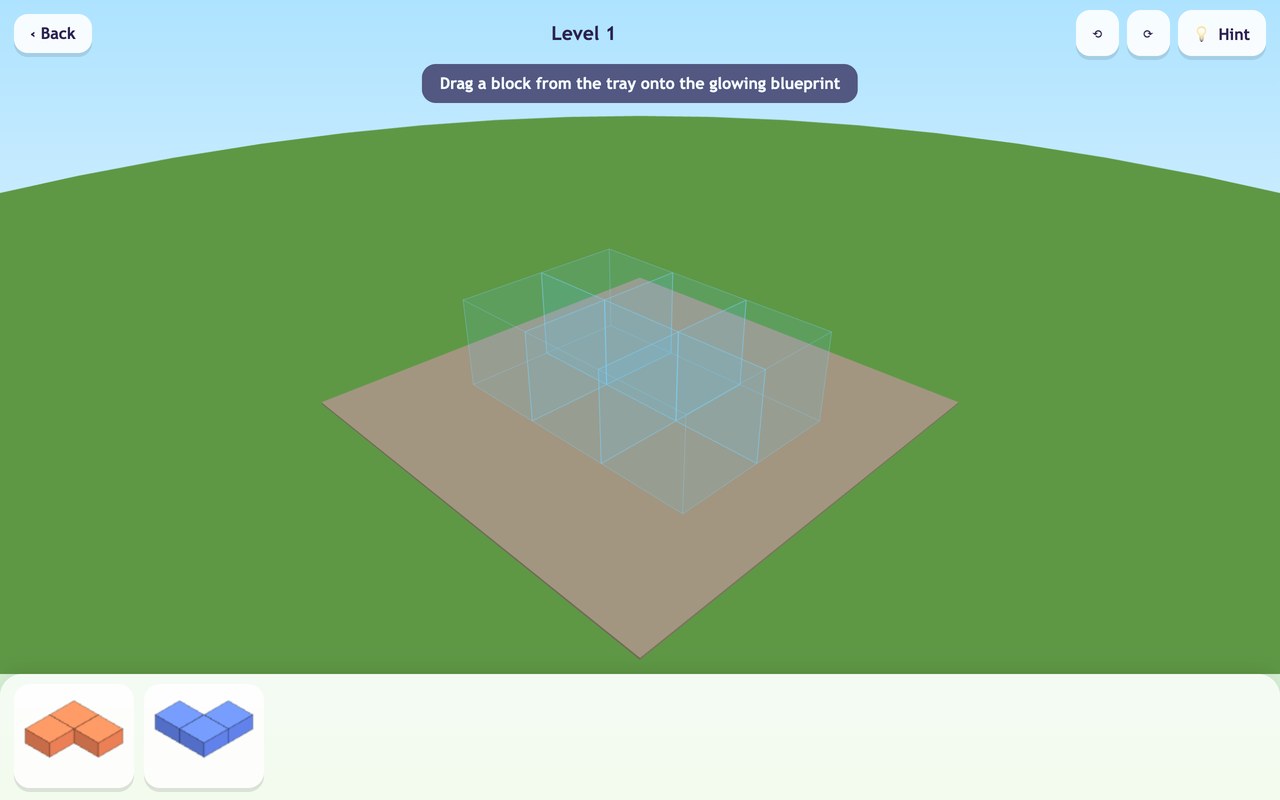
Castle Keep is a real pentomino puzzle for ages 6+ — a Katamino-style spatial game, not a drag-and-drop matching toy. The child sees an empty grid and a set of shapes, and must fit every shape so the board is covered exactly once: no holes, no overlaps. There are no outlines, ghost shapes or arrows telling the answer — the solution is found by rotating, visualising and planning ahead.
500 handcrafted, always-solvable levels build from tiny 2–3 piece boards up to expert fortresses across seven chapters — Training Grounds, Forest Outpost, Mountain Fortress, Lava Citadel, Frozen Keep, Orc Siege and the Final Castle. Finish a puzzle and your walls go up before the orcs arrive.
How to play
Drag a shape onto the board and tap ↻ to rotate it (⇄ to flip on later levels). Pieces snap to the grid but never into the answer for you. Tap a placed piece to take it back and try again. Stuck? The hint button gives a gentle nudge — never the full answer — and you can reveal the solution only after several tries.
What your child learns
Builds visual-spatial reasoning, mental rotation, planning ahead, error detection, flexible thinking and persistence — through genuine puzzle solving, not pattern matching.
The science behind the games
Every Dad4Kids game is built on one simple truth: children want to play, not study — so we turn learning into a game worth replaying. The method draws on peer-reviewed research in game-based learning, motivation, and how memory works.
- Tokac et al. (2019). Effects of game-based learning on students' mathematics achievement: A meta-analysis. Journal of Computer Assisted Learning.
- Alotaibi (2024). Game-based learning in early childhood education: a systematic review and meta-analysis. Frontiers in Psychology.
- Lampropoulos & Sidiropoulos (2024). Impact of gamification on students' learning outcomes and academic performance: a meta-analysis. Education Sciences.
- Taylor & Boyer (2019). Play-based learning: evidence-based research to improve children's learning experiences. Early Childhood Education Journal.
- Gottfried (1990). Academic intrinsic motivation in young elementary school children. Journal of Educational Psychology.
- Yang et al. (2018). Enhancing learning and retrieval of new information: a review of the forward testing effect. npj Science of Learning.
FAQ
What age is it for?
Designed for ages 6+. Early levels teach the controls with 2–3 simple pieces; difficulty rises gradually across 500 levels.
Is every level solvable?
Yes — every level is generated by tiling the board and is machine-verified to be solvable with the allowed moves. No impossible levels.
Does it show the answer?
No. There are no outlines or ghost pieces. Hints only nudge ('look at the corners'); the full solution is optional and only after several attempts.
Is it free?
Yes — free, no ads, no purchases, right in your browser.
More free games for kids

By Evgeny Arsentiev, PhD · Last updated: September 2026