
Shogi Online — Japanese Chess Where Captured Pieces Come Back 6+
 New from Dad4Kids
Clean YouTube for kids
For families with traditional values, hand-picked by parents.
Open →
Shogi is Japanese chess, and it has one great difference from the Western game: a captured piece does not leave the board. It goes into the hand of whoever took it, and can be dropped back onto any empty square as a whole move. Trading pieces never simplifies the position — it arms your opponent.
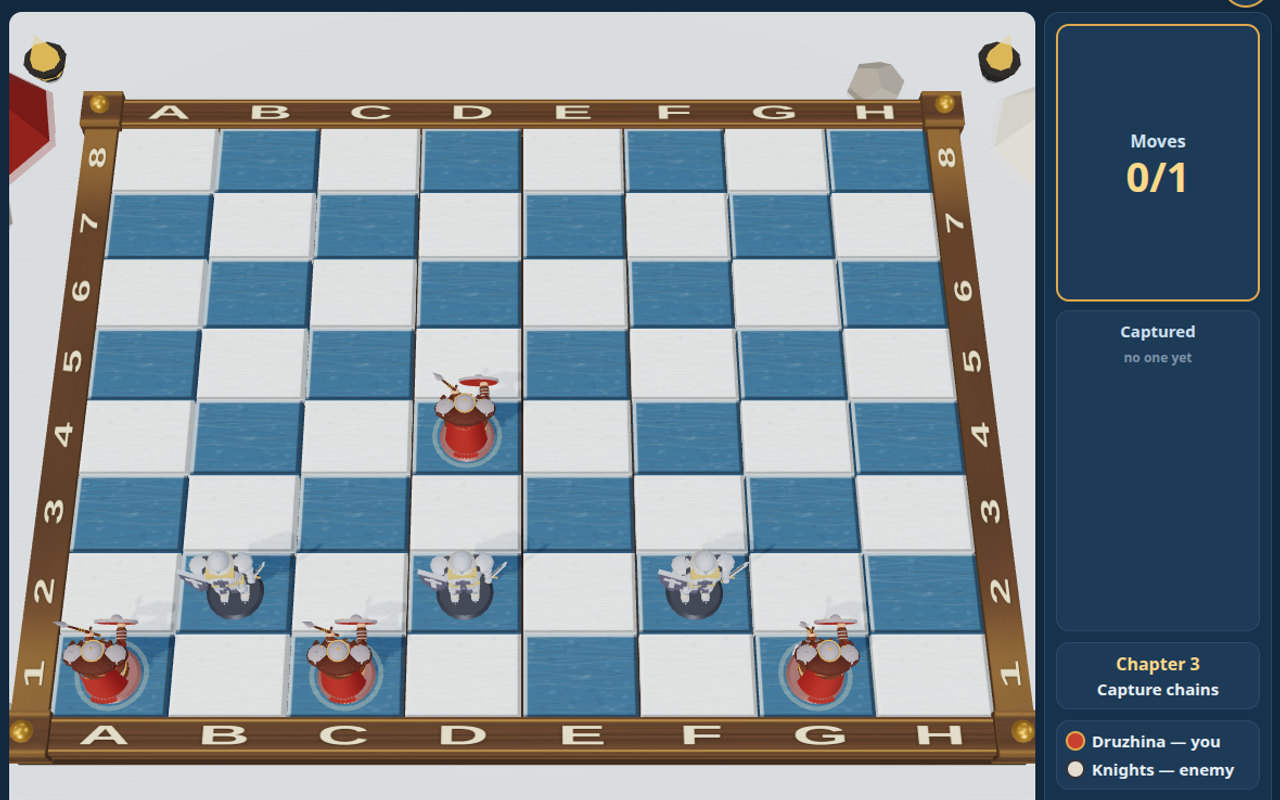
Because that is a lot to hold at once, the 80 levels bring the rules in one at a time: first a small 5×5 board with moves only, then the hand and drops, then promotion in the far rows, and finally full boards — 7×7 and 9×9 — with everything switched on and a deterministic opponent answering each move.
How to play
- Tap one of your pieces at the bottom of the board — the squares it may reach light up.
- Tap a lit square to move; landing on an enemy piece captures it and sends it to your side table.
- Tap a piece on your side table, then an empty square, to drop it back into play as your move.
- Reach the goal written in the header — usually trapping the shadow king in the given number of moves.
What your child learns
- Real shogi rules: drops from hand, promotion in the last three rows, the lance and the forward-only knight, no two pawns on one file, no mate by dropping a pawn.
- Counting the opponent's replies, including the pieces they hold in hand.
- Losing the habit of "I captured it, so I am ahead" — in shogi that piece can come back.
- Planning two and three moves deep on a board that never empties out.
The science behind the games
Every Dad4Kids game is built on one simple truth: children want to play, not study — so we turn learning into a game worth replaying. The method draws on peer-reviewed research in game-based learning, motivation, and how memory works.
- Prins et al. (2013). “Braingame Brian”: toward an executive function training program with game elements. Games for Health Journal.
- Tokac et al. (2019). Effects of game-based learning on students' mathematics achievement: A meta-analysis. Journal of Computer Assisted Learning.
- Alotaibi (2024). Game-based learning in early childhood education: a systematic review and meta-analysis. Frontiers in Psychology.
- Lampropoulos & Sidiropoulos (2024). Impact of gamification on students' learning outcomes and academic performance: a meta-analysis. Education Sciences.
- Taylor & Boyer (2019). Play-based learning: evidence-based research to improve children's learning experiences. Early Childhood Education Journal.
- Gottfried (1990). Academic intrinsic motivation in young elementary school children. Journal of Educational Psychology.
FAQ
What makes shogi different from chess?
Isn't shogi too hard for a child?
Do I need to read Japanese characters?
Is there a single right answer to each level?
More free games for kids
By Evgeny Arsentiev, PhD · Last updated: September 2026