
The Planets in Order — Free Interactive 3D Solar System 5+
 New from Dad4Kids
Clean YouTube for kids
For families with traditional values, hand-picked by parents.
Open →
The planets in order from the Sun are Mercury, Venus, Earth, Mars, Jupiter, Saturn, Uranus and Neptune. That is the short answer. Below is the longer one: what each planet is like, why Pluto is no longer on the list, which planet has no moon at all, and how to remember the order for good.
Above it, you can simply fly through it. The model is the real Solar System — 39 worlds on their true orbits, wearing the surfaces that spacecraft actually photographed, under a sky of 8,920 real stars. Tap a planet and the camera flies to it. Free, no ads, nothing to install.
The Planets in Order From the Sun
- Mercury — smallest and fastest. A year there lasts 88 Earth days, and there is no air to hold the heat, so it swings from about +430 °C in daylight to −180 °C at night.
- Venus — almost Earth's twin in size, and the hottest planet of all at about 465 °C, because a thick carbon-dioxide blanket traps the heat. Its day is longer than its year.
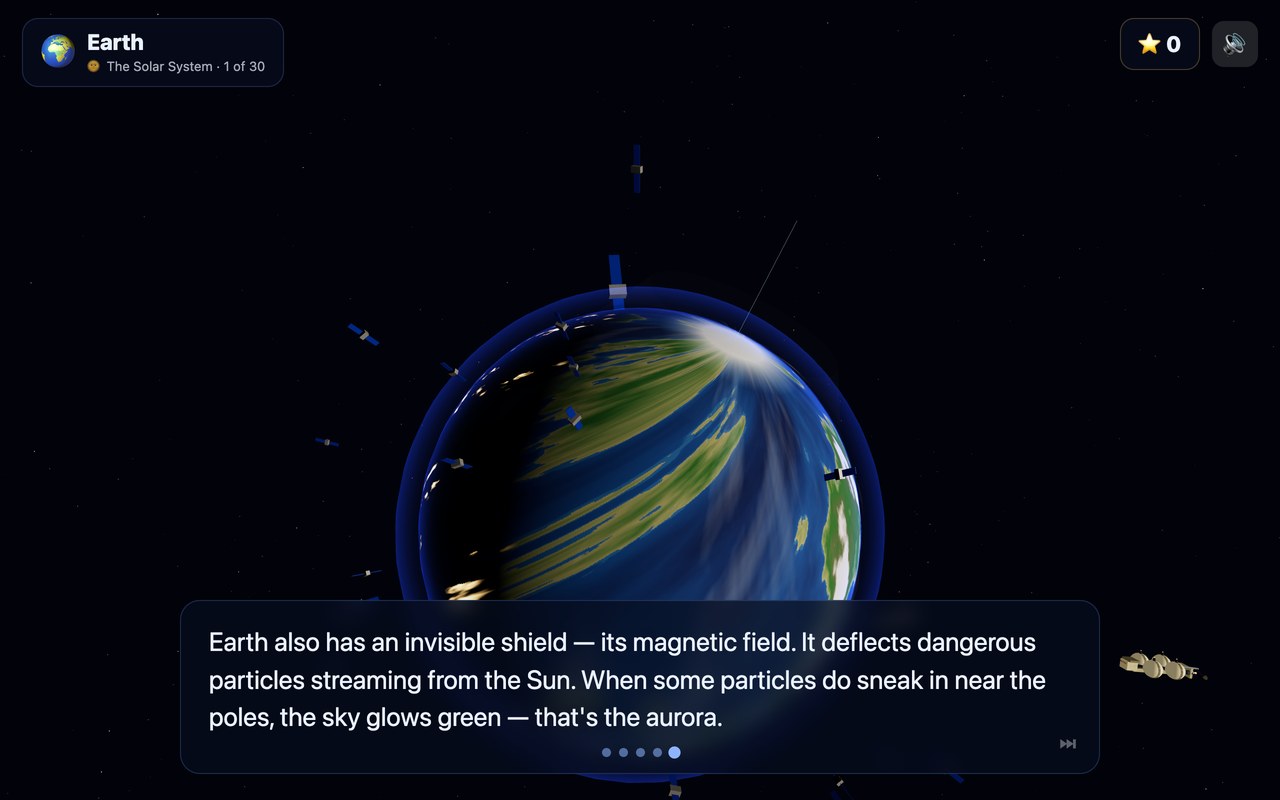
- Earth — the only world known to have liquid water on the surface and life anywhere on it.
- Mars — the rusty one. Its red colour is iron oxide, the same chemistry as rust on a bike. Rovers are driving there right now.
- Jupiter — the giant. All the other planets would fit inside it with room to spare, and its Great Red Spot is a storm wider than the Earth.
- Saturn — the ringed one. The rings are billions of pieces of ice and rock, most no bigger than a snowball, and they are astonishingly thin.
- Uranus — the one lying on its side, tipped over by about 98°, so it rolls around the Sun rather than spinning upright.
- Neptune — the farthest and windiest, with gales over 2,000 km/h. One Neptune year is 165 Earth years.
Between Mars and Jupiter sits the asteroid belt, and far beyond Neptune lies the Kuiper Belt, where Pluto lives.
How Many Planets Are in the Solar System — 8 or 9?
Eight. Until 2006 the answer was nine. That year the International Astronomical Union wrote down, for the first time, what a planet actually is: it must orbit the Sun, be round under its own gravity, and have cleared its neighbourhood of other objects. Pluto passes the first two tests and fails the third — it shares its region with a crowd of icy bodies — so it was reclassified as a dwarf planet.
Nothing happened to Pluto itself. The definition changed, not the sky. The recognised dwarf planets today are Ceres, Pluto, Haumea, Makemake and Eris.
How to Remember the Planets in Order
Take the first letters — M V E M J S U N — and turn them into a sentence:
My Very Easy Method Just Speeds Up Naming.
Older mnemonics ended “…Nine Planets” with a P for Pluto; if a child brings that version home from an old book, it is a perfect moment to explain why the ending changed. Children usually lock the order in faster by flying it than by chanting it — in the model above the strip along the bottom is the order itself.
What Is the Solar System? In Simple Words
The Solar System is the Sun and everything its gravity holds on to: eight planets and their moons, the dwarf planets, millions of asteroids, comets and dust. The Sun is an ordinary star, and it contains about 99.8% of all the mass in the system — everything else put together is the remaining two tenths of one percent.
The part no poster manages to show is that it is almost entirely empty. If the Sun were a football, Earth would be a peppercorn about 25 metres away and Neptune a small pea three quarters of a kilometre off, with nothing at all in between.
Inner Planets and Outer Planets
The inner planets — Mercury, Venus, Earth and Mars — are small, rocky and close together. Between them and the rest lies the asteroid belt.
The outer planets — Jupiter, Saturn, Uranus and Neptune — are huge, made mostly of gas and ice, and spaced enormously far apart. Jupiter and Saturn are the gas giants; Uranus and Neptune are usually called ice giants, because under their atmospheres is hot slushy water, ammonia and methane rather than rock.
The split is not a coincidence. Close to the young Sun it was too warm for ice to survive, so only rock and metal could stick together; past the “frost line” ice was available in huge quantities, and the planets that formed there grew big enough to hold on to hydrogen and helium as well.
The Asteroid Belt
A ring of leftover rock between Mars and Jupiter, holding millions of objects — yet all of them together weigh far less than our Moon. It is not the crowded shooting gallery films enjoy: the average gap between asteroids is hundreds of thousands of kilometres, which is why every spacecraft sent through it has passed without trouble.
The belt is not a smashed planet. Jupiter's gravity kept stirring the material there so violently that it never managed to stick together into one world. Ceres, the largest object in the belt, is round enough to count as a dwarf planet, and you can fly to it in the model above.
Planet Names and Where They Come From
Every planet but one is named after a Roman god: Mercury the messenger, Venus goddess of beauty, Mars god of war, Jupiter king of the gods, Saturn his father, Neptune god of the sea. Uranus is the exception among exceptions — a Greek name, the sky god and Saturn's father.
The other exception is Earth. It is the only planet not named after a god at all; the word simply comes from the old English and Germanic word for ground. The ancients did not think of it as a planet in the first place — it was simply the world under their feet.
Moons: Which Planet Has None, and Which Has the Most
Mercury and Venus have no moons at all. Earth has one, Mars has two small lumpy ones (Phobos and Deimos), and after that the counting gets hard: Saturn currently leads with more than 270 confirmed moons, with Jupiter next at around 95, and new small ones are still being found.
You may see “600 moons” claimed online — no planet has that many; the number people are reaching for is Saturn's growing tally of small outer moons. Size is the surprising part: Jupiter's Ganymede and Saturn's Titan are both bigger than the planet Mercury, and Titan has a thick orange atmosphere with rivers and lakes of liquid methane.
Weird Facts: Gravity, Day Length and 42 Years of Darkness
How much would a 150 lb person weigh on Mars? About 57 lb — Martian gravity is roughly 38% of Earth's. On the Moon the same person would weigh about 25 lb, and on Jupiter roughly 380 lb. Their mass never changes; only the pull does.
Which planet is dark for 42 years? Uranus. Because it is tipped on its side, each pole faces the Sun for one half of its 84-year orbit and faces away for the other — 42 years of continuous daylight, then 42 years of night.
Which day is longer than its year? Venus. It turns once in 243 Earth days but goes round the Sun in 225 — and it turns backwards while doing it.
10 Facts About the Solar System
- The Sun holds about 99.8% of all the mass in the Solar System.
- Sunlight takes 8 minutes 20 seconds to reach Earth — and about 4 hours to reach Neptune.
- Jupiter spins so fast (under 10 hours) that it is visibly squashed at the poles.
- Saturn's rings are hundreds of thousands of kilometres wide but often only tens of metres thick.
- Olympus Mons on Mars is about three times the height of Mount Everest.
- Venus is hotter than Mercury, even though it is farther from the Sun.
- Neptune has completed only one orbit since it was discovered in 1846.
- Jupiter's moon Europa hides a salty ocean under its ice — probably more water than all of Earth's oceans.
- The planets do not orbit in one perfectly flat plane; each is tilted a little, which is why eclipses are rare rather than monthly.
- Deep blue Neptune was an illusion: a 2024 reanalysis of the Voyager 2 images showed Uranus and Neptune are almost the same pale greenish blue. The model above uses the corrected colours.
How to Explain the Solar System to a Child
Begin with size and distance, not with names. Names are the easy part and children collect them anyway; what almost no picture conveys is that the Solar System is mostly emptiness. A useful trick: if the Sun were a football, Earth would be a peppercorn about 25 metres away, and Neptune a small pea three-quarters of a kilometre off.
Children typically meet the planets at ages 5–7 and return to orbits and gravity around ages 9–11. Both ages get something here: the little ones fly and name, the older ones start asking why Mercury races and Neptune crawls. The model has a switch between “so you can see everything” and “the way it really is”, where the planets shrink to dots and the emptiness becomes the lesson.
Using It as a Solar System Model, Diagram or School Project
For a school project the model works as a live diagram: turn on orbits and labels, set the true-scale view, and take a screenshot straight from the browser. The time slider runs the whole system forwards and backwards, so you can show the planets lining up and spreading out again, or watch Earth's snow cover advance across Siberia and retreat — the planet wears twelve real monthly maps.
Positions are computed from Kepler elements published by JPL and checked against JPL Horizons ephemerides to better than a quarter of a degree over 1900–2100, so a diagram taken from it is accurate enough to hand in.
Keep Going
For a guided, narrated tour outward — Moon, Mars, nearest stars, distant galaxies — play Space Explorer. To go the other way and take matter apart, try What Is Matter? or peel our own planet in Layers of the Earth. More free science play on the STEM games page.
How to play
Drag to turn the system, pinch or scroll to zoom, tap any world to fly to it. The strip along the bottom is your map: tap a planet and it lists that planet's moons, so you can go one level in and one level back out. The time slider speeds the whole system up or down — push it far enough and you will watch snow spread across Siberia and retreat again, because Earth wears twelve real monthly maps. One button switches between “so you can see everything” and “the way it really is”, where the planets shrink to dots and the emptiness becomes the lesson.
What your child learns
The Solar System as astronomers actually know it: why the planets do not sit in one flat plane, why Mercury races and Neptune crawls, why Jupiter is visibly squashed by its ten-hour day, why Uranus lies on its side, and why a moon can be bigger than a planet. The honest bits are the point — Uranus and Neptune are shown in the corrected colours published in 2024, both a pale greenish blue, because the famous deep-blue Neptune turned out to be a side effect of image processing. Where nobody has data, the game says so instead of inventing scenery.
The science behind the games
Every Dad4Kids game is built on one simple truth: children want to play, not study — so we turn learning into a game worth replaying. The method draws on peer-reviewed research in game-based learning, motivation, and how memory works.
- Tokac et al. (2019). Effects of game-based learning on students' mathematics achievement: A meta-analysis. Journal of Computer Assisted Learning.
- Alotaibi (2024). Game-based learning in early childhood education: a systematic review and meta-analysis. Frontiers in Psychology.
- Lampropoulos & Sidiropoulos (2024). Impact of gamification on students' learning outcomes and academic performance: a meta-analysis. Education Sciences.
- Taylor & Boyer (2019). Play-based learning: evidence-based research to improve children's learning experiences. Early Childhood Education Journal.
- Gottfried (1990). Academic intrinsic motivation in young elementary school children. Journal of Educational Psychology.
- Yang et al. (2018). Enhancing learning and retrieval of new information: a review of the forward testing effect. npj Science of Learning.
FAQ
What are the 9 planets in order?
There are eight: Mercury, Venus, Earth, Mars, Jupiter, Saturn, Uranus, Neptune. The ninth in older books is Pluto, reclassified as a dwarf planet in 2006.
What is Pluto's name now?
Still Pluto — it also carries the catalogue number 134340. What changed is its category: it is a dwarf planet, not a planet.
Is the girl who named Pluto still alive?
No. Venetia Burney was 11 years old in Oxford in 1930 when she suggested the name to her grandfather, who passed it to astronomers. She died on 30 April 2009, aged 90.
What planet has a 99.7% chance of life?
None. That figure circulates online but comes from no scientific study. Earth is the only world where life is known; Mars, Europa and Enceladus are considered worth searching, and nothing more than that has been established.
What will happen on March 23, 2178?
Neptune and Pluto complete one full cycle of their 3:2 orbital resonance and return to the same relative positions — the pattern that keeps them from ever colliding. Nothing happens on Earth; it is a bookkeeping date, not an event.
Are the planets in the right places in the model?
They are. Positions come from Kepler elements published by JPL and were checked against JPL Horizons ephemerides — better than a quarter of a degree across the years 1900 to 2100.
Why does Neptune look pale instead of deep blue?
Because that is its real colour. In 2024 astronomers at Oxford reprocessed the Voyager 2 images with modern calibration and found the familiar cobalt Neptune was an artefact of contrast stretching. Uranus and Neptune are almost the same pale greenish blue.
Is it free?
Completely free, no ads and no purchases, straight in the browser on a computer or tablet.
More free games for kids
By Evgeny Arsentiev, PhD · Last updated: August 2026