
Chess960 — Play Fischer Random Chess Free Online 7–14
 New from Dad4Kids
Clean YouTube for kids
For families with traditional values, hand-picked by parents.
Open →
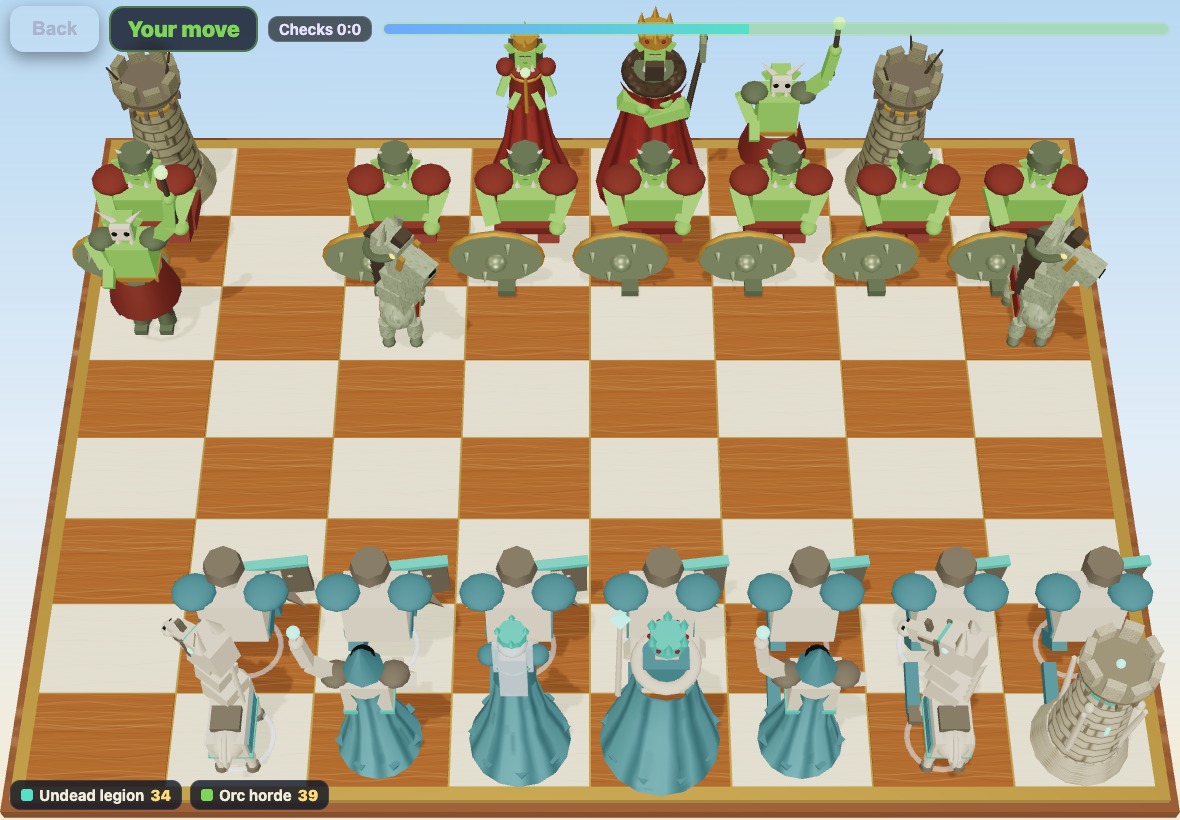
Chess960, also called Fischer Random, is ordinary chess with one change made before the first move: the eight pieces on the back rank are shuffled. The pawns stay where they are, both sides get the same arrangement — and everything you memorised about openings stops being worth anything.
All 960 positions, generated properly
The shuffle is not random-looking, it is genuinely one of the 960 legal positions, numbered the standard way. Two rules survive the shuffle: the two bishops must end up on squares of opposite colours, and the king must stand somewhere between the two rooks. Position 518 is the ordinary chess start, and it is in the set like any other.
Castling still works, and it lands where it always did
This is the part that confuses newcomers, so the game does it for you. However far apart the king and rook begin, castling puts the king on g1 or c1 and the rook on f1 or d1 — exactly the squares they reach in ordinary chess. Sometimes that means the king barely moves; sometimes it crosses half the board.
Why it is such a good variant for a child
A beginner playing standard chess is often losing by move six to memorised lines they have never seen. Here nobody has memorised anything: an adult and a nine-year-old look at the same strange back rank and both have to work out what the pieces can do. It is the fairest first taste of real chess thinking we know.
More chess to try
Every one of these is the same board and the same pieces with one rule changed, and each has its own page: Chess960, Duck Chess, King of the Hill, Three-Check, Crazyhouse, Antichess, Atomic Chess and Fog of War. If you would rather start with the ordinary rules, our chess for kids teaches them from the first move.
How to play
The rules of play are ordinary chess with one change made before move one: the eight back-rank pieces are shuffled into one of 960 legal starting positions — the bishops always on opposite colours, the king somewhere between the rooks. Pawns start where they always do, and both sides get the same arrangement. Castling still puts the king on g1 or c1 and the rook on f1 or d1, wherever the two of them began. The difference from ordinary chess is exactly that shuffle: memorised openings are worthless, so you look at the position and think from the first move.
Drag a piece or tap it and tap where it should go — legal squares light up, and a move the rules forbid simply will not happen. The computer takes the other side, and it plays this variant rather than ordinary chess: its evaluation is rewritten for the rule that changed. You can also play a person instead: press the two-player button, share the room code, and the other browser joins the same game — this variant included.
What your child learns
Looking at a position on its own terms instead of reciting a sequence — the exact skill that separates a player from someone who has learned some openings. Because the bishops, knights and rooks start in unfamiliar places, a child has to ask the basic questions out loud every game: which pieces are stuck, which squares are weak, what happens when the centre opens. It also quietly teaches that castling is a rule about where the king ends up, not about which way it walks.
The science behind the games
Every Dad4Kids game is built on one simple truth: children want to play, not study — so we turn learning into a game worth replaying. The method draws on peer-reviewed research in game-based learning, motivation, and how memory works.
- Prins et al. (2013). “Braingame Brian”: toward an executive function training program with game elements. Games for Health Journal.
- Tokac et al. (2019). Effects of game-based learning on students' mathematics achievement: A meta-analysis. Journal of Computer Assisted Learning.
- Alotaibi (2024). Game-based learning in early childhood education: a systematic review and meta-analysis. Frontiers in Psychology.
- Lampropoulos & Sidiropoulos (2024). Impact of gamification on students' learning outcomes and academic performance: a meta-analysis. Education Sciences.
- Taylor & Boyer (2019). Play-based learning: evidence-based research to improve children's learning experiences. Early Childhood Education Journal.
- Gottfried (1990). Academic intrinsic motivation in young elementary school children. Journal of Educational Psychology.
FAQ
What does Chess960 mean?
Nine hundred and sixty is the number of different legal starting positions you can make by shuffling the back rank while keeping the bishops on opposite colours and the king between the rooks. Every game begins from one of them, drawn at random.
Did Bobby Fischer invent Chess960?
Yes — the world champion announced it in 1996, tired of games being decided by memorised preparation rather than play. It is often still called Fischer Random for that reason.
Is Chess960 harder than normal chess?
Harder to prepare for, easier to start. The pieces move exactly as they always do, so nothing new has to be learned; what disappears is the advantage held by whoever memorised more. For a child that usually makes the game easier, not harder.
How does castling work in Chess960?
The king finishes on g1 or c1 and the rook on f1 or d1, just as in ordinary chess, no matter where the two of them started. The squares in between must be empty and the king may not pass through check. This game handles it for you — pick castling and the pieces land correctly.
Does it work on a tablet?
Yes. Tap a piece, then tap the square you want — the same as dragging with a mouse. The board turns to fit the screen in both orientations.
More free games for kids
By Evgeny Arsentiev, PhD · Last updated: September 2026