
Chinese Chess (Xiangqi) Online — Learn by Playing 6+
 New from Dad4Kids
Clean YouTube for kids
For families with traditional values, hand-picked by parents.
Open →
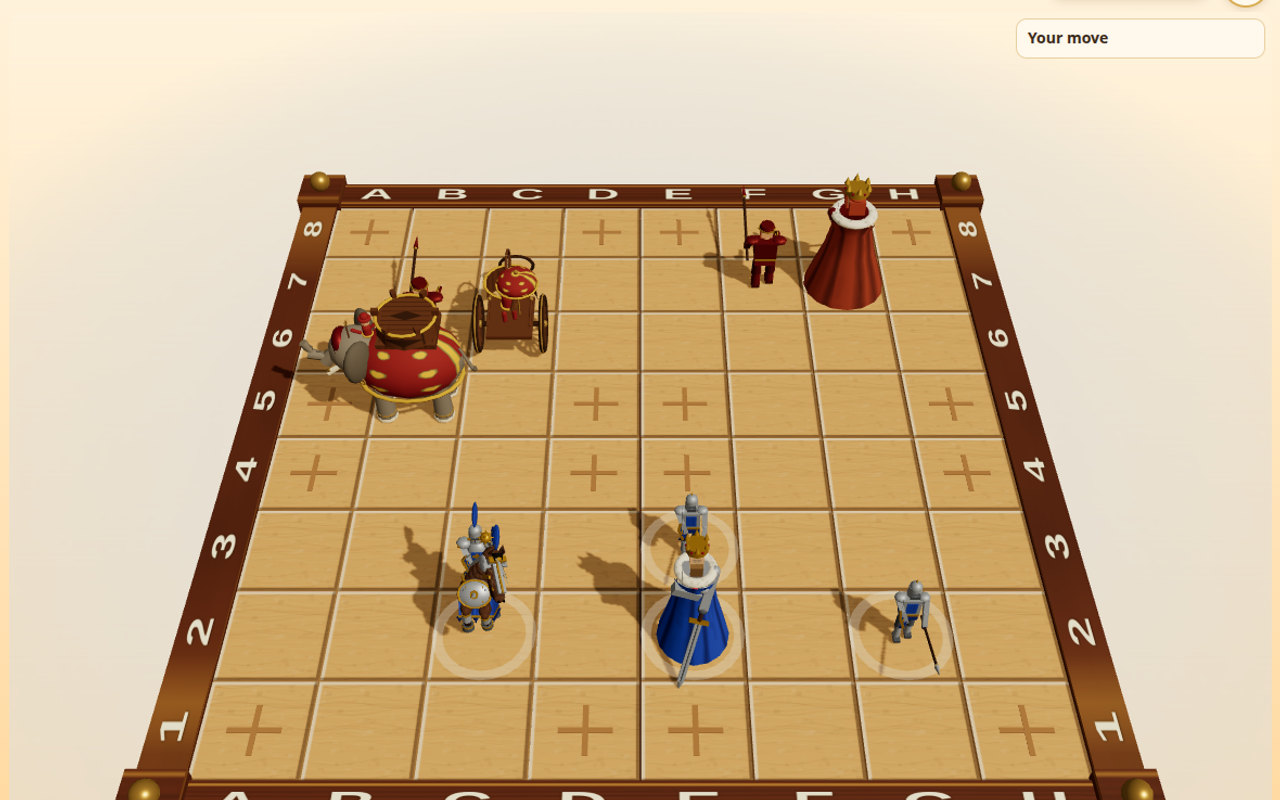
Chinese chess — Xiangqi — is played on the crossings of the lines, with a river across the middle and a palace for each general. Our board is warm wood with a jade river; the pieces are turned lacquer counters with a badge for every branch of the army, so a child can tell a horse from a cannon without reading a single character.
The course is 80 levels. Each step teaches exactly one new idea — the chariot's straight road, the soldier that gains a sideways step past the river, the horse held by its leg, the cannon that fires only over a screen, the elephant that never crosses the river, the advisor locked in the palace, the two generals that must never face each other — and only then checkmate in one, two and three moves, and short games against a deterministic opponent.
How to play
- Tap one of your pieces at the bottom — jade dots show every legal point.
- Tap a dot to move; an amber ring means you capture the piece standing there.
- If a move is not allowed, the piece that blocks it pulses and one short line says why.
- Reach the goal shown in the header — capture the marked piece, or checkmate the general.
What your child learns
- All real Xiangqi rules: horse leg, elephant eye, cannon screen, palace, river, flying generals.
- Planning two and three moves ahead, and counting the opponent's replies.
- Reading a position: what threatens what, and which road is still open.
- Patience with mistakes — a wrong tap explains itself instead of punishing.
The science behind the games
Every Dad4Kids game is built on one simple truth: children want to play, not study — so we turn learning into a game worth replaying. The method draws on peer-reviewed research in game-based learning, motivation, and how memory works.
- Prins et al. (2013). “Braingame Brian”: toward an executive function training program with game elements. Games for Health Journal.
- Tokac et al. (2019). Effects of game-based learning on students' mathematics achievement: A meta-analysis. Journal of Computer Assisted Learning.
- Alotaibi (2024). Game-based learning in early childhood education: a systematic review and meta-analysis. Frontiers in Psychology.
- Lampropoulos & Sidiropoulos (2024). Impact of gamification on students' learning outcomes and academic performance: a meta-analysis. Education Sciences.
- Taylor & Boyer (2019). Play-based learning: evidence-based research to improve children's learning experiences. Early Childhood Education Journal.
- Gottfried (1990). Academic intrinsic motivation in young elementary school children. Journal of Educational Psychology.
FAQ
Does my child need to know Chinese characters?
How is Chinese chess different from ordinary chess?
Is there a single right answer to each level?
Does the opponent play back?
More free games for kids
By Evgeny Arsentiev, PhD · Last updated: September 2026