
King of the Hill Chess — Play Free Online, March Your King to the Centre 6–12
 New from Dad4Kids
Clean YouTube for kids
For families with traditional values, hand-picked by parents.
Open →
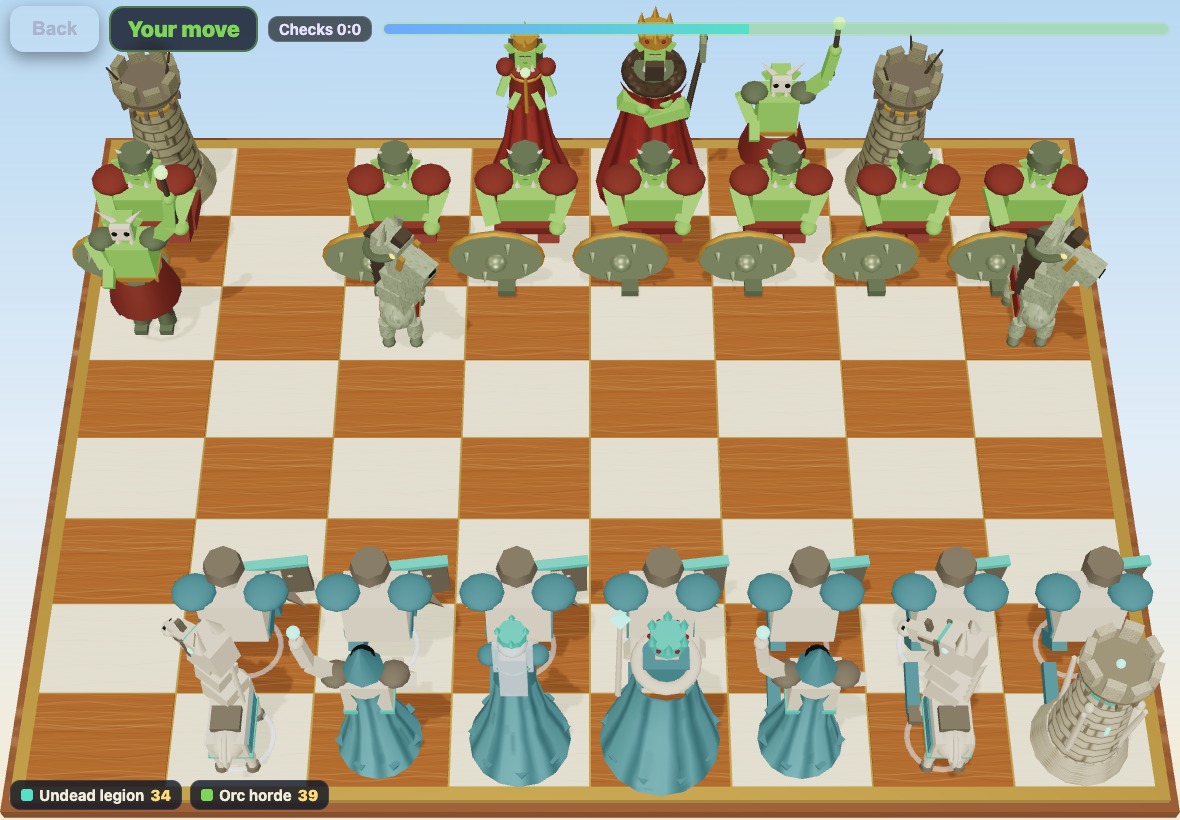
King of the hill chess adds a second finish line to ordinary chess: walk your king onto one of the four central squares — d4, d5, e4 or e5 — and you win at once. Everything else about the game is unchanged, and normal checkmate still ends it too.
The piece you spend the whole game hiding now has somewhere to go
In standard chess a beginner learns to castle and tuck the king away. Here the king is a runner with a destination, and the whole shape of the game changes: pawn structures in the centre become roadblocks or highways, a rook on an open central file is worth a great deal, and an exchange of queens is not safety, it is a starting gun.
Simple to explain, hard to play well
Four squares. Get there. That is the whole rule, and a six-year-old has it after one sentence. But keeping a king safe while marching it towards the busiest part of the board is a genuinely difficult balancing act, which is why the variant is popular with strong players too.
What has not changed
Castling, en passant, promotion, stalemate and the moves of every piece are exactly standard. You may not move into check to reach the hill, so the last step has to be safe — that final square is often the hardest one to earn.
More chess to try
Every one of these is the same board and the same pieces with one rule changed, and each has its own page: Chess960, Duck Chess, King of the Hill, Three-Check, Crazyhouse, Antichess, Atomic Chess and Fog of War. If you would rather start with the ordinary rules, our chess for kids teaches them from the first move.
How to play
Everything is standard chess with a second way to win: walk your king onto one of the four central squares — d4, d5, e4 or e5 — and the game is yours at once. Normal checkmate still works; castling, en passant and promotion are unchanged, and you still may not move into check. The difference from ordinary chess is what the king is for: instead of hiding in a corner, he has a destination in the middle of the board.
Drag a piece or tap it and tap where it should go — legal squares light up, and a move the rules forbid simply will not happen. The computer takes the other side, and it plays this variant rather than ordinary chess: its evaluation is rewritten for the rule that changed. You can also play a person instead: press the two-player button, share the room code, and the other browser joins the same game — this variant included.
What your child learns
The value of the centre, learned by walking through it. Chess teachers spend months telling children the middle of the board matters; here the middle is literally the goal, and control of four squares becomes something a child can see and want. It also teaches the difference between a plan and a rush — a king that sprints for d5 without support gets caught, and the game that follows shows exactly why. Endgames improve too, because the king becomes an active piece early instead of a thing to protect.
The science behind the games
Every Dad4Kids game is built on one simple truth: children want to play, not study — so we turn learning into a game worth replaying. The method draws on peer-reviewed research in game-based learning, motivation, and how memory works.
- Prins et al. (2013). “Braingame Brian”: toward an executive function training program with game elements. Games for Health Journal.
- Tokac et al. (2019). Effects of game-based learning on students' mathematics achievement: A meta-analysis. Journal of Computer Assisted Learning.
- Alotaibi (2024). Game-based learning in early childhood education: a systematic review and meta-analysis. Frontiers in Psychology.
- Lampropoulos & Sidiropoulos (2024). Impact of gamification on students' learning outcomes and academic performance: a meta-analysis. Education Sciences.
- Taylor & Boyer (2019). Play-based learning: evidence-based research to improve children's learning experiences. Early Childhood Education Journal.
- Gottfried (1990). Academic intrinsic motivation in young elementary school children. Journal of Educational Psychology.
FAQ
What does King of the Hill mean in chess?
It is a chess variant with an extra winning condition: bringing your own king to one of the four central squares, d4, d5, e4 or e5, wins the game on the spot. Everything else is ordinary chess.
Does checkmate still win?
Yes. There are simply two ways to end the game, and either will do. In practice most games are decided on the hill, but a mate along the way counts exactly as it always has.
Can I move my king into the centre if it is attacked there?
No — the usual rule still holds, you may never move into check. The final step onto the hill must be to a safe square, and defending the four central squares is the main way the opponent stops you.
Is this a good variant for a beginner?
Very. The rule takes one sentence, it makes the centre matter in a way a child can see, and games are short and decisive. It is our usual recommendation right after three-check.
Does it work on a tablet?
Yes. Tap a piece, then tap the square you want — the same as dragging with a mouse. The board turns to fit the screen in both orientations.
More free games for kids
By Evgeny Arsentiev, PhD · Last updated: September 2026