
Tablut Online — the King's Getaway in 80 Levels 6+
 New from Dad4Kids
Clean YouTube for kids
For families with traditional values, hand-picked by parents.
Open →
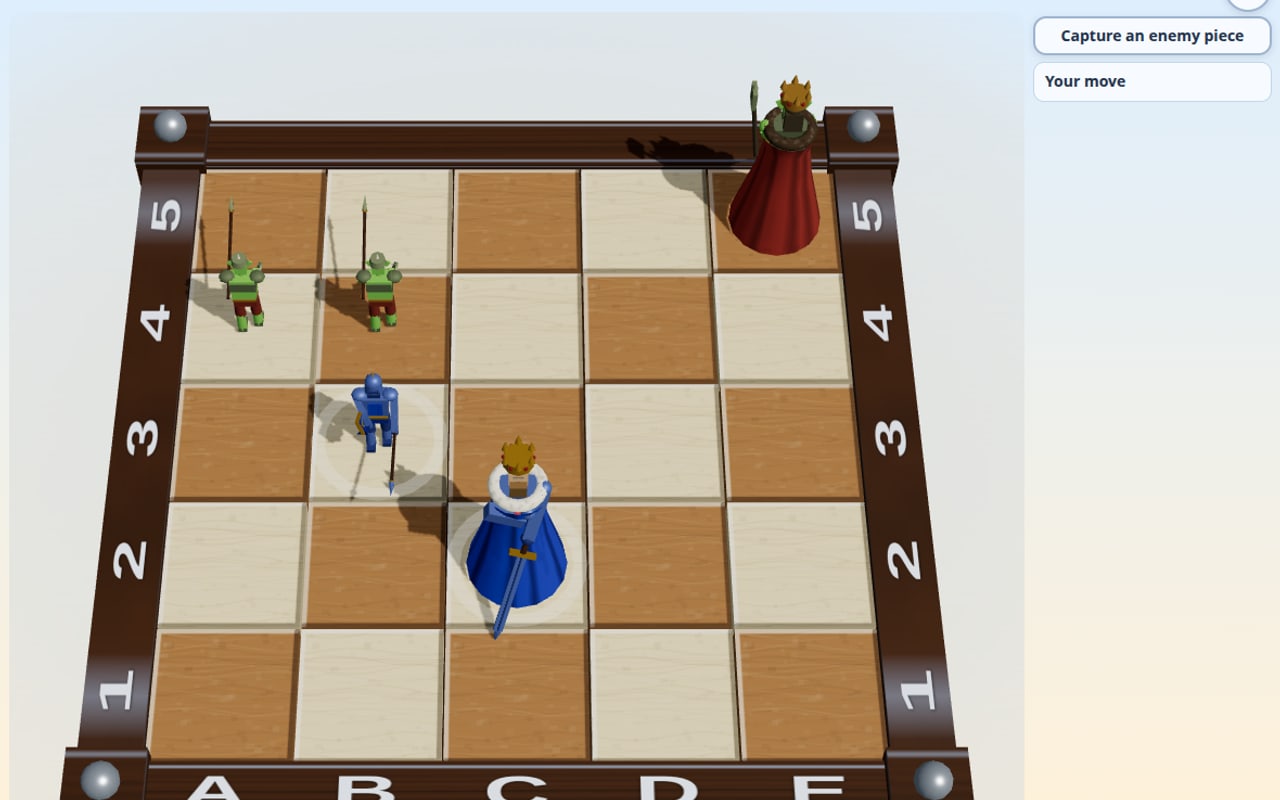
Tablut is the old board game of the Sámi of Lapland, and it is not a fair fight: in the middle of the 9×9 board the king stands on his throne with eight defenders in a cross, and sixteen besiegers wait in fours along the four edges. The king wins by reaching any edge of the board; the besiegers win by closing a ring around him on all four sides.
Everything moves like a rook — any number of squares in a straight line, never jumping. You capture by pinching an enemy between two of your own along a line, and a piece that steps between two enemies by itself is safe. The 80 levels start with a single dash for the edge, then add capture, the shield wall, the fork that threatens two edges at once, and finally full endgames — including ten levels where the child plays the besiegers instead.
How to play
- Tap one of your own pieces — every square it can reach lights up along its lines.
- Tap a lit square to slide there; pieces never jump over one another.
- Trap an enemy between two of yours along a row or a column and it is struck down.
- As the king, reach any edge square. As the besiegers, close all four sides around the king.
- The header shows the goal in one short line; the lamp gives a hint and «retry» restarts the level.
What your child learns
- Thinking for both sides: 70 levels are played for the king, 10 for the besiegers.
- Counting threats along rows and columns on an open board where every piece is long-range.
- Building a shield wall, and breaking one.
- The fork: creating two threats at once so the defence can only stop one.
- Planning an escape route two and three moves ahead.
The science behind the games
Every Dad4Kids game is built on one simple truth: children want to play, not study — so we turn learning into a game worth replaying. The method draws on peer-reviewed research in game-based learning, motivation, and how memory works.
- Prins et al. (2013). “Braingame Brian”: toward an executive function training program with game elements. Games for Health Journal.
- Tokac et al. (2019). Effects of game-based learning on students' mathematics achievement: A meta-analysis. Journal of Computer Assisted Learning.
- Alotaibi (2024). Game-based learning in early childhood education: a systematic review and meta-analysis. Frontiers in Psychology.
- Lampropoulos & Sidiropoulos (2024). Impact of gamification on students' learning outcomes and academic performance: a meta-analysis. Education Sciences.
- Taylor & Boyer (2019). Play-based learning: evidence-based research to improve children's learning experiences. Early Childhood Education Journal.
- Gottfried (1990). Academic intrinsic motivation in young elementary school children. Journal of Educational Psychology.
FAQ
How are pieces captured in tablut?
How does the king win?
Is tablut the same as chess?
Does the child play only the escaping side?
More free games for kids
By Evgeny Arsentiev, PhD · Last updated: September 2026