
Four Towers — a Game Like Chess for Kids, Free and Online 8+
 New from Dad4Kids
Clean YouTube for kids
For families with traditional values, hand-picked by parents.
Open →
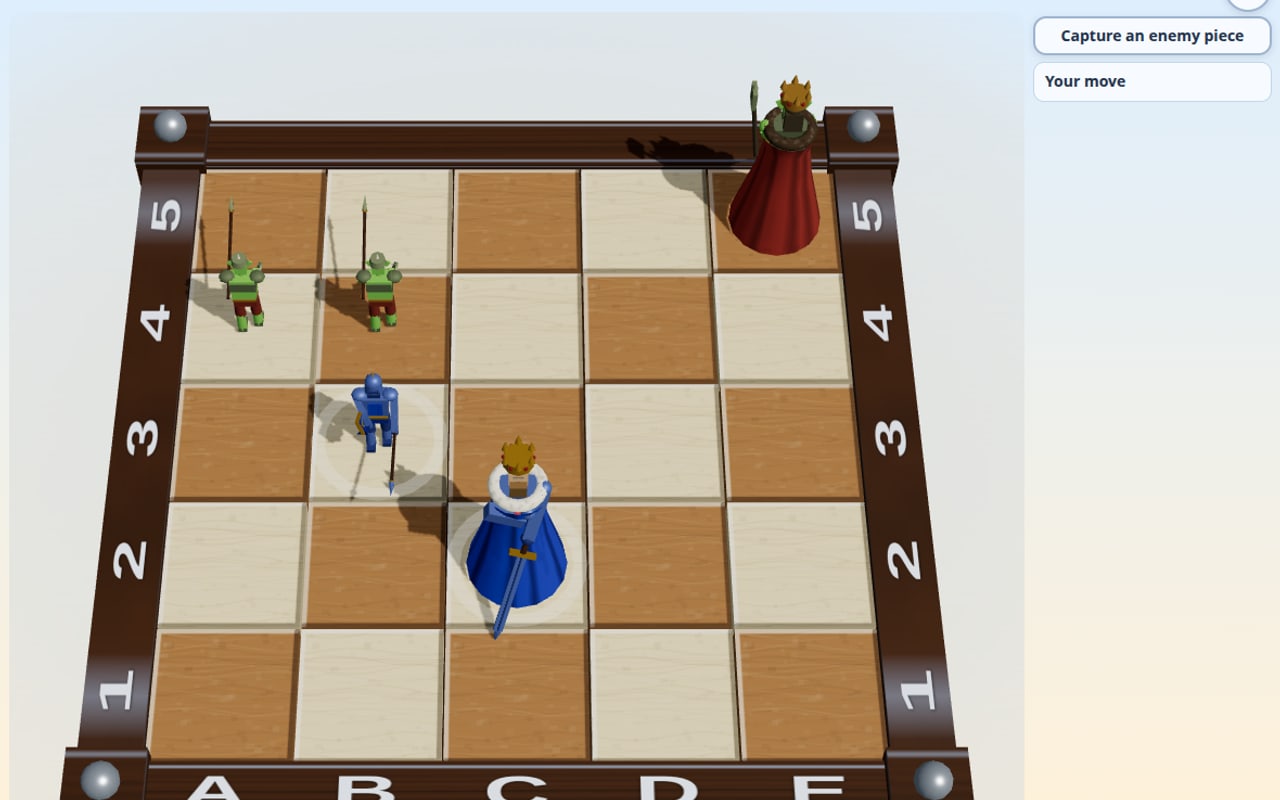
Four Towers is one of those short games like chess that you can actually sit down and play right now: a free logic board game for kids that runs straight in the browser — no install, no account, no ads. It belongs to the classic 16-piece logic game family — often searched as Quarto® — and ours is an independent original version; we are not connected with the owner of that trademark. Sixteen stone towers stand on the shelves of a castle courtyard, and no two of them are alike. Whoever puts the fourth tower into a row, column or diagonal where all four share one feature wins the duel, and the winning line lights up by itself.
Your rival picks the tower you have to play
This is the rule that turns a simple line-up into real thinking, and it is rare enough that most children have never met it. You never choose your own piece. Every tower you place was handed to you by your rival — and every tower your rival places was handed to them by you. So half the game is not on the board at all. It happens in the moment you look at the sixteen squares, look at what is still on the shelves, and ask the only question that matters: which tower is safe to give away?
That single twist is what makes this an honest thinking game rather than a race. A child who only plans their own move loses. A child who starts asking «what could the other one do with this?» starts winning — and that is exactly the habit worth building.
Four features, sixteen towers, no two the same
Every tower carries four independent features, each one either on or off: tall or short, dark or light stone, round or square, with a flag or without. Two choices four times over make exactly sixteen towers, and the courtyard has exactly sixteen squares. A line counts when all four towers share at least one of those features — four talls, four squares, four dark ones, four with flags, or any of the opposites. The game highlights the line and names the feature out loud, so nobody argues about who won.
If you have ever seen a set of attribute blocks on a classroom table — the shapes sorted by size, colour and form — this is the same kind of thinking, turned into a duel with a winner. As a pattern matching board game it asks the child to notice what four towers have in common while everything else about them differs.
No dice, no cards, no luck
Four Towers is an abstract strategy game in the strict sense — no hidden information at all: both players see everything all the time — the board, both shelves, the tower waiting on the pedestal. There is nothing hidden, nothing shuffled and nothing to roll. Every defeat has a reason a child can find and fix, which is precisely what makes a board game a logic trainer instead of a lottery. Among the games like chess this one is the short version: one rule to learn instead of six ways pieces move, and a full match lasts about five minutes.
Three rivals — or a friend on the same screen
Play alone against three bots that genuinely grow in strength, or pass the tablet back and forth as a 2 player strategy board game in the «Two players, one screen» mode. The rules are the same either way; only the opponent changes.
How to play
A turn has two halves. First you place the tower your rival handed you: the free squares glow, tap the one you want. Then you choose a tower from the shelves for your rival — tap it and it flies to their pedestal. That is the whole game. A built-in tutorial teaches it in four short spoken steps on the first launch, and the towers are shuffled across both shelves at the start of every match, so you have to read the towers themselves rather than remember where they stood.
Against the two easier rivals the game is kind to mistakes: if the tower you are about to hand over would let them win at once, it quietly asks «give it anyway?» — the classic beginner blunder, caught until the child stops making it. The three bots grow in strength: the Squire overlooks things, the Knight never hands you a winning tower, and the Grandmaster looks several moves ahead. It plays with a mouse on a computer and with a finger on a tablet.
What your child learns
Four Towers trains three things at once, and all three are hard to practise anywhere else. Comparing by several features at a time: each tower is four yes/no properties, and the child has to hold all four in their head while scanning ten possible lines. Deduction: what is left on the shelves tells you what your rival cannot get, so the pieces nobody has taken are information, not leftovers — that is what turns this into a real deduction board game rather than a race to four. Planning one move ahead for somebody else: before giving a tower away you have to look at the board through the opponent's eyes — the exact skill chess coaches spend years building.
Because there is no luck and no timer, a child can slow down and actually think — which is what makes it one of the critical thinking games that survives more than one evening. And because a match is five minutes, a bad game costs nothing and the next one starts immediately.
The science behind the games
Every Dad4Kids game is built on one simple truth: children want to play, not study — so we turn learning into a game worth replaying. The method draws on peer-reviewed research in game-based learning, motivation, and how memory works.
- Prins et al. (2013). “Braingame Brian”: toward an executive function training program with game elements. Games for Health Journal.
- Tokac et al. (2019). Effects of game-based learning on students' mathematics achievement: A meta-analysis. Journal of Computer Assisted Learning.
- Alotaibi (2024). Game-based learning in early childhood education: a systematic review and meta-analysis. Frontiers in Psychology.
- Lampropoulos & Sidiropoulos (2024). Impact of gamification on students' learning outcomes and academic performance: a meta-analysis. Education Sciences.
- Taylor & Boyer (2019). Play-based learning: evidence-based research to improve children's learning experiences. Early Childhood Education Journal.
- Gottfried (1990). Academic intrinsic motivation in young elementary school children. Journal of Educational Psychology.
FAQ
What are the best abstract strategy games for kids?
The ones with no dice — the abstract strategy family: if a roll can undo a good plan, a child learns that thinking does not pay. Look for a game where both players see everything, where a match is short enough to play again after losing, and where the rules fit in one sentence. Four Towers meets all three — one rule, five minutes, nothing hidden — and it costs nothing to try because it runs in the browser.
What game is most similar to chess?
Any abstract strategy game with perfect information belongs to the same family: both sides see the whole position, nothing is random, and the sharper thinker wins. Four Towers is the short end of that family. There are no piece movements to memorise — every tower is simply placed and stays put — but the question «what will my rival do with what I give them?» is the same one chess is built on, and it arrives on the very first turn.
What is the best game for an 8-year-old?
One whose rules a child can hold in their head while thinking about the position instead of the instructions. Eight is about right here: the tutorial explains everything in four spoken steps, the first bot makes childlike mistakes on purpose, and the warning before giving away a winning tower keeps early games from feeling unfair. Younger children can play the placing part happily; the giving-away part is what clicks around eight.
What exactly counts as a line?
Four towers filling a whole row, a whole column or one of the two diagonals, where all four share at least one feature: all tall, all short, all dark, all light, all round, all square, all with flags or all without. One shared feature is enough — the towers may differ in everything else. When it happens the game lights the four squares and says the feature aloud.
Which game is best for critical thinking?
The useful ones make you argue with yourself before you move. Here the game forces it: you cannot make a move without also choosing what your opponent gets, so every turn has two decisions pulling in opposite directions. That is a sharper workout than a puzzle with one right answer, because there is a thinking person on the other side of it.
Is this the same as Quarto®?
Quarto® is a registered trademark of another company and we are not connected with them. Four Towers belongs to the same classic family of sixteen-piece logic games, where every piece carries four yes/no features and the winner is whoever completes a line of four sharing one of them. Ours is an original castle-towers version with its own pieces, artwork and voiced tutorial.
Is it really free?
Yes — free, with no ads, no installation and no account. Open the page and play.
Does it work on a tablet?
Yes. Tap a glowing square to place your tower, tap a tower on the shelf to hand it over. On a computer it is the same two taps with a mouse. The «Two players, one screen» mode is built for a tablet passed from hand to hand.
More free games for kids
By Evgeny Arsentiev, PhD · Last updated: September 2026