
Space Explorer — Free Astronomy Game for Kids 6+
 New from Dad4Kids
Clean YouTube for kids
For families with traditional values, hand-picked by parents.
Open →
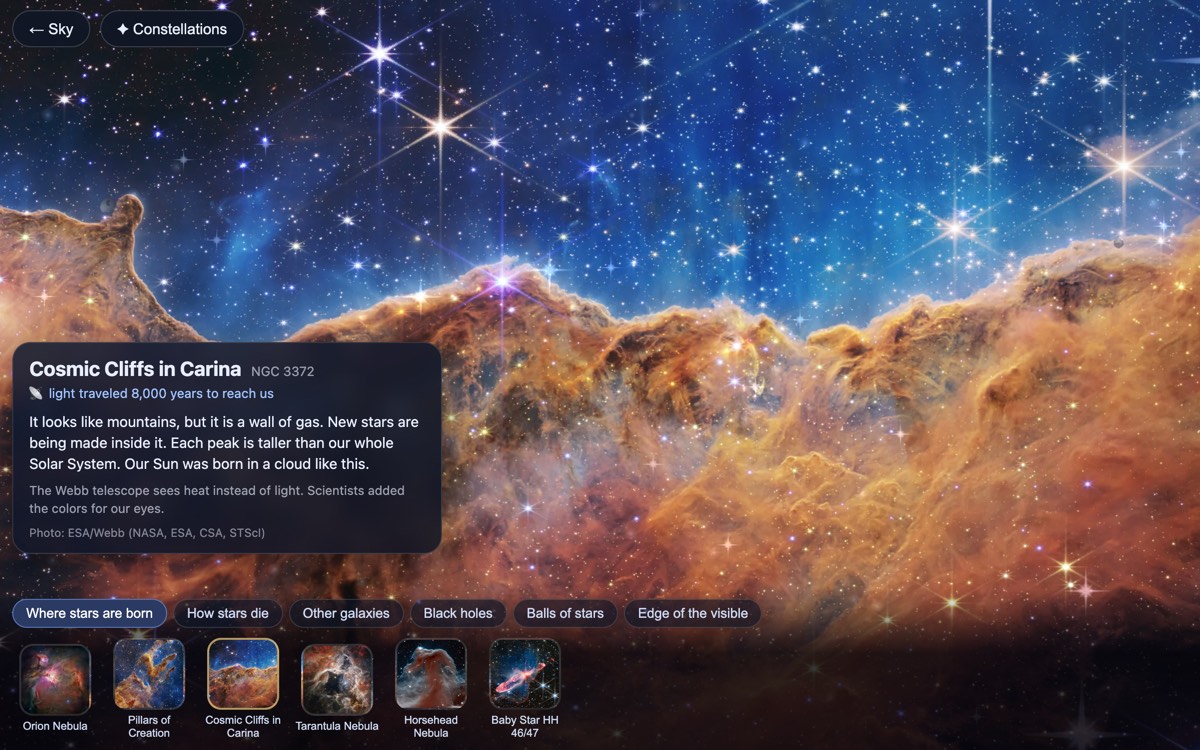
Space Explorer is one of those space games for kids that is really a guided spaceship journey through the real Universe. The ship warps from stop to stop — Earth, the Moon, the Sun, Venus, Mars, Jupiter and Saturn, then out to comets and the nearest stars, to black holes, our Milky Way galaxy and the Big Bang itself — while a friendly voice explains what the child is seeing, in simple words and honest numbers.
This is real school astronomy, not decoration: why day turns to night, why the tilted axis — not distance — makes the seasons, why footprints on the Moon never blow away, what makes Venus hotter than an oven, and why even light needs four years to reach the next star. One of the most striking moments: the ship crosses to the night side of Mars, the sky fills with thousands of stars — and the journey to the truly big Universe begins.
After each stop comes a short CHECK: two or three life-sized YES/NO questions (“Summer is warmer because Earth flies closer to the Sun — yes or no?”). Wrong answers get a kind one-line explanation, right ones earn knowledge stars. At the end the child can free-fly around every planet with the mouse.
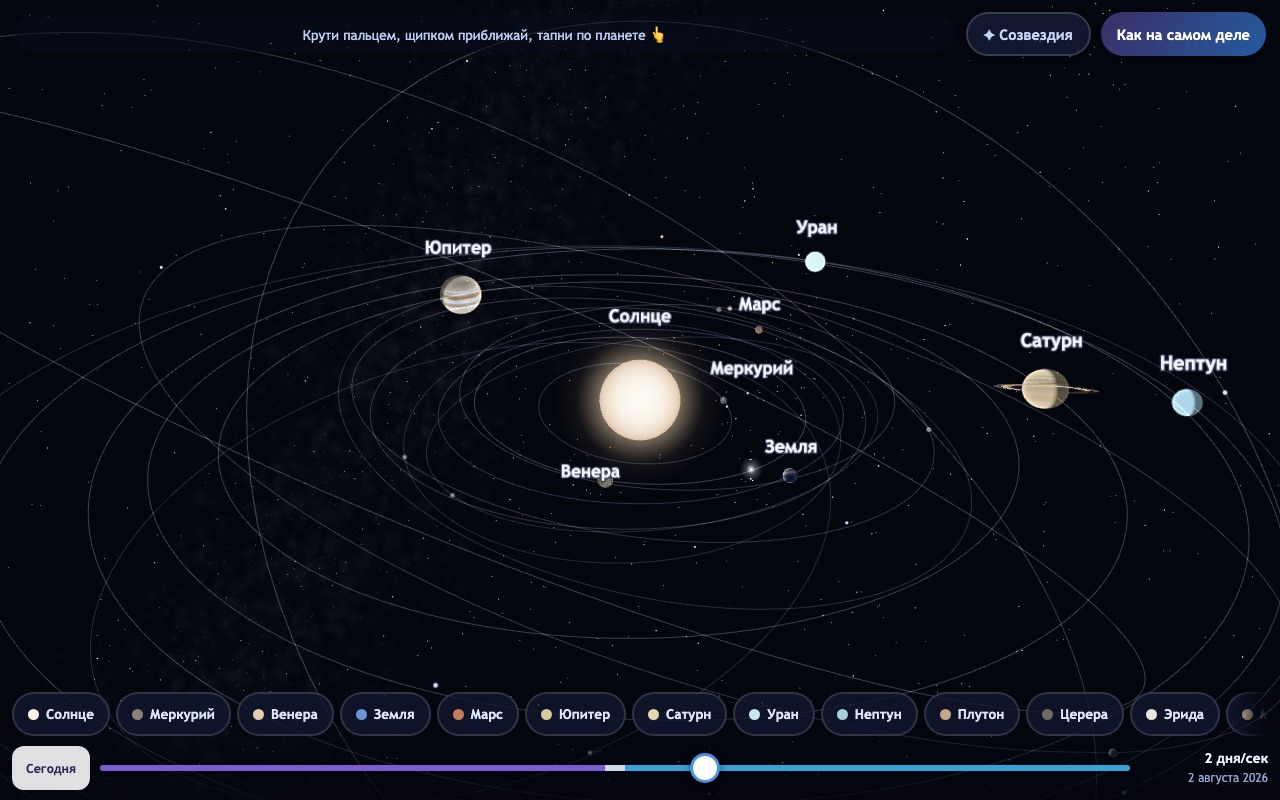
Want the map rather than the tour? See the planets in order — a free interactive 3D Solar System with all eight planets, their moons and the asteroid belt on their real orbits.
How to play
Press Launch and watch each stop’s story — the narrator reads it aloud while the camera flies around planets, satellites and galaxies. Then answer the YES/NO check questions to earn stars. After the check, drag with the mouse or finger to orbit the planet yourself, zoom with the wheel, and press “Fly onward” for the next warp jump. Thirty stops across three chapters — from Earth to black holes and the Big Bang; progress is saved.
What your child learns
The game builds the core mental model of astronomy that schools aim for: Earth as a rotating, tilted planet (day/night, seasons), the Moon as our airless companion, the Sun as an ordinary star, the planets as real explorable worlds, and then the honest scale of everything — light-minutes inside the Solar System, light-years to stars, millions of light-years to galaxies. Misconception-busting questions (“Is the Moon a lamp?”, “Is Mars hot because it’s red?”) are exactly the items used to test science understanding in elementary school.
The science behind the games
Every Dad4Kids game is built on one simple truth: children want to play, not study — so we turn learning into a game worth replaying. The method draws on peer-reviewed research in game-based learning, motivation, and how memory works.
- Tokac et al. (2019). Effects of game-based learning on students' mathematics achievement: A meta-analysis. Journal of Computer Assisted Learning.
- Alotaibi (2024). Game-based learning in early childhood education: a systematic review and meta-analysis. Frontiers in Psychology.
- Lampropoulos & Sidiropoulos (2024). Impact of gamification on students' learning outcomes and academic performance: a meta-analysis. Education Sciences.
- Taylor & Boyer (2019). Play-based learning: evidence-based research to improve children's learning experiences. Early Childhood Education Journal.
- Gottfried (1990). Academic intrinsic motivation in young elementary school children. Journal of Educational Psychology.
- Yang et al. (2018). Enhancing learning and retrieval of new information: a review of the forward testing effect. npj Science of Learning.
FAQ
Is the narration really spoken aloud?
Yes — every stop is narrated by the browser’s built-in voice, and the same text is shown as large subtitles. You can mute the sound and read instead.
Is the science accurate?
Yes. Seasons come from the axial tilt, light takes eight minutes from the Sun and four years from Proxima Centauri, rovers really drive on Mars, and astronomers have found thousands of exoplanets. Numbers are rounded so a six-year-old can hold them.
What age is it for?
Reading is optional thanks to the voice narration, so curious kids from about 6 enjoy it. The YES/NO checks use everyday language, no formulas.
Is it free?
Yes — completely free, no ads and no purchases, right in the browser on a computer or tablet.
More free games for kids
By Evgeny Arsentiev, PhD · Last updated: September 2026