
Weather & Water Cycle Game for Kids — Free Storm Command 7+
 New from Dad4Kids
Clean YouTube for kids
For families with traditional values, hand-picked by parents.
Open →
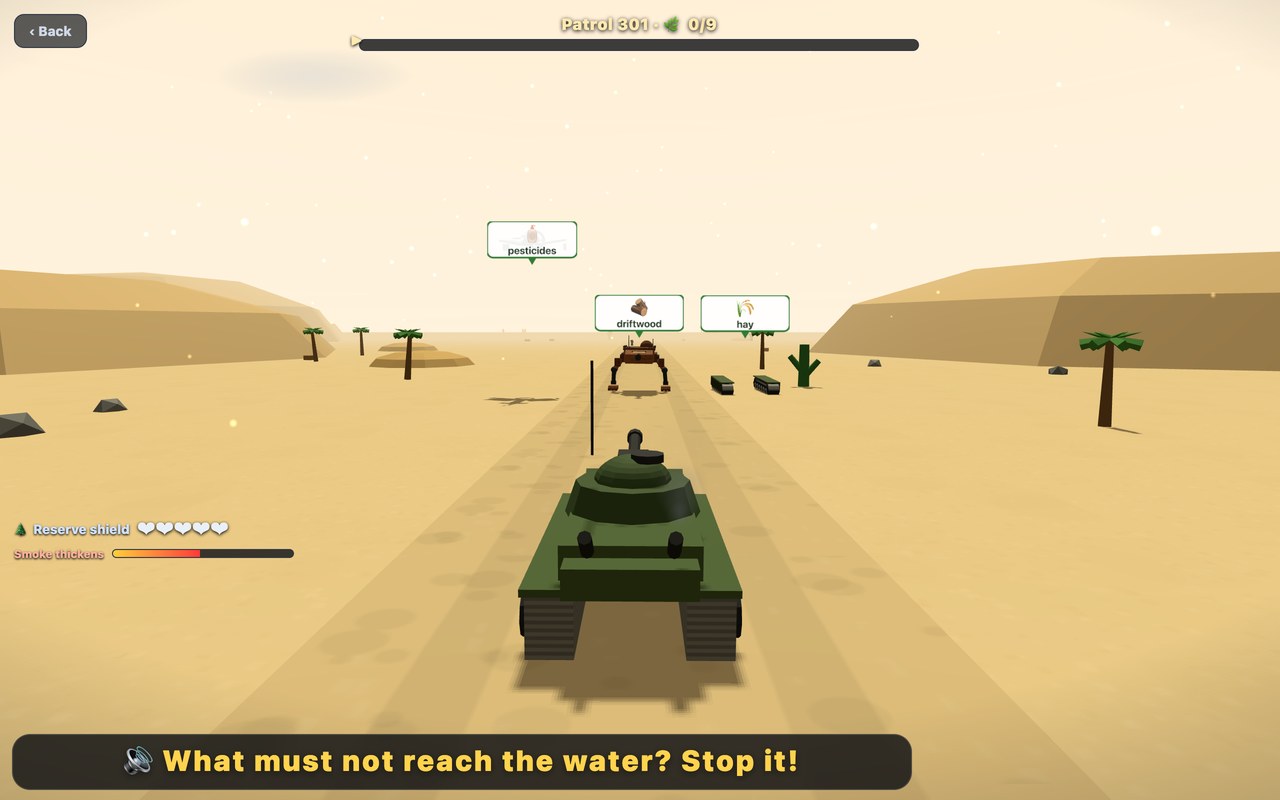
Storm Command is a water cycle game for kids built as a third-person survival-defense adventure, where science is the shield. The game first simulates the true storm — temperature, pressure, humidity, wind, clouds, rainfall, river levels — then shows it through instruments and radar. Prepare the base, and the very same storm arrives: rain really flows down slopes into the drains you cleared, wind really drives the ash you predicted.
Ten campaigns cover observation and fronts, the full water cycle with honest water accounting, contour maps and floods, drought and wildfire, thunderstorms and tornado probability zones, tropical cyclones and storm surge, mountain snow and avalanches, volcanoes and earthquakes as geologic hazards, climate as long-term patterns, and a grand finale combining everything. Hostile machines of the Tempest Array exploit the hazards — but physics stays fair.
How to play
Five phases: walk the base in your exosuit and read the instruments; build the forecast from real measurements; prepare — clear drains, open spillways, ground the lightning rods, anchor towers; defend through the storm with your weapons and repair beam while the hazard rages; recover and compare forecast vs reality. The drone Nimbus highlights faults and celebrates correct calls.
What your child learns
Observation instruments and units, air pressure and fronts, cloud types, dew point, the complete water cycle (evaporation, condensation, precipitation, runoff, infiltration, groundwater), contour lines and watersheds, flood management, drought, thunderstorm safety, lightning grounding, tornado warning zones, tropical cyclone structure and storm surge, snowpack and avalanches, volcanoes, earthquakes and tsunamis as geologic hazards, and weather vs climate. Difficulty never changes the science.
The science behind the games
Every Dad4Kids game is built on one simple truth: children want to play, not study — so we turn learning into a game worth replaying. The method draws on peer-reviewed research in game-based learning, motivation, and how memory works.
- Tokac et al. (2019). Effects of game-based learning on students' mathematics achievement: A meta-analysis. Journal of Computer Assisted Learning.
- Alotaibi (2024). Game-based learning in early childhood education: a systematic review and meta-analysis. Frontiers in Psychology.
- Lampropoulos & Sidiropoulos (2024). Impact of gamification on students' learning outcomes and academic performance: a meta-analysis. Education Sciences.
- Taylor & Boyer (2019). Play-based learning: evidence-based research to improve children's learning experiences. Early Childhood Education Journal.
- Gottfried (1990). Academic intrinsic motivation in young elementary school children. Journal of Educational Psychology.
- Yang et al. (2018). Enhancing learning and retrieval of new information: a review of the forward testing effect. npj Science of Learning.
FAQ
Is the science real or game magic?
The simulations are simplified but honest: water is conserved to a millionth, runoff follows real slopes, ash follows the actual wind field, thunder arrives later for distant lightning. The validator checks 1200 generated worlds for physical consistency.
Are disasters scary?
The world is populated by service robots — no people are ever in danger. Storms are dramatic but the game rewards preparation: a well-prepared base visibly stands, and failure just restarts the mission with the forecast remembered.
More free games for kids
By Evgeny Arsentiev, PhD · Last updated: September 2026