
4 Player Chess — Free Four Player Chess Online 7–12
 New from Dad4Kids
Clean YouTube for kids
For families with traditional values, hand-picked by parents.
Open →
4 player chess — four-handed chess, four-way chess, call it what you like — on one cross-shaped board, free in your browser. The board is a 14×14 square with the four 3×3 corners cut away: 160 squares. Four armies of sixteen line the four edges — blue knights to the south, green orcs to the west, the undead host to the north, copper dwarves to the east — and the pieces move exactly as they do in ordinary chess.
Every side for itself
No teams, no alliances, no partners across the board: four armies, four kings, and the last king still standing takes the game. Play runs round the circle — south, then west, then north, then east — and each side's pawns march towards their own far edge, so all four fronts meet in the middle at once. Attack the weak side and you hand the board to the strong one; that choice, made every single move, is what four-player chess is really about.
A beaten army turns to grey stone
When an army is checkmated — or when its king is left alone with nothing to mate with — the king leaves the board and every other piece freezes into grey stone right where it stands. Frozen pieces never move and never give check, but they still block squares and can still be captured. So the board fills up with the wreckage of the war instead of emptying out, and the survivors have to fight through it.
You do not need three friends
The other three armies are played by the computer, so one player gets a real four-way game on one device — no account, no waiting for a lobby, nothing to install. Three rivals to choose from: Baby Troll moves at random and drops pieces, Warlord thinks two moves ahead, The Underking calculates deeply and rarely slips. After that they tune themselves to how you are playing.
How to play
Tap one of your pieces — green dots show where it may go, red rings show what it may take — then tap the square. Touch someone else's piece and the game says so instead of doing anything. «Check! Save your king» means you must answer the attack before making any other move, and a move that would leave your own king in check is simply refused. A pawn that reaches the far edge of the cross promotes. The scoreboard along the bottom shows the strength of all four armies at once, with a crossed-out name for any army that has already fallen.
What your child learns
Two-player chess trains calculation: he goes there, so I go here. A four-way board adds the question a normal chessboard never asks — which of them do I hit first? Take the weakest neighbour and you clear the road for the strongest. Trade queens with the leader and the two behind you gain more than you do. Children feel that long before they can put it in words, and it is the same judgement that makes a good negotiator: whose problem is worse than mine right now. The frozen armies teach a smaller lesson well too — a defeated force does not vanish from the world, it stays in the way.
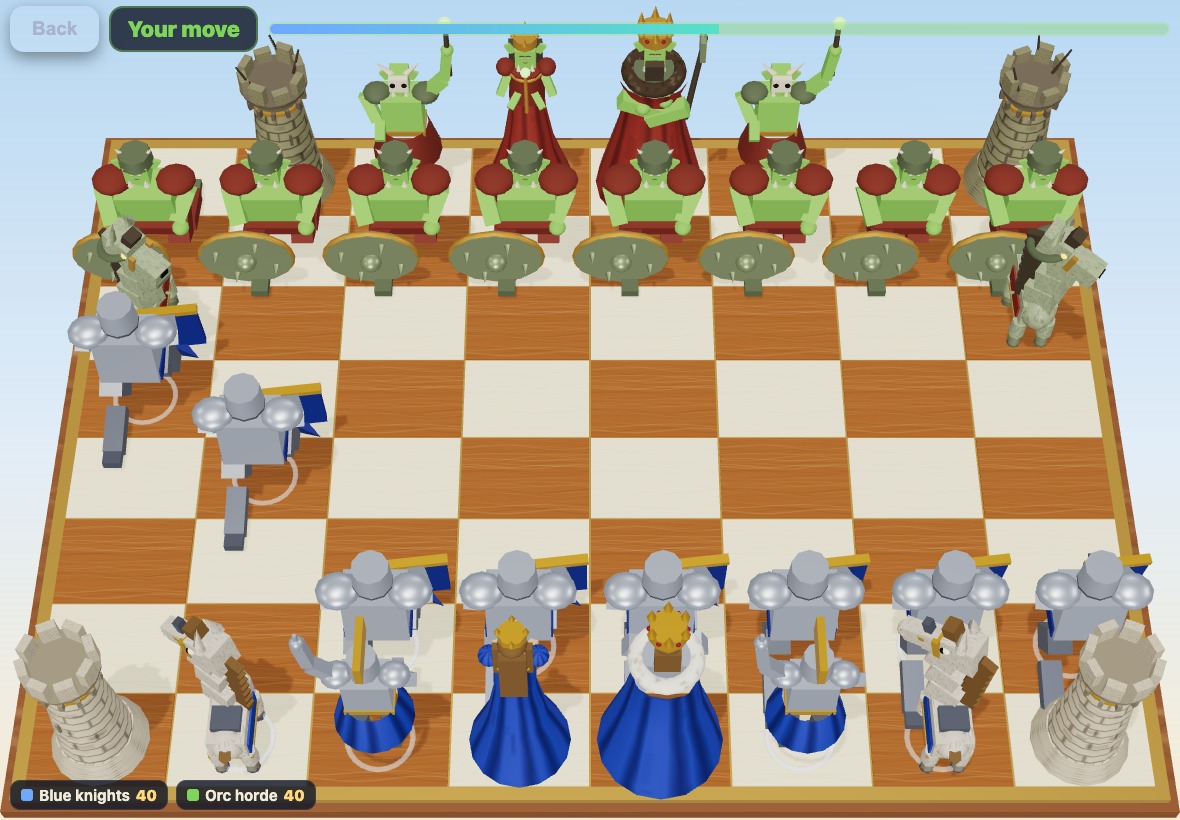
More chess: three player chess for three armies on one wide board, battle chess for kids — ordinary 8×8 chess with the full rules and pieces that fight when they capture — and viking chess (hnefatafl).
The science behind the games
Every Dad4Kids game is built on one simple truth: children want to play, not study — so we turn learning into a game worth replaying. The method draws on peer-reviewed research in game-based learning, motivation, and how memory works.
- Prins et al. (2013). “Braingame Brian”: toward an executive function training program with game elements. Games for Health Journal.
- Tokac et al. (2019). Effects of game-based learning on students' mathematics achievement: A meta-analysis. Journal of Computer Assisted Learning.
- Alotaibi (2024). Game-based learning in early childhood education: a systematic review and meta-analysis. Frontiers in Psychology.
- Lampropoulos & Sidiropoulos (2024). Impact of gamification on students' learning outcomes and academic performance: a meta-analysis. Education Sciences.
- Taylor & Boyer (2019). Play-based learning: evidence-based research to improve children's learning experiences. Early Childhood Education Journal.
- Gottfried (1990). Academic intrinsic motivation in young elementary school children. Journal of Educational Psychology.
FAQ
What is 4 player chess called?
Four-player chess, four-handed chess and four-way chess all mean the same thing: chess for four sides on one board, usually a cross made by adding three extra ranks to each side of a normal 8×8. The version here is the common free-for-all one — no fixed teams, last king standing wins.
How do you play 4 player chess?
Each of the four armies has its own edge of the cross and its own forward direction, so pawns from all four sides advance towards the middle. Turns go round the board in one direction. Everything else is ordinary chess: same moves, same check, same checkmate. The difference is what happens after a checkmate — the beaten king leaves and his army stays behind as grey stone.
What is the standard setup for a 4 player chess board?
A 14×14 square with the four 3×3 corners removed, which leaves 160 playable squares. Each army gets the usual sixteen: eight pawns in front, and behind them rook, knight, bishop, queen, king, bishop, knight, rook — with the king and queen mirrored between facing pairs, exactly as on a physical four-player set.
How can you achieve checkmate in 4 player chess?
Exactly as in ordinary chess: attack the king so that no legal move gets him out. The catch is that on a cross board a king is often attacked by two different armies at once, and defending against one can open the door to another. Mating an opponent does not clear his pieces off the board either, so a well-timed mate can leave you walled in behind the stone army you just made.
Can I play 4 player chess alone, against the computer?
Yes — that is how this one is built. You lead one army and the computer plays the other three, on your own screen, straight away. No account, no lobby, no waiting for three other people to show up.
Are castling and en passant in the game?
No, and that is on purpose. Four-way chess already asks a child to track three opponents at once; the two rules that need the most exceptions were left out so that the board stays learnable. Everything else — all the piece moves, check, checkmate and pawn promotion — is standard. Our two-player chess game has castling and en passant in full.
Does it work on a tablet?
Yes, in landscape — the cross is a wide board, and the game asks you to turn the tablet if you hold it upright.
More free games for kids
By Evgeny Arsentiev, PhD · Last updated: September 2026