
Adding Integers: Why Minus Plus Minus Is Not Plus
Games
-
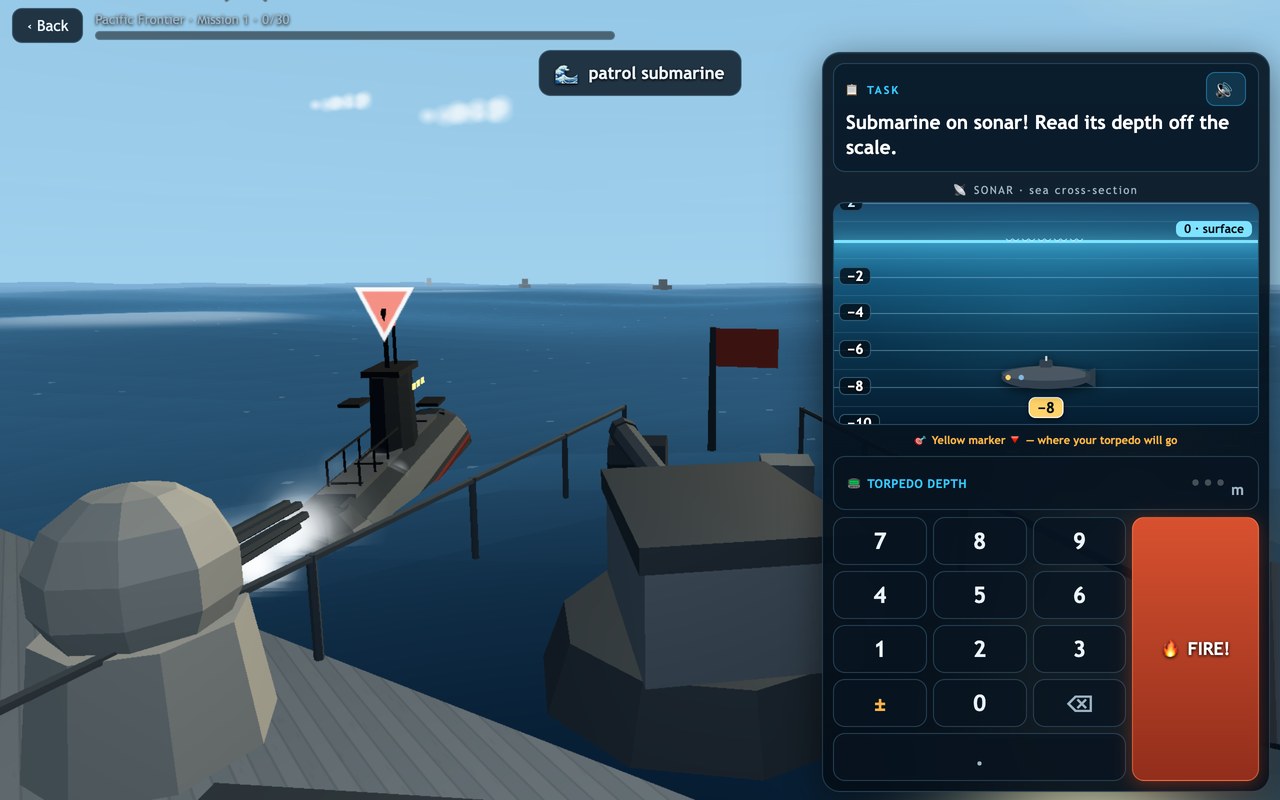 Math Games for 6th Graders — Free Deep Number 8+
Math games for 6th graders on a submarine depth scale: negative numbers, opposites, comparing …
-
 Math Games for 5th Graders — Free Math Blaster 4+
Math games for 5th graders: decimals, percent, fractions, area, perimeter, volume and solving for …
-
 Algebra Games for Kids — Free Sea Battle: Find X 6+
Algebra games where solving is the trigger: work out the hidden enemy's position, type …
-
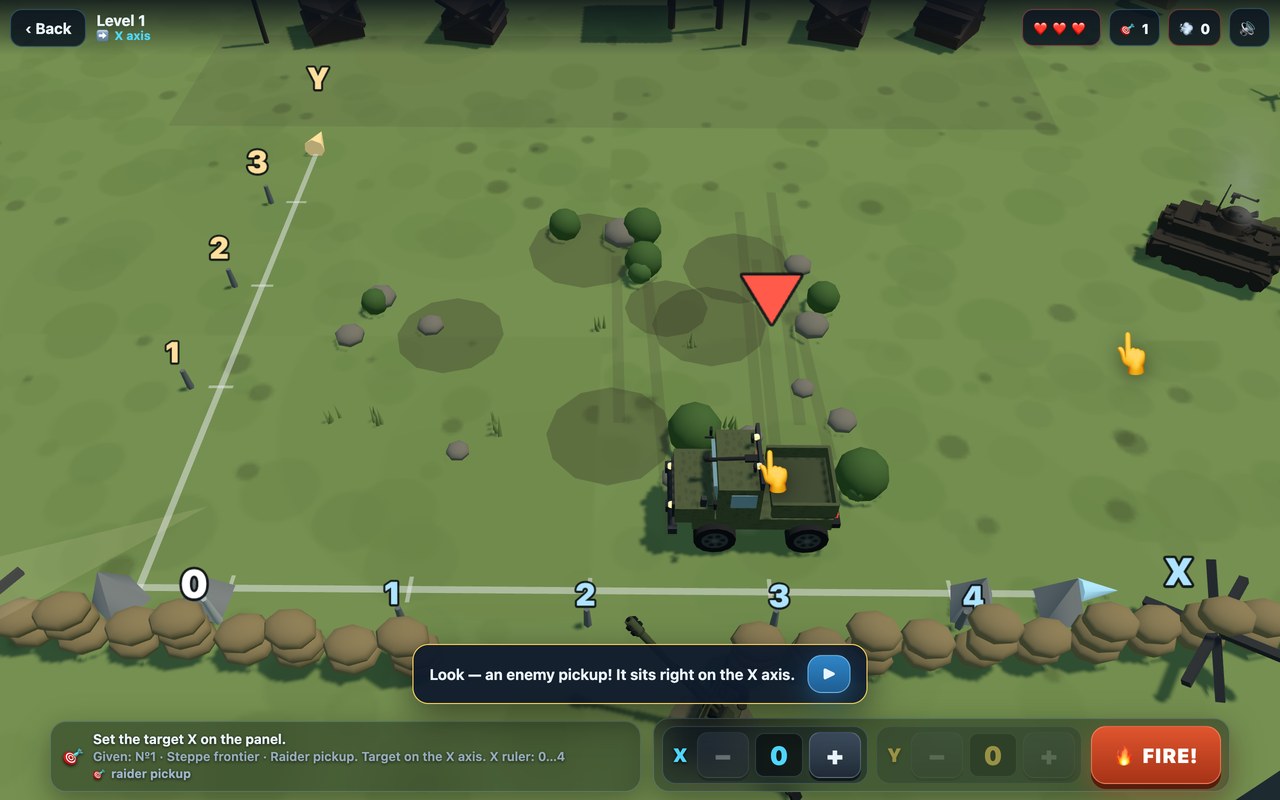 Coordinate Grid — Free Grid Artillery Game for Kids 7+
A coordinate grid game where the point is the target: read it, call it …
-
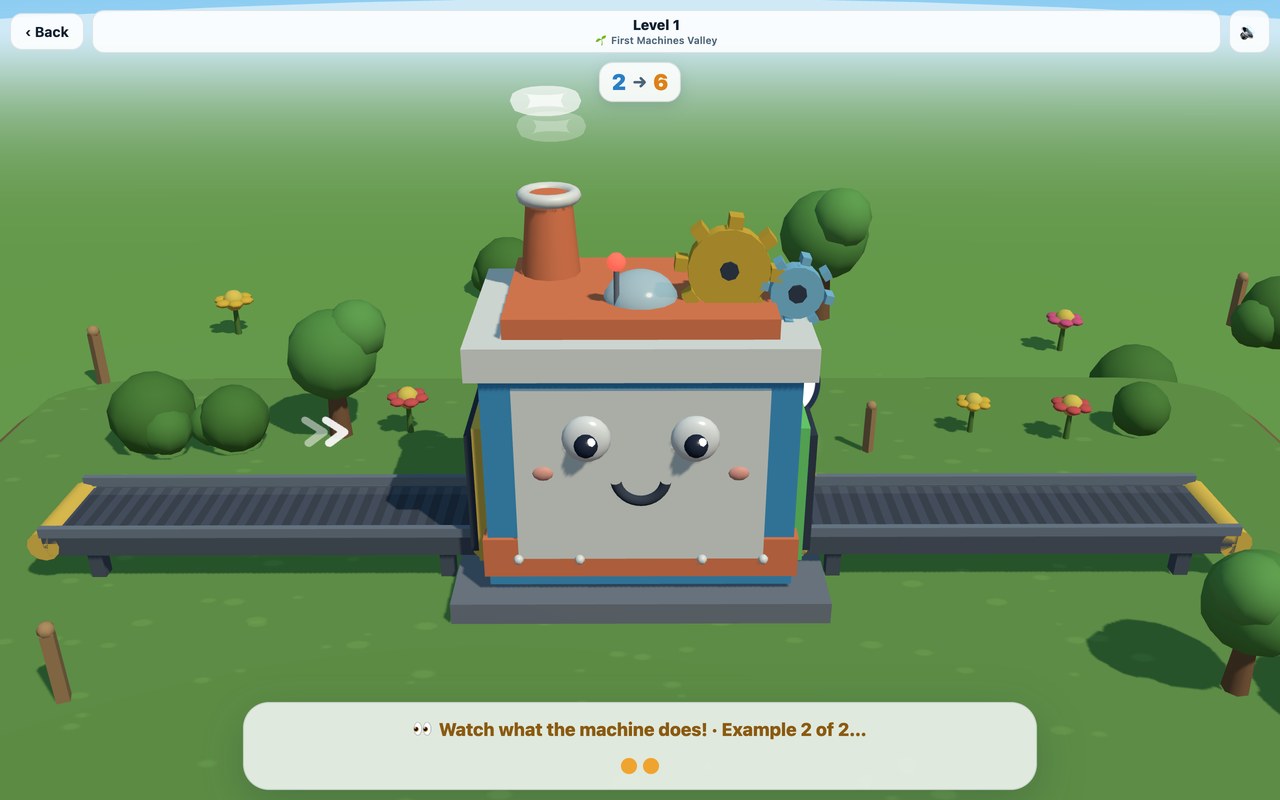 Function Machine Game — Free Function Forge Academy 7+
Function tables made visible: drop an input into the machine, watch the output, fill …
Negative numbers break for one reason: children are taught rules about signs before they are given a picture of what a negative number is. Give them the picture and most of the rules become unnecessary.
Picture one: the number line. Numbers live on a line. Adding a positive means walking right; adding a negative means walking left. So −3 + 5 is "start at −3, walk 5 right" = 2. There is no rule to remember, just a direction.
Picture two: money and debt. +7 is seven dollars in your pocket; −7 is seven dollars you owe. −4 + 9 is "you owe 4, you earn 9" — you clear the debt and have 5 left. Children who resist the number line usually accept this one instantly.
The one genuinely confusing case: subtracting a negative. 6 − (−2) = 8. In the debt model: someone cancels a debt of 2, so you are 2 better off. Say it that way once and it stops being magic.
What to practise, in order. First, ordering: which is bigger, −8 or −3? (−3 — it is further right.) Second, adding a negative. Third, subtracting a positive that takes you below zero. Only then, subtracting a negative. Mixing all four on day one guarantees confusion.
Where children actually meet this. Temperature below zero, floors below ground in a lift, a submarine's depth, a bank balance. Every one of those is a number line stood on its end, and it is worth pointing at all four in real life rather than only on paper.
Next: ordered pairs (where negatives create the four quadrants), function machine games, math word problems and games for 5th graders.
The science behind the games
Every Dad4Kids game is built on one simple truth: children want to play, not study — so we turn learning into a game worth replaying. The method draws on peer-reviewed research in game-based learning, motivation, and how memory works.
- Tokac et al. (2019). Effects of game-based learning on students' mathematics achievement: A meta-analysis. Journal of Computer Assisted Learning.
- Alotaibi (2024). Game-based learning in early childhood education: a systematic review and meta-analysis. Frontiers in Psychology.
- Lampropoulos & Sidiropoulos (2024). Impact of gamification on students' learning outcomes and academic performance: a meta-analysis. Education Sciences.
- Taylor & Boyer (2019). Play-based learning: evidence-based research to improve children's learning experiences. Early Childhood Education Journal.
- Gottfried (1990). Academic intrinsic motivation in young elementary school children. Journal of Educational Psychology.
- Yang et al. (2018). Enhancing learning and retrieval of new information: a review of the forward testing effect. npj Science of Learning.
By Evgeny Arsentiev, PhD · Last updated: August 2026