
Puzzle Games for Kids — Free Rescue Bot: Wild Station 4+
 New from Dad4Kids
Clean YouTube for kids
For families with traditional values, hand-picked by parents.
Open →
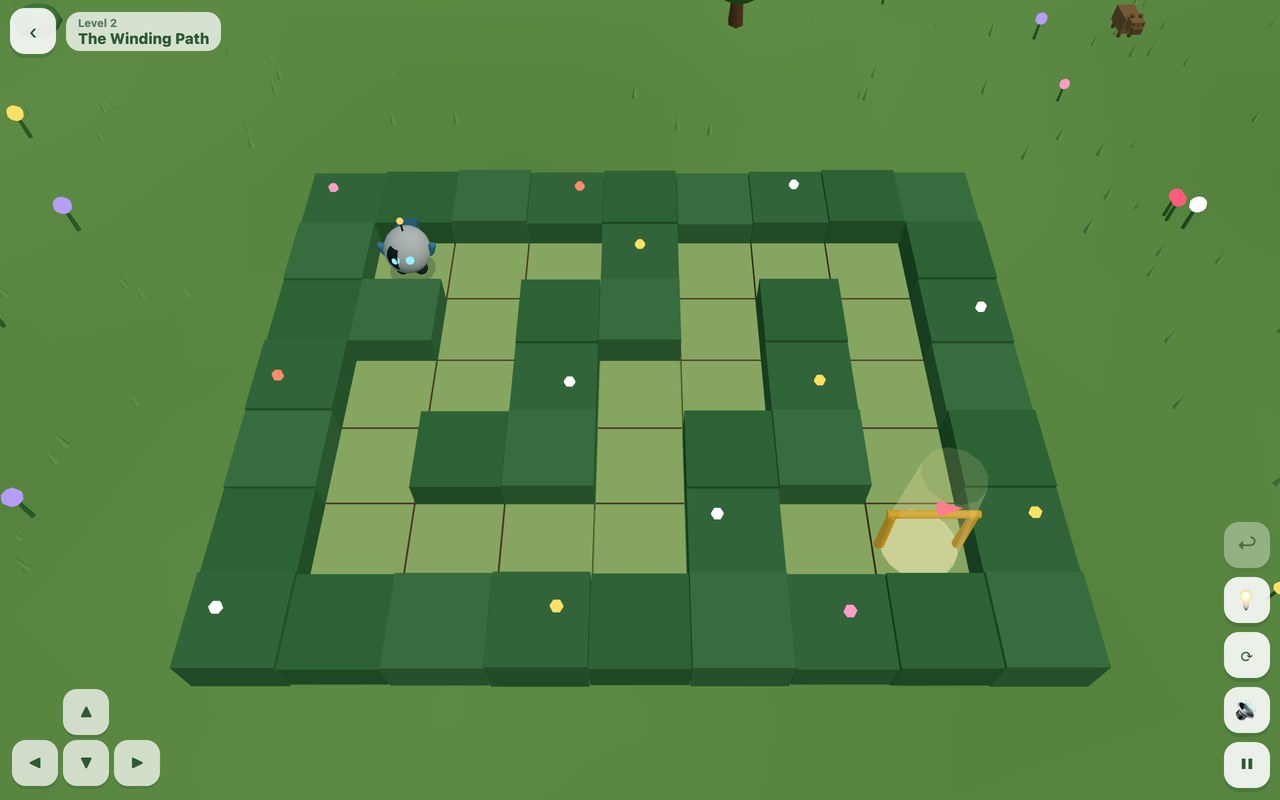
Rescue Bot: Wild Station is a set of puzzle games for kids: a small, big-eyed repair robot lands on a huge wildlife island scrambled by a mysterious storm. Every level is a tiny rescue story: push a battery into its charging dock, deliver a food crate to a hungry capybara, roll a log into the river so it becomes a bridge — and watch the habitat light up, flowers pop and the rescued animal hop over to say thanks.
The island unfolds across ten regions with their own look, music and puzzle ideas: sunny meadows teach pure pushing, the whispering forest adds color-matched crystals and keys, the river valley floats logs into bridges, crystal caverns add teleports and cracking floors, the highlands freeze everything into slippery ice, and the Heart of the Island mixes it all in grand finale missions — 500 hand-tuned levels in total, each verified solvable by the game's own solver.
How to play
Move one tile at a time: swipe anywhere, tap a cell to walk there, use the on-screen arrows or WASD/arrow keys on a computer. The robot pushes crates but can never pull — that single rule is the whole puzzle. Unlimited undo, instant restart and a four-step hint system (a question, a highlight, an arrow, a demonstration) mean nobody ever gets truly stuck. Pick an age at the start — 4–5, 6–7, 8–10 or Challenge — and the same island rebuilds its puzzles to fit.
What your child learns
Classic Sokoban thinking dressed as an animal rescue: planning several moves ahead, spatial reasoning, sequencing, cause and effect, and recovering calmly from mistakes with undo instead of fear of failure. Later regions quietly add light reflection, water flow, weight switches and order-of-operations thinking.
The science behind the games
Every Dad4Kids game is built on one simple truth: children want to play, not study — so we turn learning into a game worth replaying. The method draws on peer-reviewed research in game-based learning, motivation, and how memory works.
- Prins et al. (2013). “Braingame Brian”: toward an executive function training program with game elements. Games for Health Journal.
- Tokac et al. (2019). Effects of game-based learning on students' mathematics achievement: A meta-analysis. Journal of Computer Assisted Learning.
- Alotaibi (2024). Game-based learning in early childhood education: a systematic review and meta-analysis. Frontiers in Psychology.
- Lampropoulos & Sidiropoulos (2024). Impact of gamification on students' learning outcomes and academic performance: a meta-analysis. Education Sciences.
- Taylor & Boyer (2019). Play-based learning: evidence-based research to improve children's learning experiences. Early Childhood Education Journal.
- Gottfried (1990). Academic intrinsic motivation in young elementary school children. Journal of Educational Psychology.
FAQ
What are some fun puzzle games for kids like this one?
Rescue Bot fits the classic Sokoban family — push crates to solve a scene — but wraps every puzzle in a gentle rescue story with unlimited undo, so a 4-year-old and a 10-year-old can both play at their own difficulty.
Is there any fighting?
None at all. Nobody is ever harmed — the robot repairs, delivers, unlocks and rescues. The only tension is the puzzle itself, and every solved level makes the island visibly more alive.
What if my child pushes a crate into a corner?
The narrator gently points out that the crate looks stuck and suggests the undo button. Undo is unlimited and free, so experimenting is always safe.
Are all 500 levels really solvable?
Yes. Every level is generated with the box positions walked backwards from the solved state and then double-checked by a solver before it is shown, so an impossible level simply cannot appear.
More free games for kids
By Evgeny Arsentiev, PhD · Last updated: September 2026