
Odd One Out Game for Kids — and It Tells You Why 4–8
 New from Dad4Kids
Clean YouTube for kids
For families with traditional values, hand-picked by parents.
Open →
The odd one out game is the shortest thinking game ever invented: here are some things, one of them is not like the others, which one? This version is free, runs in a browser and is built for children who cannot read yet — the task is spoken, and so is the reason.
The answer is not the end — the reason is
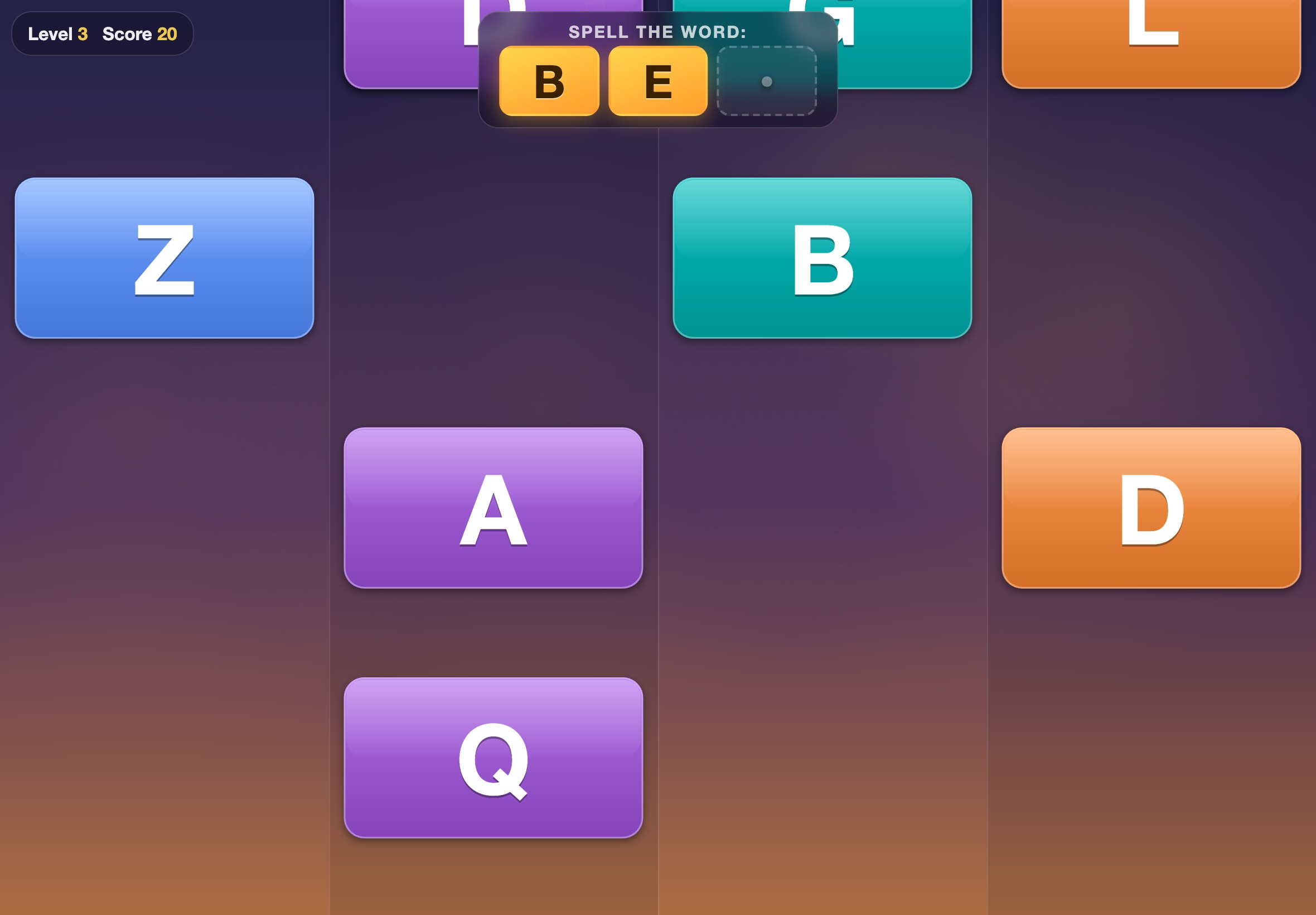
Tap the odd one and it rides out to the middle of the stage, jumps, throws off sunbeams and confetti — and the voice says why: “F is not a vowel — the rest are vowels!”, “These numbers count by twos — that one breaks the pattern!”. The explanation is the lesson; the confetti is just the receipt. Tap a wrong one and it wobbles and the task is repeated. There is no timer, no lives and no way to lose.
Five kinds of round
Letters — a consonant among vowels, or a vowel among consonants (Y is left out on purpose: it is both, and that is a fight for later). Syllables — the one with a different vowel sound, easy at first (MA-MA-MO-MA), harder later (BA-DA-MA-LO). Animals — water, birds and land, twenty-one species. Numbers — the one that breaks the count: +1, +2, +5, +10, and counting down. Shapes — the wrong form, the wrong colour or the wrong size, and the differences get finer towards the end of a chapter.
A hundred levels that get easier when they need to
Five chapters of twenty levels, six rounds each; from the second chapter on, the rounds mix categories so nothing settles into a habit. Two wrong answers in a round and the next one loses a distractor — the field narrows instead of the child stalling. Everything is spoken, so a four-year-old starts without an adult reading anything out.
How to play
Listen to the task — the speaker button repeats it whenever you want — then tap the thing that does not belong. That is the whole control scheme: one tap, mouse or finger. The right answer comes out to the middle and gets explained; a wrong one wobbles and the task starts again. Score and stars are kept on your own device, so the next visit picks up where the last one stopped. Landscape and portrait both work — in portrait the stage folds into two rows.
What your child learns
Two things at once. The obvious one is categorising: to say which thing is out, a child first has to work out what the others have in common, and that is the same move as finding the point of a paragraph. The quiet one matters more for reading. The letter rounds separate vowels from consonants — the split every phonics programme is built on, because a vowel is what makes a syllable. The syllable rounds put the difference into the ear rather than the eye: MA, MA, MO, MA are all the same shape on screen, so only listening finds the odd one. That is phoneme categorisation, and it is the exact skill that lets a child later hear that cap and cup are different words. Because the game explains its reason out loud every single time, the child is not left guessing what the rule was.
The science behind the games
Every Dad4Kids game is built on one simple truth: children want to play, not study — so we turn learning into a game worth replaying. The method draws on peer-reviewed research in game-based learning, motivation, and how memory works.
- Tokac et al. (2019). Effects of game-based learning on students' mathematics achievement: A meta-analysis. Journal of Computer Assisted Learning.
- Alotaibi (2024). Game-based learning in early childhood education: a systematic review and meta-analysis. Frontiers in Psychology.
- Lampropoulos & Sidiropoulos (2024). Impact of gamification on students' learning outcomes and academic performance: a meta-analysis. Education Sciences.
- Taylor & Boyer (2019). Play-based learning: evidence-based research to improve children's learning experiences. Early Childhood Education Journal.
- Gottfried (1990). Academic intrinsic motivation in young elementary school children. Journal of Educational Psychology.
- Yang et al. (2018). Enhancing learning and retrieval of new information: a review of the forward testing effect. npj Science of Learning.
FAQ
What is Find the Odd One Out?
A puzzle where several things are shown and one of them does not fit the group the others make — by sound, by shape, by category or by a number pattern. Finding it means naming the rule first, which is why teachers use it for everything from letters to fractions.
How do you identify the odd one out?
Look for what most of them share, not for what one of them is. Ask “what do these three have in common?” and the fourth usually falls out by itself. In this game the voice says the rule after every correct answer, so a child hears that method modelled dozens of times instead of being told it once.
What are fun phonemic awareness activities?
The ones done with the ears shut off from the eyes: clap the syllables in a name, say which of four words starts with a different sound, take a sound away and say what is left. The syllable rounds here are that kind of task — the four tiles look alike, and only the vowel sound tells them apart.
What is the best way to teach phonemic awareness?
Short, spoken, daily, and before letters get involved. Five minutes of sound work beats twenty minutes of worksheets, because the skill lives in the ear. Keep the answer choices few — three or four — and always say why the answer was right, which is the part most games skip.
What are signs of weak phonemic awareness?
A child who cannot hear rhymes, cannot tell you the first sound of a word, or reads cat and cot as the same word is usually short on sound work, not on effort. It is worth checking before piling on more phonics: letters attached to sounds a child cannot hear do not stick.
Is it really free?
Yes — free, no ads, no install and no account. It runs in the browser on a computer with a mouse and on a tablet with a finger.
More free games for kids
By Evgeny Arsentiev, PhD · Last updated: September 2026