
Mini Chess — Play Free on a 5×5 Board 6+
 New from Dad4Kids
Clean YouTube for kids
For families with traditional values, hand-picked by parents.
Open →
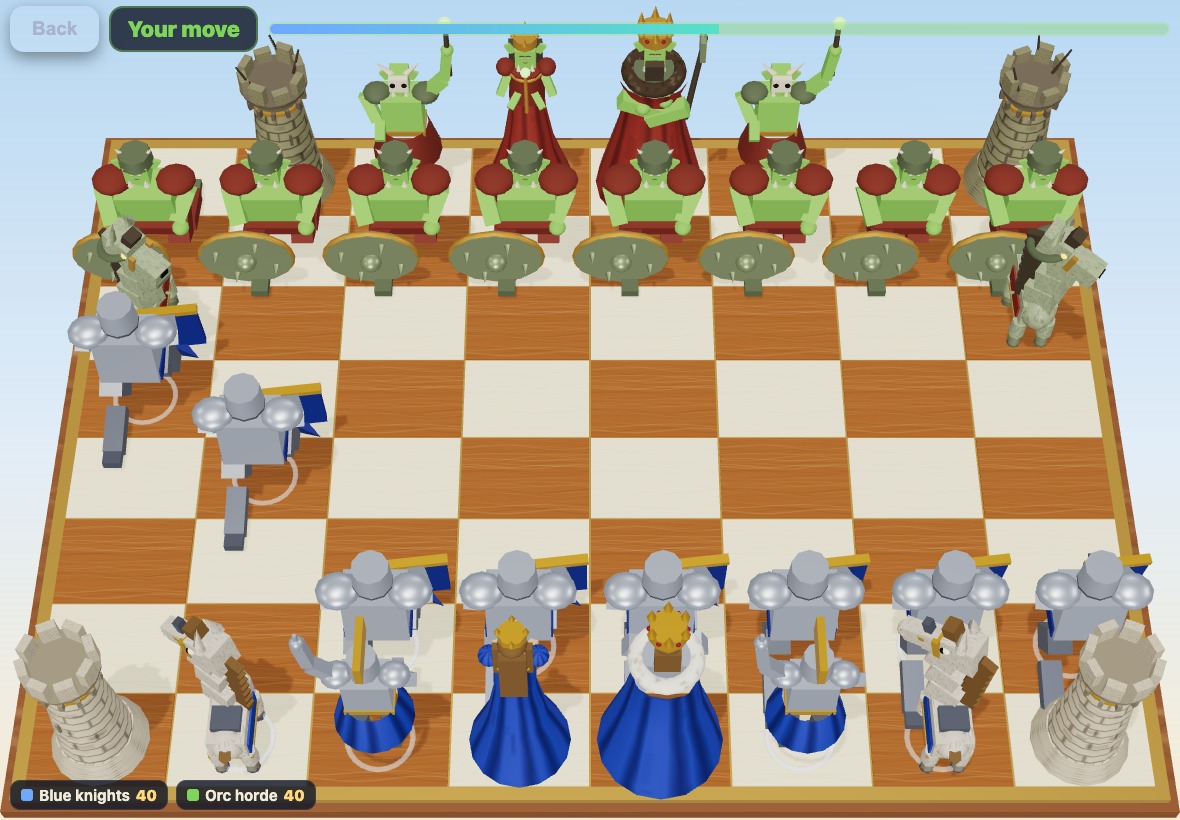
Mini chess here is a game you play, not a set you buy — it runs free in the browser, with nothing to order and nothing to install. The board is the 5×5 one Martin Gardner proposed: king, queen, rook, bishop, knight and five pawns a side.
Everything real chess has, on a board a child can take in at one look. 80 levels teach one idea at a time — how each piece moves and captures, promotion, mate in one, mate in two, the pin — and only then come whole games against an opponent that plays honestly. A game runs 15–25 moves, so the plan made at the start is still remembered at the end.
How to play
- Tap your piece — the squares it can reach light up.
- Tap a square to move; a square with an enemy piece on it is a capture.
- The task is written above the board: capture, promote, or mate.
- A pawn that reaches the far row turns into a queen.
- A wrong move is taken back with a word about why, not a buzzer.
What your child learns
- How every chess piece moves and captures
- Checkmate in one move and in two
- The fork and the pin — the first real tactics
- Thinking one move ahead: what will the other side answer?
- Reading a whole position at a glance, because 5×5 fits in one look
The science behind the games
Every Dad4Kids game is built on one simple truth: children want to play, not study — so we turn learning into a game worth replaying. The method draws on peer-reviewed research in game-based learning, motivation, and how memory works.
- Prins et al. (2013). “Braingame Brian”: toward an executive function training program with game elements. Games for Health Journal.
- Tokac et al. (2019). Effects of game-based learning on students' mathematics achievement: A meta-analysis. Journal of Computer Assisted Learning.
- Alotaibi (2024). Game-based learning in early childhood education: a systematic review and meta-analysis. Frontiers in Psychology.
- Lampropoulos & Sidiropoulos (2024). Impact of gamification on students' learning outcomes and academic performance: a meta-analysis. Education Sciences.
- Taylor & Boyer (2019). Play-based learning: evidence-based research to improve children's learning experiences. Early Childhood Education Journal.
- Gottfried (1990). Academic intrinsic motivation in young elementary school children. Journal of Educational Psychology.
FAQ
Do I need to buy a mini chess set?
No. This is the game itself, free in any browser on a phone, tablet or computer — no board to order, no registration, no downloads.
How is a 5×5 board different from ordinary chess?
The pieces and their moves are the same. There is no castling, no en passant and no two-square first pawn move, and each side has five pawns instead of eight. A whole game lasts 15–25 moves, so a child finishes it and sees how the plan ended.
What age is it for?
From 6. Level 1 asks for a single capture and shows the rule by highlighting the squares; full games start only after the pieces and the first tactics have been learned.
Does it help with real chess?
Yes. The fork, the pin and mate in two are the same ideas as on the big board — here they happen on a field the child can hold in their head, so they are seen instead of memorised.
More free games for kids
By Evgeny Arsentiev, PhD · Last updated: September 2026