
Counting Coins: Pennies, Nickels, Dimes and Quarters
Games
-
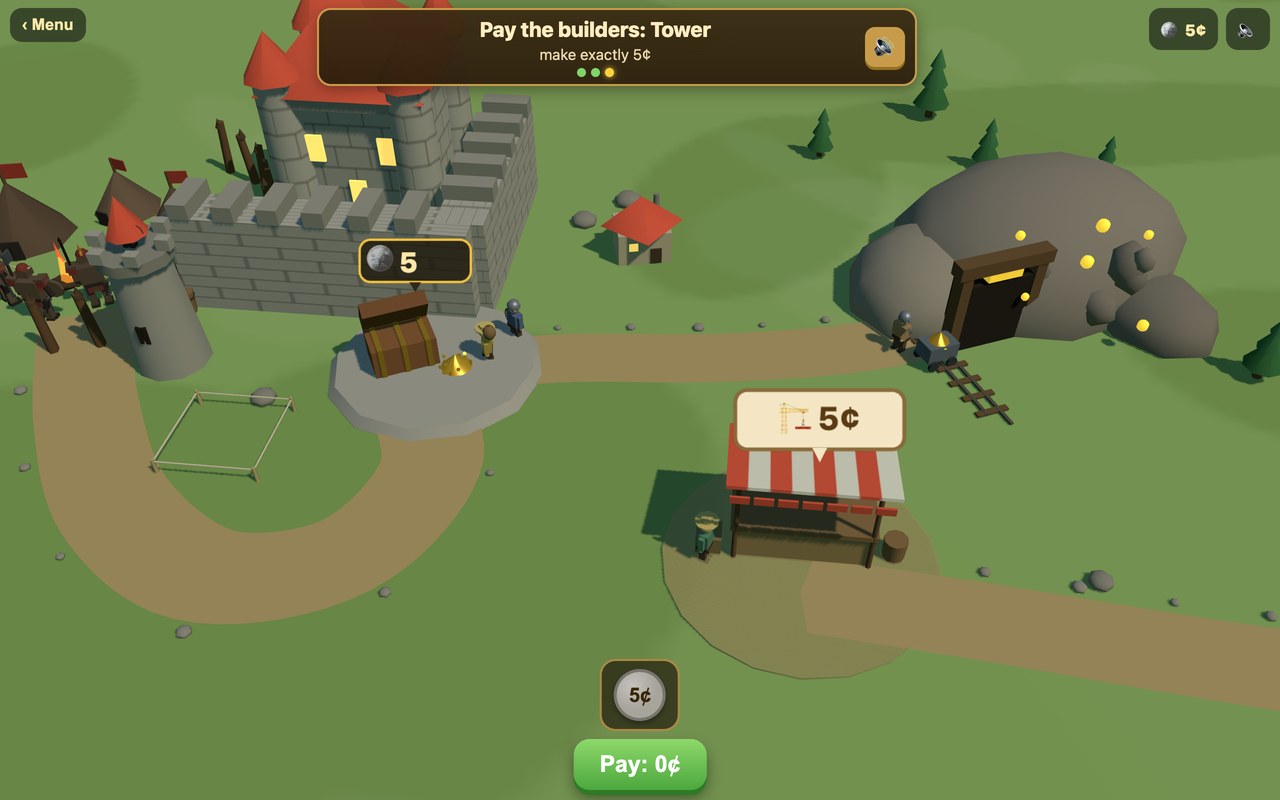 Counting Money — Free Treasury Keep Game for Kids 7+
Counting money in a treasury: add up the coins, compare two prices, make an …
-
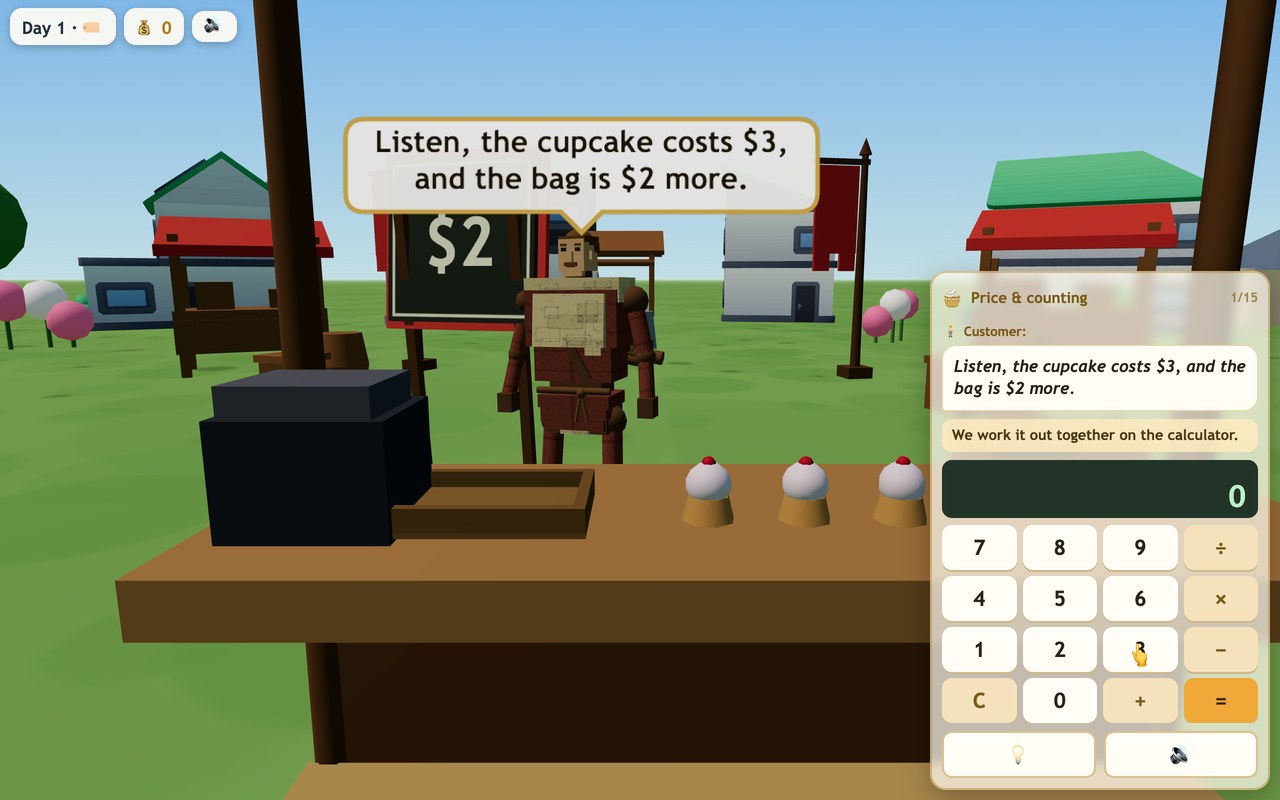 Business Game for Kids — Free Venture City 7+
Business games for kids built on real money math: use the built-in calculator to …
-
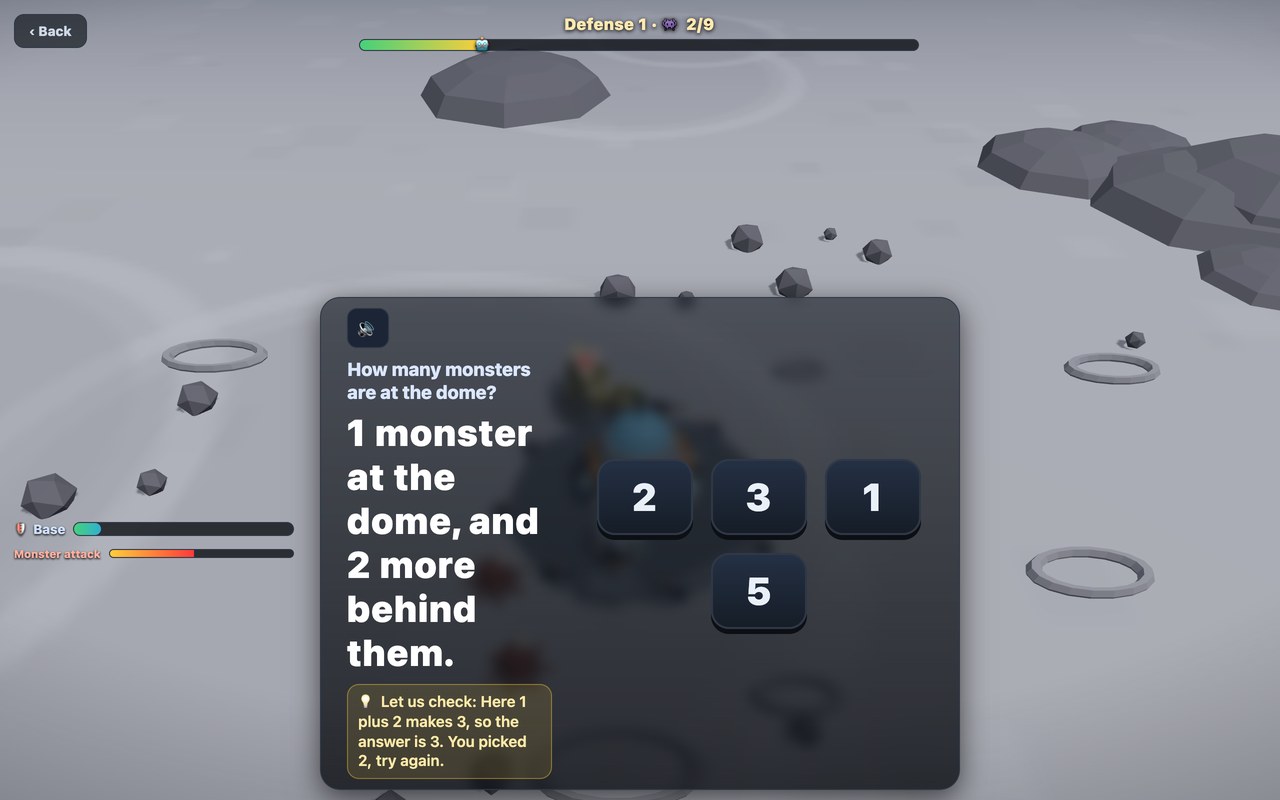 Math Games for 2nd Graders — Free Moon Base Defence 7+
Math games for 2nd graders: monsters rush the moon base and only a correct …
-
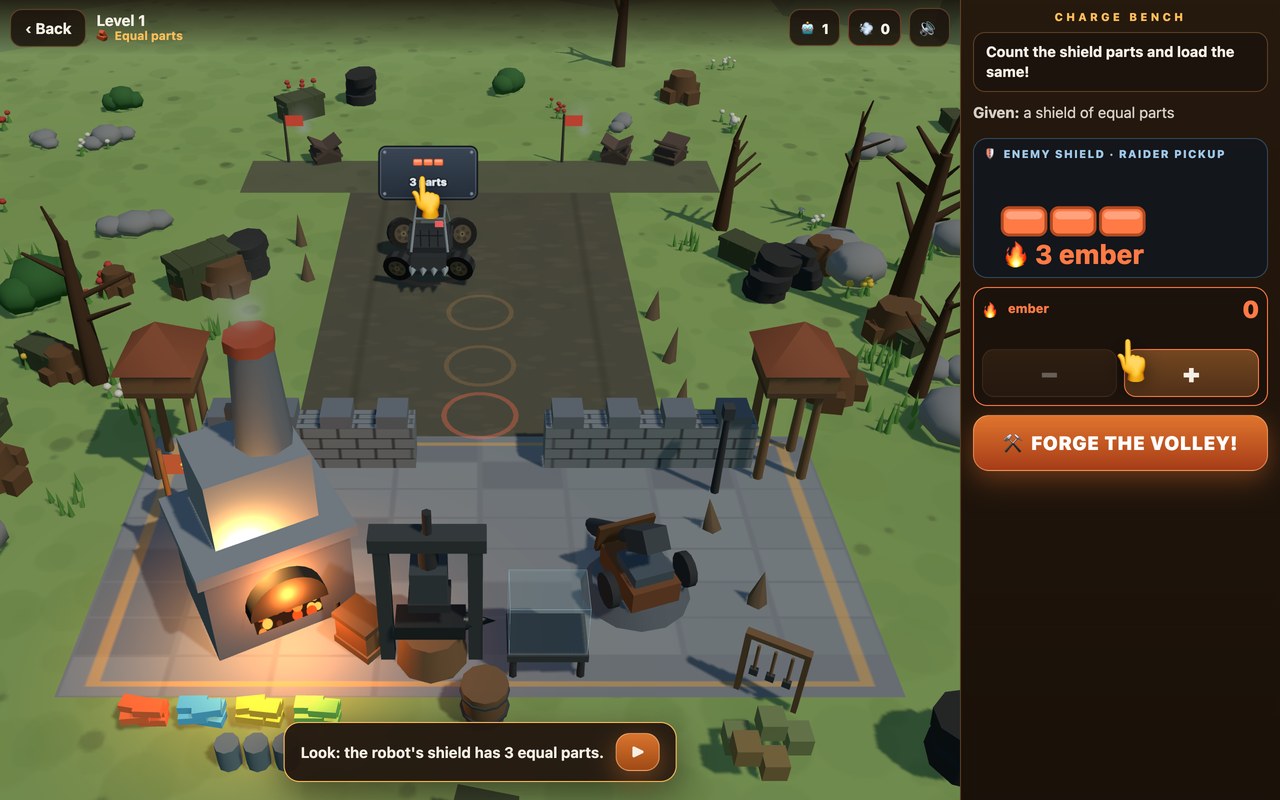 Ratio & Proportion Games for Kids — Free Ratio Forge 9+
Ratio games for kids where the math is the weapon: use ratios, unit rates …
Counting coins is the first place a child meets a hard idea: a small object can be worth more than a big one. A dime is smaller than a nickel and worth twice as much. Nothing in a child's experience prepares them for that, so it has to be said out loud.
The four values. Penny 1¢, nickel 5¢, dime 10¢, quarter 25¢. Learn them by value in that order, not by appearance — appearance is what causes the dime problem.
The method that works: count on from the largest. Given a quarter, two dimes and three pennies, a child who counts in the order the coins happen to lie will get lost. Sorted largest first, it becomes: 25 … 35, 45 … 46, 47, 48. Two rules only — sort, then count on.
Skip counting is the hidden prerequisite. Counting a pile of nickels is counting by fives; a pile of dimes is counting by tens; quarters are 25, 50, 75, 100. A child who cannot skip count fluently will count coins one at a time and get them wrong.
Making a dollar. Four quarters, ten dimes, twenty nickels, or any mix. This is where money quietly teaches number bonds to 100 — and it is far more motivating than a worksheet of "what makes 100".
Giving change, the step most curricula rush. Change is not subtraction, it is counting up: the item costs $3.40, you paid $5, so count 3.50, 4.00, 5.00 — a dime, then two dollars. Shopkeepers have counted up for centuries because it is easier, and children find it easier too.
The games below use real prices and real coins on screen. Related: 2nd grade math games, math word problems, reading a clock and games for 7 year olds.
The science behind the games
Every Dad4Kids game is built on one simple truth: children want to play, not study — so we turn learning into a game worth replaying. The method draws on peer-reviewed research in game-based learning, motivation, and how memory works.
- Tokac et al. (2019). Effects of game-based learning on students' mathematics achievement: A meta-analysis. Journal of Computer Assisted Learning.
- Alotaibi (2024). Game-based learning in early childhood education: a systematic review and meta-analysis. Frontiers in Psychology.
- Lampropoulos & Sidiropoulos (2024). Impact of gamification on students' learning outcomes and academic performance: a meta-analysis. Education Sciences.
- Taylor & Boyer (2019). Play-based learning: evidence-based research to improve children's learning experiences. Early Childhood Education Journal.
- Gottfried (1990). Academic intrinsic motivation in young elementary school children. Journal of Educational Psychology.
- Yang et al. (2018). Enhancing learning and retrieval of new information: a review of the forward testing effect. npj Science of Learning.
By Evgeny Arsentiev, PhD · Last updated: August 2026