
Three Player Chess — Free 3 Player Chess Online 7+
 New from Dad4Kids
Clean YouTube for kids
For families with traditional values, hand-picked by parents.
Open →
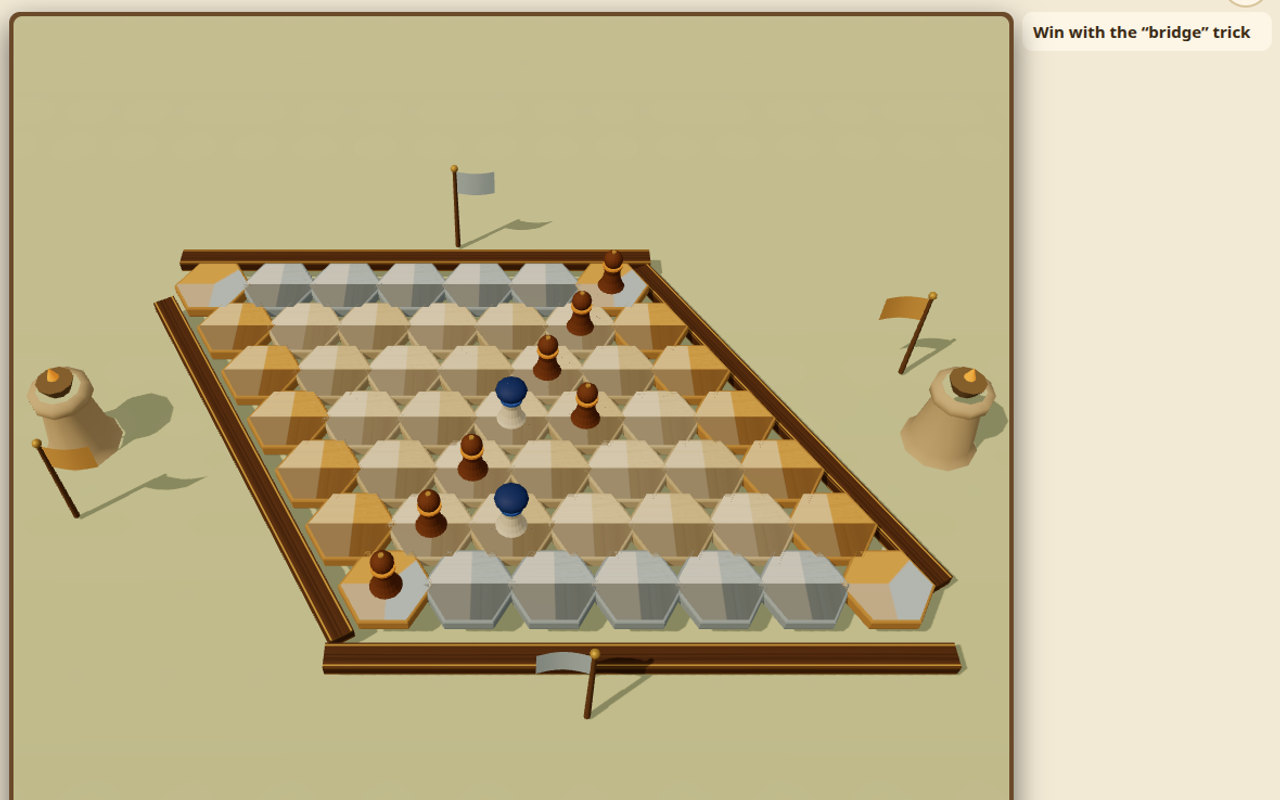
Three player chess on one board, in your browser, free. Three armies stand on a wide 16x12 field: the giant’s horde along the north edge with thirty-two pieces, and two small armies of twelve at the south — blue knights on the left, copper dwarves on the right.
The main mode is two of us against the giant: a parent and a child play on the same tablet, taking turns, hitting the huge army from two sides at once. Guard both kings — if either one is checkmated, the giant has won.
The second mode is every side for itself: three equal armies of sixteen, no alliances, last army standing takes the board.
The pieces move exactly as in ordinary chess, and the game explains each one out loud before it asks for a move. Choose your rival on three big cards, and he quietly tunes himself to how you play.
How to play
Tap one of your pieces — the game names it aloud and lights up every square it may reach. Tap a square to move. Green dots are quiet moves, red rings are captures. A red ring around your king means he is under attack and must be saved. Checkmate an army and it leaves the board.
What your child learns
Ordinary chess trains calculation against one opponent. Three-player chess adds the thing a board rarely teaches: who to hit first. In team mode a parent and a child must coordinate two armies with one shared defeat condition — real cooperation, not taking turns at the same puzzle.
More chess: 4 player chess on a cross-shaped board where four armies fight at once, battle chess for kids — ordinary 8×8 chess with the full rules and pieces that fight when they capture — and viking chess (hnefatafl).
The science behind the games
Every Dad4Kids game is built on one simple truth: children want to play, not study — so we turn learning into a game worth replaying. The method draws on peer-reviewed research in game-based learning, motivation, and how memory works.
- Prins et al. (2013). “Braingame Brian”: toward an executive function training program with game elements. Games for Health Journal.
- Tokac et al. (2019). Effects of game-based learning on students' mathematics achievement: A meta-analysis. Journal of Computer Assisted Learning.
- Alotaibi (2024). Game-based learning in early childhood education: a systematic review and meta-analysis. Frontiers in Psychology.
- Lampropoulos & Sidiropoulos (2024). Impact of gamification on students' learning outcomes and academic performance: a meta-analysis. Education Sciences.
- Taylor & Boyer (2019). Play-based learning: evidence-based research to improve children's learning experiences. Early Childhood Education Journal.
- Gottfried (1990). Academic intrinsic motivation in young elementary school children. Journal of Educational Psychology.
FAQ
How does chess work with three players?
Three armies share one wide board, each with its own forward direction for its pawns. Everything else is ordinary chess: the same moves, check, and checkmate. A checkmated army leaves the board.
Is it fair if one side has 32 pieces?
Yes, and that is measured, not guessed. Bot-versus-bot simulations over twenty thousand games settled the setup: the giant with 32 against two allies of 12 each wins about half the time — the allies move twice per round, so the giant needs the extra material.
Can a parent and a child play together on one tablet?
That is the main mode. Two live players take turns on the same device against one bot; the game says whose move it is.
Does it work on a tablet?
Yes, landscape — the board is wide, and the game politely asks you to turn the tablet if you hold it upright.
More free games for kids
By Evgeny Arsentiev, PhD · Last updated: September 2026