
Traffic Jam Puzzle — Free Logic Game for Kids 5+
 New from Dad4Kids
Clean YouTube for kids
For families with traditional values, hand-picked by parents.
Open →
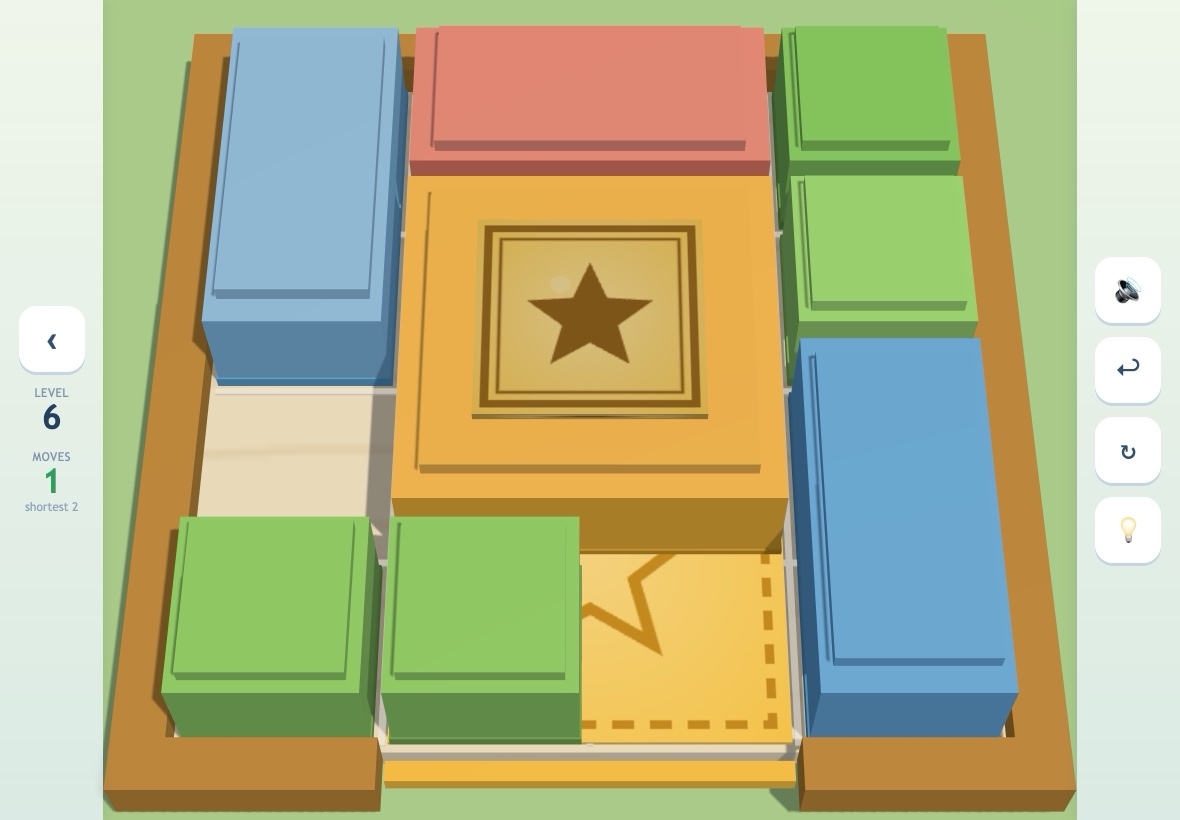
This traffic jam game is the classic “rush hour” sliding puzzle rebuilt as a cozy 3D city diorama. A little parking lot is jammed with cars, buses, tankers and even an ice-cream van. Each vehicle slides only along its own lane — and the child’s job is to think ahead and free the glowing red car so it can drive out of the gate.
The 500 levels are not random: they are picked from the complete mathematical database of solvable positions, so difficulty grows perfectly smoothly — from 1-move warm-ups for a five-year-old to 48-move monsters that make grown-ups sweat. Twenty themed districts change the scenery: sunset boulevard, snowy streets, neon nights, seaside pier, candy city…
The move counter shows the shortest possible solution for every level, three stars mean you matched it — real motivation to plan, not poke. Undo is free, thinking time is unlimited, and the hint (which caps the score at two stars) shows WHICH car to move but never solves the puzzle for you.
How to play
Drag any car forward or back along its lane — vehicles never turn. Clear a path for the red car and slide it right, through the gate. Fewer moves — more stars: match the shortest solution for three. Stuck? Undo any move, restart the level, or take a hint that shows which car to nudge next.
What your child learns
This is pure logic training disguised as play: planning several moves ahead, mentally simulating consequences, decomposing a blocked goal into sub-goals (“to move the bus, first move the taxi”), and optimizing a found solution down to the minimum — the exact skills behind math word problems and chess. Difficulty rises one notch per level across 500 levels, so the child is always challenged and never overwhelmed.
The science behind the games
Every Dad4Kids game is built on one simple truth: children want to play, not study — so we turn learning into a game worth replaying. The method draws on peer-reviewed research in game-based learning, motivation, and how memory works.
- Prins et al. (2013). “Braingame Brian”: toward an executive function training program with game elements. Games for Health Journal.
- Tokac et al. (2019). Effects of game-based learning on students' mathematics achievement: A meta-analysis. Journal of Computer Assisted Learning.
- Alotaibi (2024). Game-based learning in early childhood education: a systematic review and meta-analysis. Frontiers in Psychology.
- Lampropoulos & Sidiropoulos (2024). Impact of gamification on students' learning outcomes and academic performance: a meta-analysis. Education Sciences.
- Taylor & Boyer (2019). Play-based learning: evidence-based research to improve children's learning experiences. Early Childhood Education Journal.
- Gottfried (1990). Academic intrinsic motivation in young elementary school children. Journal of Educational Psychology.
FAQ
Is it really about logic, not luck?
Yes. Every level is a strict logical puzzle with a known shortest solution. The star system rewards planning: three stars are only given for solving in the minimum number of moves.
My child is 5 — too hard?
The first chapters are gentle 1–6 move puzzles with just a few cars. Difficulty grows so smoothly across 500 levels that the game fits ages 5 to adult.
What if the child gets stuck?
Undo is unlimited, restart is instant, and the hint highlights which vehicle to move next — it nudges thinking instead of solving the level.
Is it free?
Yes — free, no ads, right in the browser. Works great with a finger on tablets and phones.
More free games for kids
By Evgeny Arsentiev, PhD · Last updated: September 2026