
Types of Angles: Acute, Right, Obtuse — and How to Measure Them
Games
-
 Geometry Games for Kids — Free Angle Assault 8+
Geometry games for kids where the answer is the attack: measure angles, name shapes, …
-
 Area and Perimeter — Free Geometry Game for Kids 6+
Area and perimeter on a building grid: fence the yard, floor the warehouse, then …
-
 Geometry Games for Kids — Free Mars Rover 6+
Geometry for kids inside a Mars adventure: neon figures, cube builds and giant gears …
-
 Circumference of a Circle: Formula, Pi and Worked Examples 8+
The circumference of a circle is C = 2πr (or πd). See where pi …
-
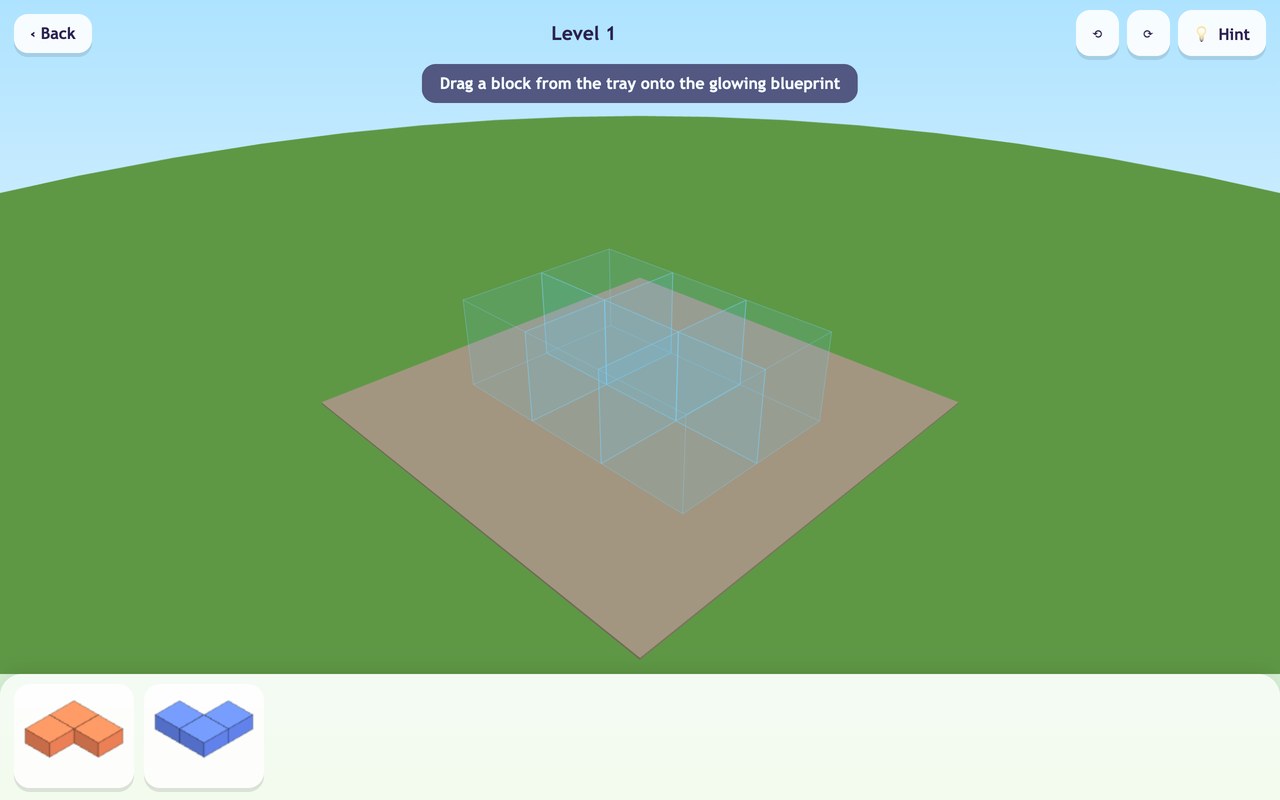 3D Block Puzzles for Kids — Free Castle Keep 3D 6+
3D block puzzles for kids aged 6+: rotate polycube blocks in your mind, fill …
-
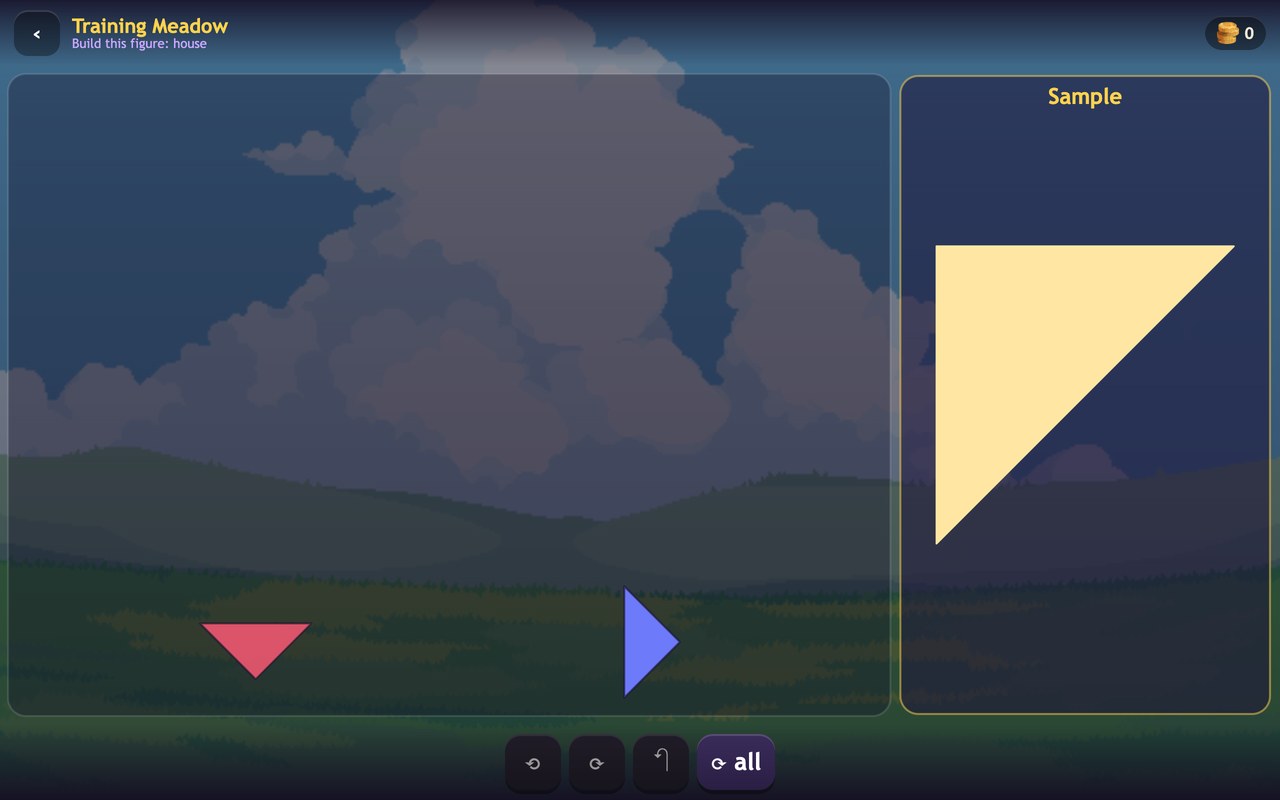 Tangram Puzzles for Kids — Free Castle Tangram 5+
Tangram puzzles for kids inside a castle-defense adventure: build the silhouette from the 7 …
-
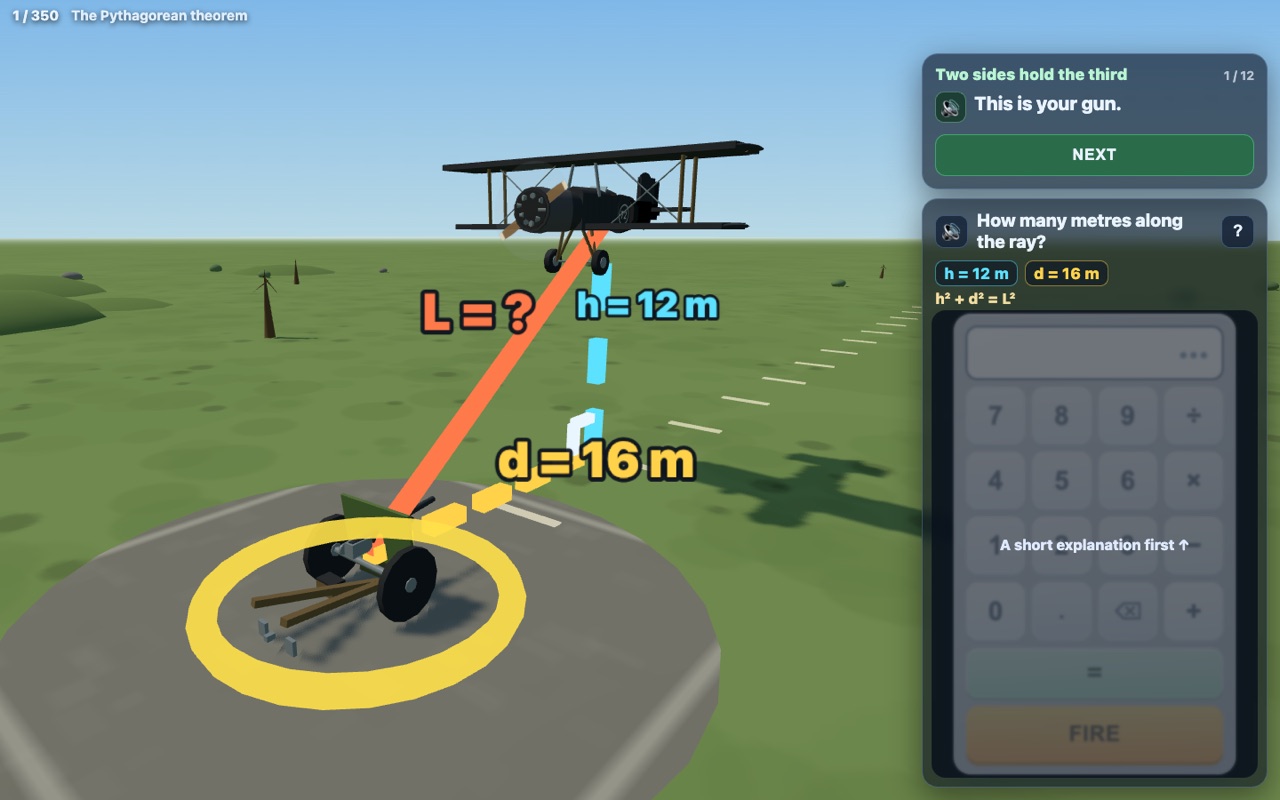 Pythagorean Theorem and Trigonometry — Explained, With a Free Game 10+
The Pythagorean theorem is a² + b² = c²: worked examples for the hypotenuse …
An angle is not a corner. An angle is an amount of turn — and once a child hears it that way, the whole topic stops being vocabulary and starts making sense. Stand facing the door, turn until you face the window: that is an angle, and the length of your arms had nothing to do with it.
The five names, in the order they are worth learning.
Right angle — exactly 90°. The corner of a book, a window, a floor tile. Learn this one first, because every other angle is described by comparison with it.
Acute — less than 90°. A sharp, narrow angle: a slice of pizza, the tip of a letter A.
Obtuse — between 90° and 180°. An open, blunt angle: a reclining chair, an open laptop pushed too far back.
Straight — exactly 180°. A half turn. It looks like a line, which is why children miss it.
Reflex — more than 180°. The outside of an angle, the long way round.
The protractor trap. A protractor has two number scales running in opposite directions, and children read the wrong one roughly half the time. The cure is not care, it is estimation: before reading any number, decide whether the angle is bigger or smaller than a right angle. If it is clearly acute and the protractor says 130°, the child now catches their own mistake without you.
Two facts that do most of the work later. Angles on a straight line add to 180°. Angles round a point add to 360°. With those two, a child can find a missing angle in most primary diagrams without any new rule.
The games below make the angle do something: a shot only lands if the angle is right, so an error is visible instead of marked. Related: ordered pairs and the coordinate plane, customary units and measuring, tangram puzzles and learning games for 4th graders.
The science behind the games
Every Dad4Kids game is built on one simple truth: children want to play, not study — so we turn learning into a game worth replaying. The method draws on peer-reviewed research in game-based learning, motivation, and how memory works.
- Tokac et al. (2019). Effects of game-based learning on students' mathematics achievement: A meta-analysis. Journal of Computer Assisted Learning.
- Alotaibi (2024). Game-based learning in early childhood education: a systematic review and meta-analysis. Frontiers in Psychology.
- Lampropoulos & Sidiropoulos (2024). Impact of gamification on students' learning outcomes and academic performance: a meta-analysis. Education Sciences.
- Taylor & Boyer (2019). Play-based learning: evidence-based research to improve children's learning experiences. Early Childhood Education Journal.
- Gottfried (1990). Academic intrinsic motivation in young elementary school children. Journal of Educational Psychology.
- Yang et al. (2018). Enhancing learning and retrieval of new information: a review of the forward testing effect. npj Science of Learning.
By Evgeny Arsentiev, PhD · Last updated: August 2026