
Engineering Games — Free Systems Engineer: Fix the World 7+
 New from Dad4Kids
Clean YouTube for kids
For families with traditional values, hand-picked by parents.
Open →
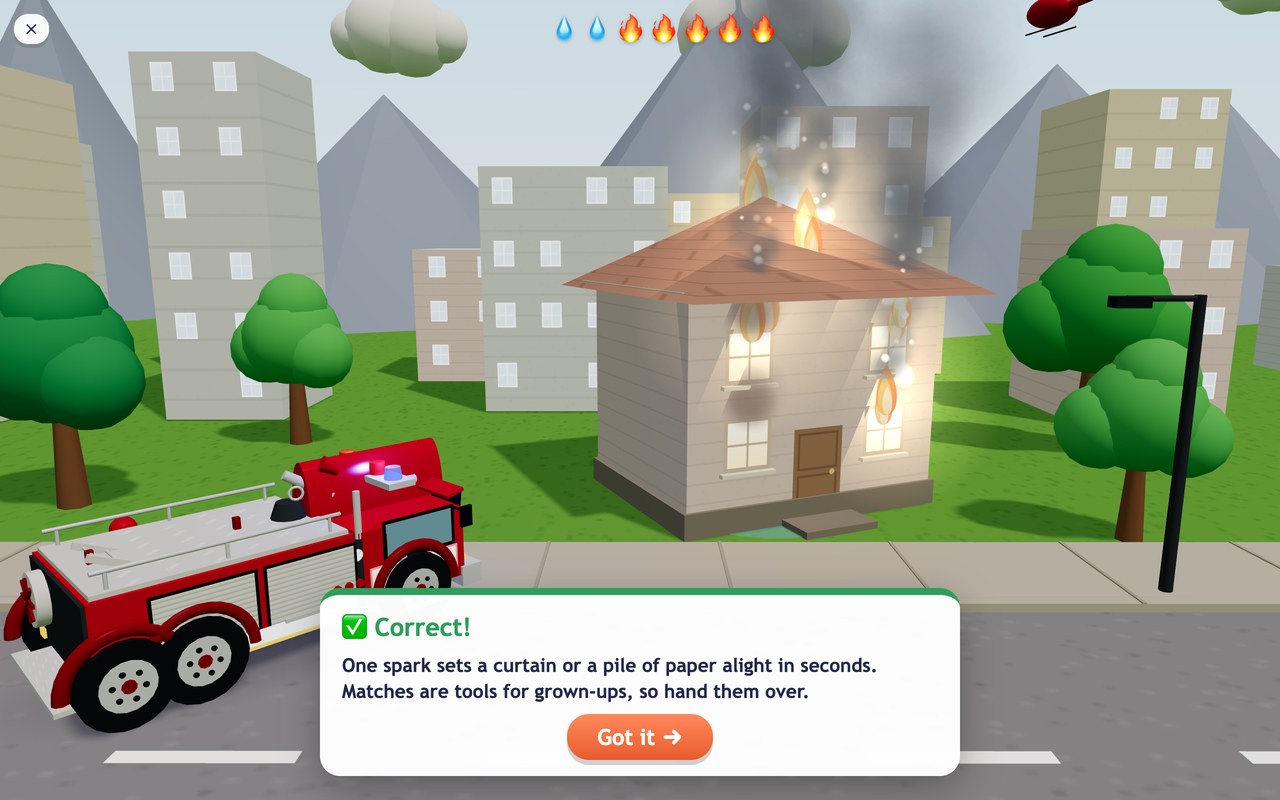
Systems Engineer: Fix the World is a set of engineering games for kids: a broken 3D city seen from above, where nine everyday systems need repair. A crane waits by a warehouse full of candidate parts; it only installs one after the child picks the part that actually fits.
Thirteen kinds of engineering reasoning keep the 100 missions fresh: matching a part to the gap it must fill, adding pieces to complete a span, splitting a load into equal sections, subtracting what a bracket already covers, multiplying outlets by houses served, matching by a reference length, sorting pipes by colour and network, tracing a line to the house that went dark, following a chain of connections to the one closed valve, and reading a growing pattern of mast heights. No number ever appears on screen — every quantity is counted straight from the scene, so scanning for a printed digit never works.
How to play
Before each new kind of mission the game gives a short plain-language explanation, then checks understanding with a picture-only quiz — no digits, just count what you see. Only a correct answer opens the warehouse. Pick a part, the crane installs it, and the simulation answers honestly: fixed or not, with a reason why. A wrong first pick gets an unforced, explained retry with no direction given away; a second miss adds a gentle hint (shorter, longer, more) so the child reasons toward the fix instead of re-guessing.
What your child learns
Real engineering-flavoured reasoning built into hands-on repair: composing a length from parts, subtracting an already-covered section to find what's left (with an honest overshoot trap), multiplying outlets by houses served, dividing a span into equal sections, matching against a reference unit, classifying by colour and network, reading a growing sequence, and tracing a single chain of cause and effect to the one closed valve. All 100 levels sit on one continuous difficulty ladder — no separate age tiers, and no number is ever printed in the world or the text, so nothing can be answered by spotting a digit instead of doing the reasoning.
The science behind the games
Every Dad4Kids game is built on one simple truth: children want to play, not study — so we turn learning into a game worth replaying. The method draws on peer-reviewed research in game-based learning, motivation, and how memory works.
- Prins et al. (2013). “Braingame Brian”: toward an executive function training program with game elements. Games for Health Journal.
- Tokac et al. (2019). Effects of game-based learning on students' mathematics achievement: A meta-analysis. Journal of Computer Assisted Learning.
- Alotaibi (2024). Game-based learning in early childhood education: a systematic review and meta-analysis. Frontiers in Psychology.
- Lampropoulos & Sidiropoulos (2024). Impact of gamification on students' learning outcomes and academic performance: a meta-analysis. Education Sciences.
- Taylor & Boyer (2019). Play-based learning: evidence-based research to improve children's learning experiences. Early Childhood Education Journal.
- Gottfried (1990). Academic intrinsic motivation in young elementary school children. Journal of Educational Psychology.
FAQ
What does my child actually learn from engineering games like this?
How to reason about real quantities inside an honest system: counting outlets, comparing lengths, splitting a load into equal shares, tracing a fault back to its cause. The crane only installs a part after a correct pick, and every level is built so a lucky guess can't pass.
Is it a puzzle where you tap the obvious answer?
No. No number is ever shown on screen, so the answer can't be read off a label — the child has to count houses, spans or notches in the scene itself, and a short picture-only quiz checks understanding before the warehouse even opens.
Does my child need to already know multiplication and division?
No — each of the 100 levels opens with a short explanation of that mission's reasoning before it's ever needed, and multiplication, division and subtraction all show up as physical counting (outlets per house, equal spans, remaining length) rather than written arithmetic.
More free games for kids
By Evgeny Arsentiev, PhD · Last updated: September 2026