
Story, Table & Graph Games — Free Modelverse Lab 8+
 New from Dad4Kids
Clean YouTube for kids
For families with traditional values, hand-picked by parents.
Open →
Modelverse Lab is a set of math games for 7th graders that trains the superpower behind maths, science, engineering and programming: seeing that one event can be shown many ways. A city tank leaks 6 litres per hour — that is a story, a sinking water line, a table, a downward graph and the equation V = 36 − 6×t all at once. The player matches models, builds missing tables and graphs point by point, finds the representation that lies, predicts future values and picks the best tool for each question.
Every mission lives inside an animated scene: reservoirs ripple, trains roll, conveyors carry crates, crystals hum. Correct model — the world visibly stabilises with fireworks; wrong model — Mira the holographic robot shows where the models disagree, softly, with another try. After three misses the answer glows with an explanation of why.
How to play
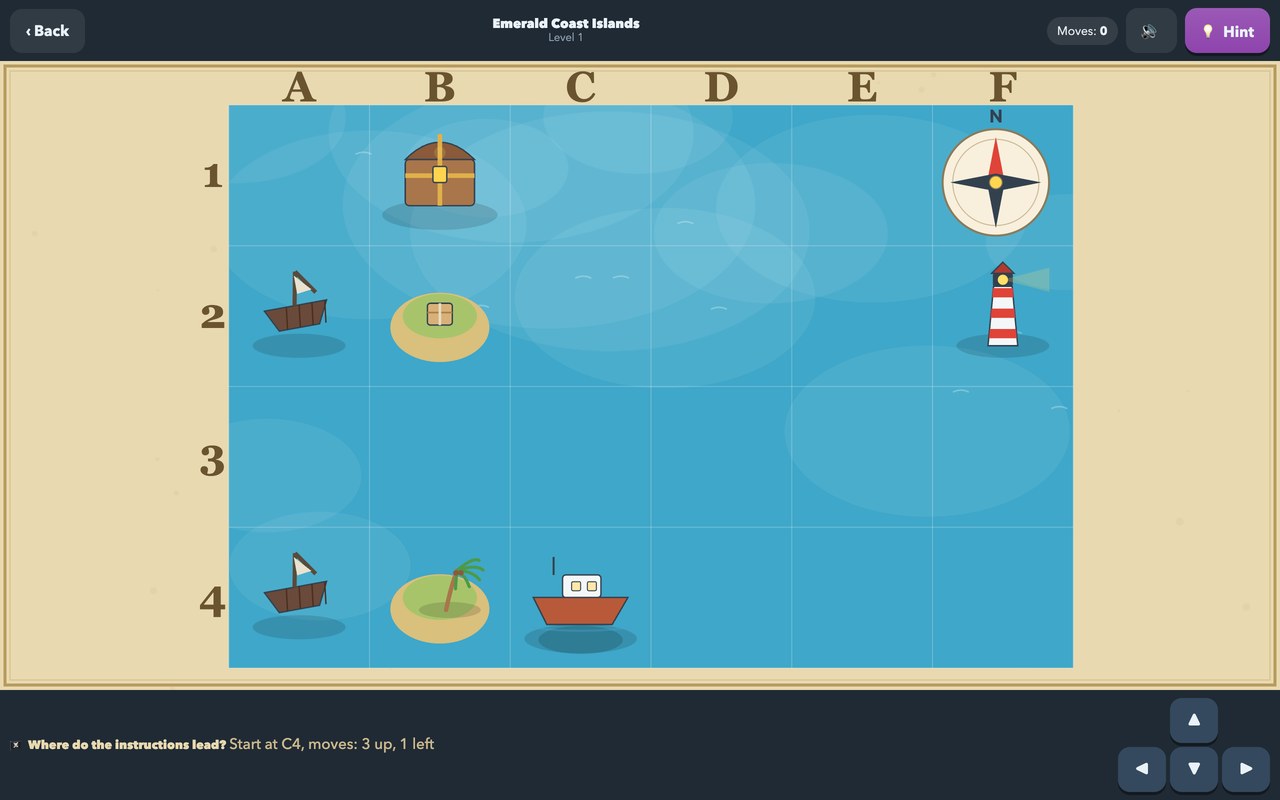
Listen to Mira's briefing (voiced, with subtitles and a slow mode), study the living scene, then act: tap the matching model, fill the table gap, place graph points column by column, mark the number line, trace the route on the map, pick the correct program, or hunt the impossible value in a data table. 20 worlds × 25 missions, a mega-mission every 25th, practice labs for weak skills and a parent dashboard.
What your child learns
Representation fluency across maths and science: story ↔ picture ↔ table ↔ graph ↔ number line ↔ equation ↔ map ↔ flow diagram ↔ code. Rates of change, prediction (“how much after 6 hours? when does it reach zero?”), input-output rules, coordinates, flow systems (time = volume ÷ rate), spotting misleading data. The game quietly adapts: whichever representation the child confuses appears more often until it clicks.
The science behind the games
Every Dad4Kids game is built on one simple truth: children want to play, not study — so we turn learning into a game worth replaying. The method draws on peer-reviewed research in game-based learning, motivation, and how memory works.
- Prins et al. (2013). “Braingame Brian”: toward an executive function training program with game elements. Games for Health Journal.
- Tokac et al. (2019). Effects of game-based learning on students' mathematics achievement: A meta-analysis. Journal of Computer Assisted Learning.
- Alotaibi (2024). Game-based learning in early childhood education: a systematic review and meta-analysis. Frontiers in Psychology.
- Lampropoulos & Sidiropoulos (2024). Impact of gamification on students' learning outcomes and academic performance: a meta-analysis. Education Sciences.
- Taylor & Boyer (2019). Play-based learning: evidence-based research to improve children's learning experiences. Early Childhood Education Journal.
- Gottfried (1990). Academic intrinsic motivation in young elementary school children. Journal of Educational Psychology.
FAQ
What are some fun bar graph activities in the game?
Missions ask the child to build a graph point by point from a living scene — a leaking water tower, a moving train — then read it back to predict what happens next, so the graph is never an abstract drawing exercise.
Is this a graphing drill?
No — every graph belongs to a living scene with a mission: save the dome's oxygen, get the rover home, stabilise the crystal mine. The child never plots abstract points; they repair worlds.
What ages is it for?
8–12. Early worlds use pictures and counting; later worlds reach equations, piecewise change, coordinates and code — difficulty rises smoothly over 500 missions.
More free games for kids
By Evgeny Arsentiev, PhD · Last updated: September 2026