
Chemistry for Kids: Atom Lab — Free Online 8+
 New from Dad4Kids
Clean YouTube for kids
For families with traditional values, hand-picked by parents.
Open →
Atom Lab turns real chemistry for kids into an adventure. Kids don't memorize formulas — they run experiments and defend their lab dome with the results. Baking soda plus vinegar fizzes into carbon-dioxide foam that puts out fire, just like a real extinguisher. Salt dissolves in water and melts ice. Soap grabs grease. Every one of the 25 short, spoken, tap-to-play lessons teaches one honest idea, then lets the child use it against a matching "substance monster". Chemistry that's true, safe, and genuinely fun.
Teach first, then defend the dome
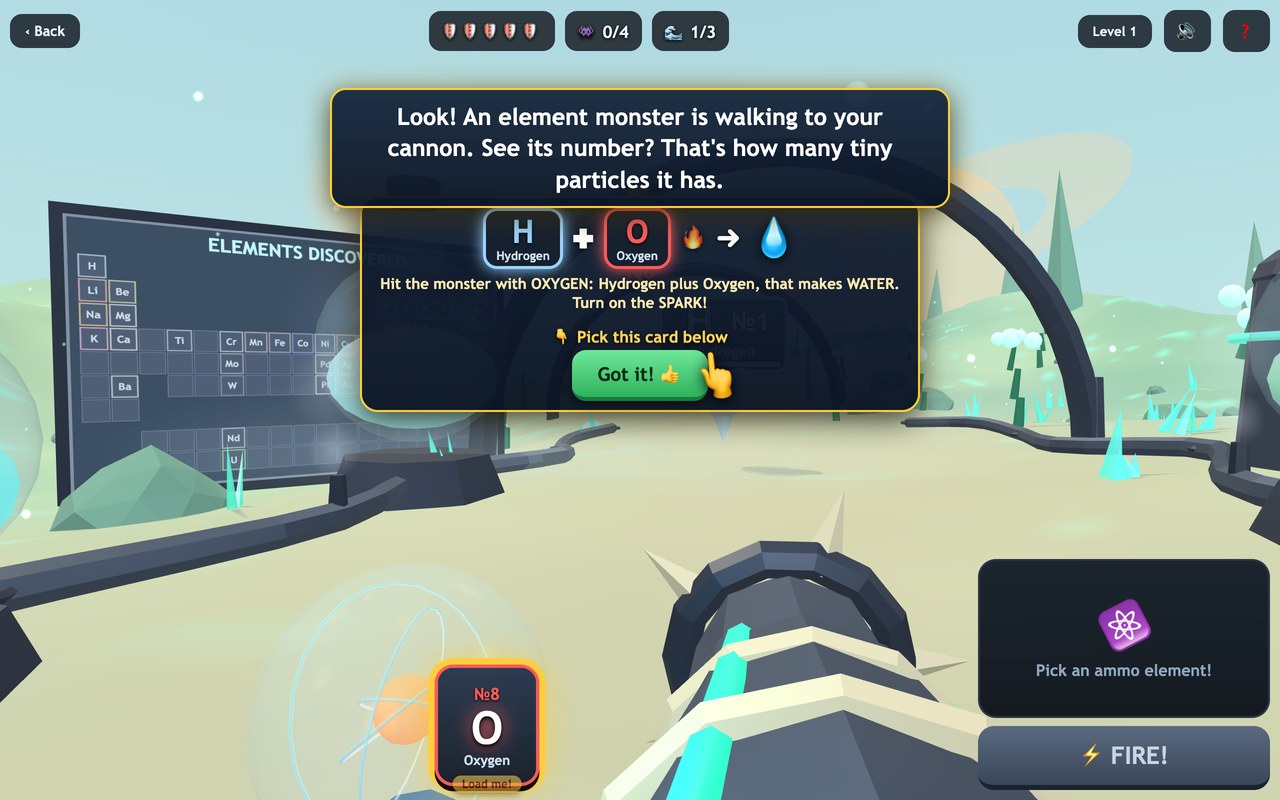
Open a chapter and it starts with a 30-second secret lesson you can touch: build a water molecule, watch salt dissolve, fizz baking soda in vinegar. Then a "substance monster" walks up and waits — no rushing. Drop one jar for a direct action ("splash water") or mix two different jars for a real reaction (baking soda + vinegar), press Mix, and the cauldron reacts and auto-fires at the monster with a real-world explanation. Clear the wave to defend the dome and earn up to 3 stars — 25 chapters × 20 levels = 500 defenses.
Real, age-appropriate chemistry
Dissolving vs. not dissolving; acids and bases; metals and rust; the fire triangle and real fire safety — including the golden rule: NEVER put water on burning oil, use sand, baking soda or a lid. Salt melts ice, ice floats because it's lighter than water, and mixtures can be separated back out. Every reaction and result in the game is real.
How to play
Open a chapter — it begins with a short hands-on lesson you touch (build a molecule, dissolve salt, fizz baking soda). A substance monster walks up and waits; the hint shows which jars to use and WHY it works in real life. Drop one jar for a direct action or mix two jars for a real reaction into the cauldron, then press Mix. The cauldron reacts, auto-fires at the monster, and you see the result plus a real-world explanation. Clear the wave to defend the dome and earn up to 3 stars.
What your child learns
Everything is made of atoms that join into molecules (H₂O, CO₂); dissolving vs. not dissolving; real reactions such as baking soda + vinegar → carbon-dioxide foam and plaster + water → stone; acids and bases; metals and rust; the fire triangle and real fire safety; salt melts ice; and why ice floats. Taught first with a hands-on lesson, then used in play.
The science behind the games
Every Dad4Kids game is built on one simple truth: children want to play, not study — so we turn learning into a game worth replaying. The method draws on peer-reviewed research in game-based learning, motivation, and how memory works.
- Tokac et al. (2019). Effects of game-based learning on students' mathematics achievement: A meta-analysis. Journal of Computer Assisted Learning.
- Alotaibi (2024). Game-based learning in early childhood education: a systematic review and meta-analysis. Frontiers in Psychology.
- Lampropoulos & Sidiropoulos (2024). Impact of gamification on students' learning outcomes and academic performance: a meta-analysis. Education Sciences.
- Taylor & Boyer (2019). Play-based learning: evidence-based research to improve children's learning experiences. Early Childhood Education Journal.
- Gottfried (1990). Academic intrinsic motivation in young elementary school children. Journal of Educational Psychology.
- Yang et al. (2018). Enhancing learning and retrieval of new information: a review of the forward testing effect. npj Science of Learning.
FAQ
Is the chemistry accurate?
Yes. Every reaction and result is real and age-appropriate — baking soda and vinegar really make carbon-dioxide foam, and water really is dangerous on an oil fire (the game teaches sand, baking soda or a lid instead).
What age is it for?
Ages 6-10 (grades 1-4). Lessons are spoken aloud and fully tap-based, so early readers can play too.
Do kids need to know any chemistry first?
No. Each chapter teaches its idea first with a short hands-on lesson, then the child uses it. Teach-first, no cramming.
Is it free and safe?
Free to play in the browser, no ads, no purchases. All experiments are simulated — nothing to mix at home unless a parent chooses to try the real, safe ones the game suggests.
Does my child need to type or read a lot?
No typing and no walls of text. Everything is tap-to-play with voiced narration and picture hints.
More free games for kids
By Evgeny Arsentiev, PhD · Last updated: September 2026