
Periodic Table Game for Kids — Free Atom Cannon 8+
 New from Dad4Kids
Clean YouTube for kids
For families with traditional values, hand-picked by parents.
Open →
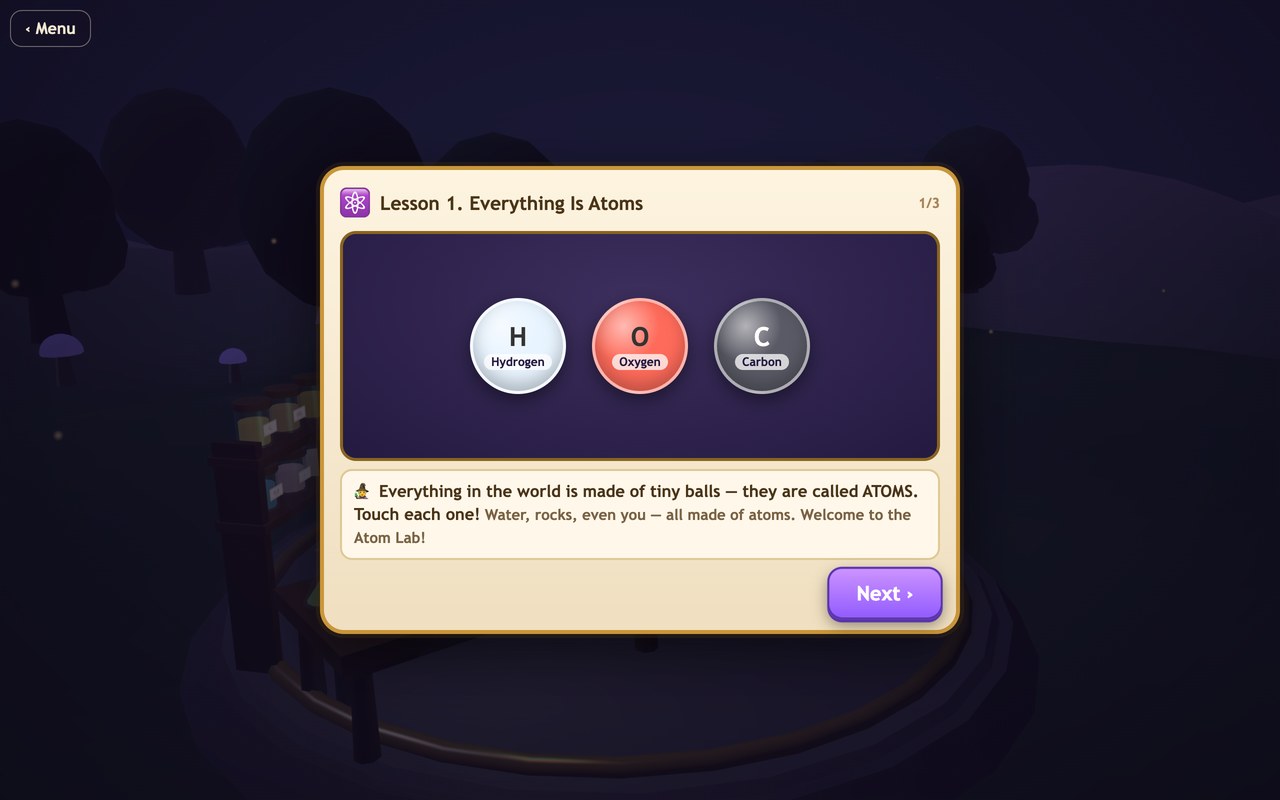
Atom Cannon is a periodic table game that puts the child behind a giant alien chemistry cannon. Across the strange valley march monsters made of elements — an iron golem, a mercury puddle, a sulfur slime — and each wears a big card: «№26 · Fe». The secret it teaches from the very first shot: an element is just a number — the number of protons in its nucleus — and people simply gave those numbers names like «oxygen» (№8) or «iron» (№26).
To beat a monster you load the cannon with an element that really reacts with it. Loading means building the atom yourself: a nucleus with Z protons appears, and you land electrons onto their shells one by one until the counter reads «8/8» and the atom lights up «LOADED». Pick the right mode — spark, heat or trap — fire, and a real reaction plays out: water quenches hydrogen, salt crystals bloom, mercury blackens into HgS, and the formula pops up big: «2H₂ + O₂ → 2H₂O 💧». 30 levels, shifting alien biomes and dozens of element monsters.
New to the idea that everything is built from tiny pieces? Start with what matter is and its states — solid, liquid and gas, then come back and build molecules here.
How to play
Read the monster's number to know which element it is, then pick from your ammo an element that reacts with it. In the loading panel on the right, build that atom: tap «+ electron» to drop electrons onto the shells until you have exactly the right number — too few or too many and the cannon gently nudges you. Choose a mode (🔥 spark, ♨ heat, 🕳 trap) and press FIRE. The right element and mode trigger a reaction and the monster is defeated in its own way; the wrong choice simply bounces off with no harm, and the monster keeps walking. Let one reach the cannon and you lose a shield — you have five.
What your child learns
The structure of the atom (a nucleus of protons ringed by electron shells), the idea that an element's place in the periodic table is simply its proton number, the names and symbols of real elements, and which elements actually react together — oxidation, salts, halogens, and why inert gases (helium, neon, argon) barely react at all and need trapping instead.
The science behind the games
Every Dad4Kids game is built on one simple truth: children want to play, not study — so we turn learning into a game worth replaying. The method draws on peer-reviewed research in game-based learning, motivation, and how memory works.
- Tokac et al. (2019). Effects of game-based learning on students' mathematics achievement: A meta-analysis. Journal of Computer Assisted Learning.
- Alotaibi (2024). Game-based learning in early childhood education: a systematic review and meta-analysis. Frontiers in Psychology.
- Lampropoulos & Sidiropoulos (2024). Impact of gamification on students' learning outcomes and academic performance: a meta-analysis. Education Sciences.
- Taylor & Boyer (2019). Play-based learning: evidence-based research to improve children's learning experiences. Early Childhood Education Journal.
- Gottfried (1990). Academic intrinsic motivation in young elementary school children. Journal of Educational Psychology.
- Yang et al. (2018). Enhancing learning and retrieval of new information: a review of the forward testing effect. npj Science of Learning.
FAQ
Is this really a periodic table game, or just a shooter?
It is both: every shot needs the right atom built first — counting protons and electrons onto their shells — so the child learns real periodic-table positions and reactions, not just aiming.
Is it scary?
No. The «enemies» are goofy cartoon element monsters — a rusty iron golem, a wobbly mercury puddle, sleepy glowing gas spirits — and no people are ever shown. Each one is defeated gently, in a chemistry way: it rusts and crumbles, blackens, flashes, or crystallises into salt.
Does my child need to know chemistry first?
No. The very first level explains everything it needs: an element is a number, and building an atom means placing that many electrons. Names and formulas are introduced slowly, one element at a time.
Is there any nuclear or explosion content?
No. Even the uranium monster (№92) is beaten purely by chemistry — oxidation and fluorides — with no nuclear mechanic at all. The «reactions» are ordinary chemistry: water, salts, rust and burning.
More free games for kids
By Evgeny Arsentiev, PhD · Last updated: September 2026