
Capitals of the World — Free Globe Game for Kids 7+
 New from Dad4Kids
Clean YouTube for kids
For families with traditional values, hand-picked by parents.
Open →
The capitals of the world are impossible to memorise from a list and surprisingly easy to learn from a globe that spins to the right part of the planet and waits. Ottawa means nothing next to Canberra on paper; on a globe they are on opposite sides of the world.
Name, capital, flag
Rounds rotate between three questions about the same countries — find it by name, find it by its capital city, find it by its flag — so a country is met from three directions before it is expected to stick.
The hints get taken away on purpose
Early levels in a zone light the country up and point an arrow at it. The next ones only outline it. The last ones give nothing at all. Fifty zones — Europe twice over, Asia, the Americas, Africa, Oceania and a final world round — 500 levels in all.
Free, in the browser
No download, no account, no ads. Every question is read aloud, and progress is saved on the device.
More science and geography for kids
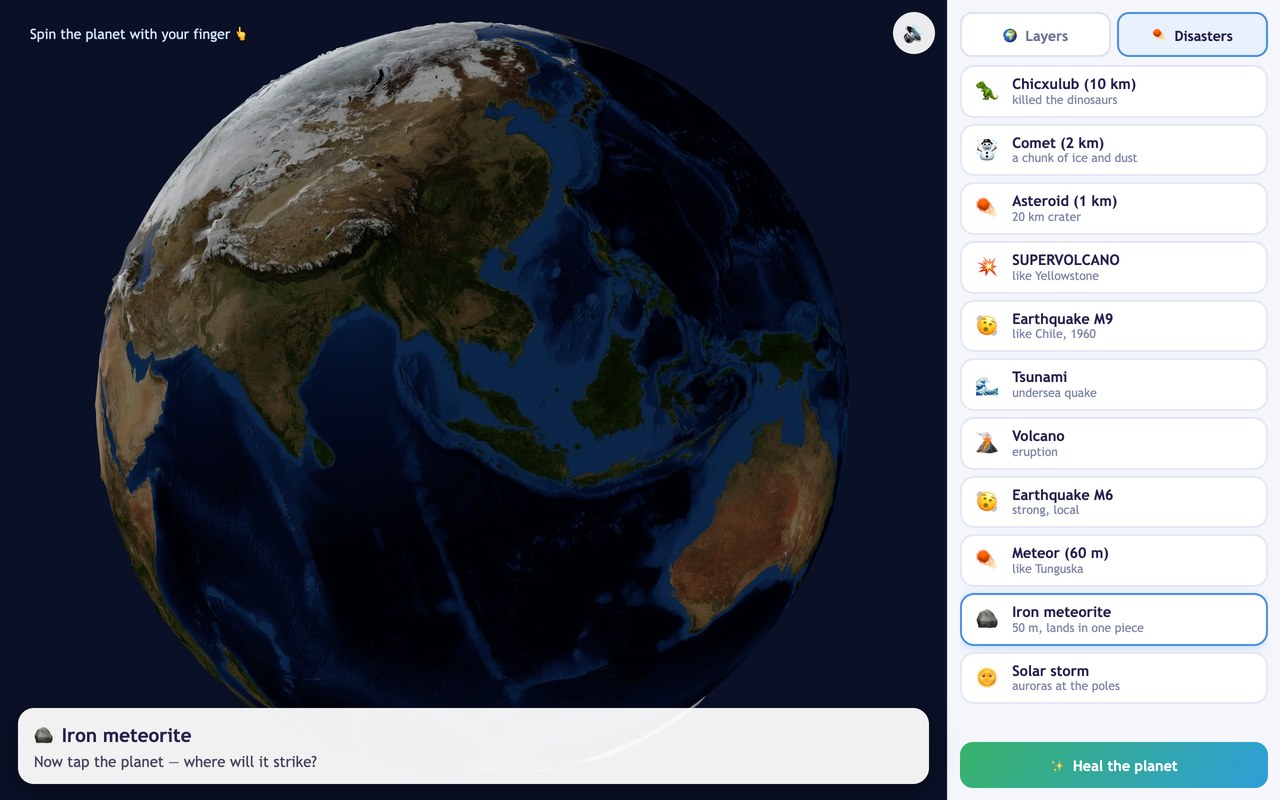
- layers of the earth — peel the planet apart, crust to inner core, in 3D
- human body systems — heart, lungs, gut, muscles and bones — with a question after each
- cardinal directions — north, south, east, west and grid squares on a treasure map
- water cycle game for kids — evaporation, clouds, rain and the whole water cycle
- food web game for kids — who eats whom, and what happens when a link disappears
How to play
Up top an alert shows where the missile is headed — a country name, its capital, or its flag. A few candidate countries are highlighted with pins on the globe. Spin the globe, find the right one and tap it — the interceptor from your shield base takes the missile down. Clear every missile in the level to win up to three stars.
What your child learns
Countries on the world map (80 countries across every continent), their capital cities and flags, and where the regions sit: Europe, Asia, the Americas, Africa and Oceania.
The science behind the games
Every Dad4Kids game is built on one simple truth: children want to play, not study — so we turn learning into a game worth replaying. The method draws on peer-reviewed research in game-based learning, motivation, and how memory works.
- Tokac et al. (2019). Effects of game-based learning on students' mathematics achievement: A meta-analysis. Journal of Computer Assisted Learning.
- Alotaibi (2024). Game-based learning in early childhood education: a systematic review and meta-analysis. Frontiers in Psychology.
- Lampropoulos & Sidiropoulos (2024). Impact of gamification on students' learning outcomes and academic performance: a meta-analysis. Education Sciences.
- Taylor & Boyer (2019). Play-based learning: evidence-based research to improve children's learning experiences. Early Childhood Education Journal.
- Gottfried (1990). Academic intrinsic motivation in young elementary school children. Journal of Educational Psychology.
- Yang et al. (2018). Enhancing learning and retrieval of new information: a review of the forward testing effect. npj Science of Learning.
FAQ
Is the map real?
Yes — it's Natural Earth, the real outlines of countries, the same as in atlases. The globe zooms to each level's region so the detail is clear.
What age is it for?
From age 7: the first zones are big European countries by name. Capitals and flags are added gradually, one mode at a time.
What if my child doesn't know the country?
There are only a few candidates and each has a pin with its flag, so kids can reason by elimination. A wrong tap does no damage — the country flashes and they simply try again.
Is it a twitch/arcade game?
No. The missile is held by the shield while your child thinks — the weapon only fires after the correct country is found. It rewards knowing geography, not fast reflexes.
Is the game free?
Yes — free, no ads, in the browser on a tablet or computer.
More free games for kids
By Evgeny Arsentiev, PhD · Last updated: September 2026