
Layers of the Earth — Free Interactive 3D Model 6+
 New from Dad4Kids
Clean YouTube for kids
For families with traditional values, hand-picked by parents.
Open →
The layers of the earth are usually met as a coloured circle in a textbook, which is why children remember the colours and not the depths. Here the planet is a real 3D globe and each layer comes off in your hand: satellites first, then the atmosphere, the clouds, the oceans, the crust, the mantle, the outer core and finally the solid inner core.
A model, not a quiz
Be clear about what this is: there are no levels and no questions. It is an instrument. Buttons strip a layer away, put it back, cut the planet open or switch to night, and every layer explains itself in plain words — the crust is a hard skin, about 5 km under the oceans and up to 70 km under the mountains, like the peel on an apple.
And then you can hit it with an asteroid
A second tab drops real catastrophes onto the model: the 10 km Chicxulub impact that ended the dinosaurs, a Yellowstone-scale supervolcano. That is usually the part that makes a child come back and take the crust off again.
Free, in the browser
No download, no account, no ads. Every question is read aloud, and progress is saved on the device.
More science and geography for kids
- human body systems — heart, lungs, gut, muscles and bones — with a question after each
- capitals of the world — spin the globe and find the country by name, capital or flag
- cardinal directions — north, south, east, west and grid squares on a treasure map
- water cycle game for kids — evaporation, clouds, rain and the whole water cycle
- food web game for kids — who eats whom, and what happens when a link disappears
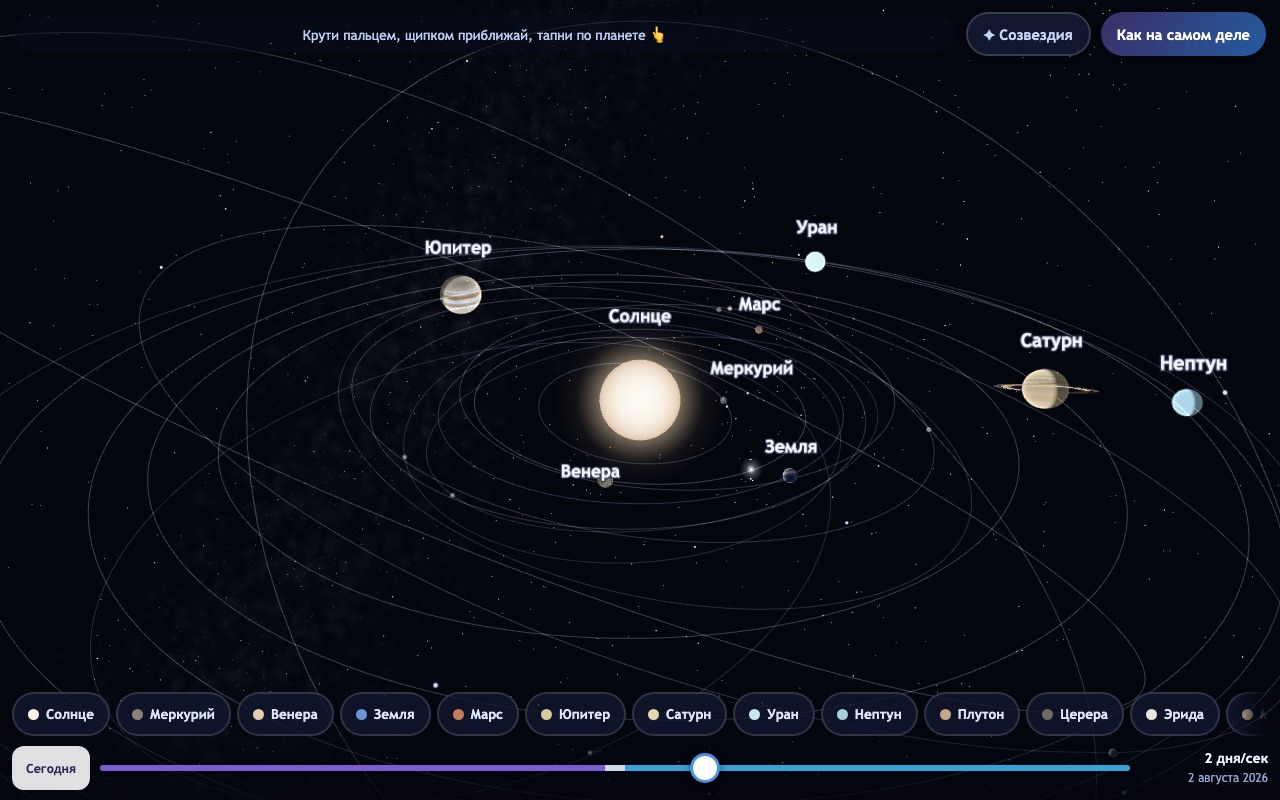
Related: the planets in order puts this planet among its neighbours, and what is matter goes the other way — down past the rock to the atoms it is built from.
How to play
Press Play, then drag the globe to spin it and use the wheel or pinch to zoom (a high-resolution NASA texture loads as you get close). On the right, the Layers tab lists the planet from the outside in — click “Remove layer” to strip one away and “Put back” to restore it; each layer is narrated aloud. “Cutaway” slices the planet open, “Night” shows city lights on the dark side. Switch to the Disasters tab, choose an event and tap the planet where it should strike — tsunamis need ocean, volcanoes need land, and the game explains why. Zoom out far enough and the Moon comes into view, lit by the same Sun, with correct phases.
What your child learns
This is the earth-science core of primary and middle school in one model: the internal structure of the Earth (crust, mantle, outer and inner core with real relative sizes), the thinness of the crust, plate tectonics as the cause of earthquakes and volcanoes, the origin of the geomagnetic field in the spinning liquid outer core, the shape of the ocean floor, and the mechanics of tsunamis — an undersea jolt pushing the whole water column, a wave that is invisible in deep water and grows at the shore. The disaster module teaches scale honestly: why a small meteor explodes in the air and leaves no crater, why an iron one survives to the ground, and why the Chicxulub impact of 66 million years ago killed the dinosaurs not by fire but by dust that hid the Sun.
The science behind the games
Every Dad4Kids game is built on one simple truth: children want to play, not study — so we turn learning into a game worth replaying. The method draws on peer-reviewed research in game-based learning, motivation, and how memory works.
- Tokac et al. (2019). Effects of game-based learning on students' mathematics achievement: A meta-analysis. Journal of Computer Assisted Learning.
- Alotaibi (2024). Game-based learning in early childhood education: a systematic review and meta-analysis. Frontiers in Psychology.
- Lampropoulos & Sidiropoulos (2024). Impact of gamification on students' learning outcomes and academic performance: a meta-analysis. Education Sciences.
- Taylor & Boyer (2019). Play-based learning: evidence-based research to improve children's learning experiences. Early Childhood Education Journal.
- Gottfried (1990). Academic intrinsic motivation in young elementary school children. Journal of Educational Psychology.
- Yang et al. (2018). Enhancing learning and retrieval of new information: a review of the forward testing effect. npj Science of Learning.
FAQ
Is the data real?
Yes. Surface imagery is NASA Blue Marble, the seafloor comes from GEBCO bathymetry, plate boundaries follow the standard Bird (2003) dataset, and layer radii use the accepted depths — crust ~35 km, mantle to 2891 km, outer core to 5150 km. Relief is exaggerated so it is visible on a globe; the game says so out loud.
Is it narrated?
Yes — every layer and every disaster is explained aloud in simple words, so children who cannot read yet can explore on their own. Sound can be muted.
What age is it for?
From about 6 for free exploration; the science content matches what is taught around grades 3–7, and adults enjoy it too.
Can the planet be restored after a disaster?
Yes. Craters, rifts, ash fields and floods stay visible so the consequences are clear, and one button — “Heal the planet” — removes them all.
Is it free?
Completely free, no ads and no purchases, straight in the browser on a computer or tablet.
More free games for kids
By Evgeny Arsentiev, PhD · Last updated: September 2026