
Properties of Logarithms — Explained, With a Free Practice Game 7+
 New from Dad4Kids
Clean YouTube for kids
For families with traditional values, hand-picked by parents.
Open →
The properties of logarithms all come from the one question a logarithm answers: how many times did you multiply a number by itself? Written out, log101000 = 3 says: to reach 1000 you multiplied ten three times (10 · 10 · 10). For base 10 there is an even shorter rule — the logarithm is the number of zeros. A million has six zeros, so log101,000,000 = 6.
Every one of the properties of logarithms grows out of that single idea. The big one: multiplying numbers turns into adding logarithms, log(x · y) = log x + log y — because zeros simply stack up. Below are all the rules with worked examples, and above is Order of Magnitude, a game where a child counts those «how many times» by eye: a starship's shield wears exactly as many glowing rings as its number has zeros.
What is a logarithm?
Take the number 100 and ask: how many times do I multiply 10 to get there? Twice — 10 · 10 = 100. That is the logarithm: log10100 = 2.
The number being multiplied is the base, written small and low. A base can be any positive number except 1 (multiplying 1 by itself gets you nowhere, so the question would have no answer). The two you meet most often are 10 and 2:
- log1010 = 1 — ten taken once;
- log10100 = 2, log101000 = 3, log101,000,000 = 6 — count the zeros;
- log28 = 3 — two multiplied three times: 2 · 2 · 2 = 8;
- log21024 = 10 — ten doublings land you near a thousand.
Logarithms and exponents are the same sentence read from opposite ends. 103 = 1000 says "here is what you get after multiplying ten three times." log101000 = 3 says "here is how many times you had to multiply to reach a thousand." That is why the logarithm is called the inverse of exponentiation.
One habit saves a lot of trouble later: you can only take the logarithm of a positive number. No amount of multiplying a positive base produces zero or a negative result, so "how many times to reach −5" simply has no answer.
The properties of logarithms
Throughout, a is the base (a > 0, a ≠ 1) and x, y are positive numbers.
- Product rule: loga(x · y) = logax + logay. Multiplication outside becomes addition inside.
- Quotient rule: loga(x / y) = logax − logay. Division becomes subtraction.
- Power rule: loga(xn) = n · logax. The exponent moves out in front as a multiplier.
- Two anchor values: logaa = 1 and loga1 = 0. The base taken once gives one; taken zero times gives zero.
- Change of base: logax = logbx / logba. You need it when your calculator only offers log (base 10) and ln (base e).
There is also the identity alogax = x, which is just the definition said out loud: take the base as many times as the logarithm says, and you are back to the original number.
Why multiplication turns into addition
The product rule looks like a magic trick until you count zeros by hand. Multiply 100 by 1000:
- 100 has two zeros, so log10100 = 2;
- 1000 has three zeros, so log101000 = 3;
- 100 · 1000 = 100,000 — five zeros, and 2 + 3 = 5.
Zeros stack when you multiply. A logarithm counts zeros, so logarithms add. Division mirrors it exactly: 100,000 / 100 = 1000, and 5 − 2 = 3.
The mistake almost everyone makes once
log(x + y) is not log x + log y. The rules cover multiplication and division only. Check it: log10(10 + 90) = log10100 = 2, while log1010 + log1090 is clearly more than 2. A sum inside a logarithm has to be worked out first, and only then does the logarithm get taken.
Worked examples: how to solve logarithms
1. Evaluate log381. Ask how many 3s multiply to 81 and count out loud: 3, 9, 27, 81 — four steps. Answer: 4.
2. Evaluate log100.001. Each division by ten is one step down: 1 → 0.1 → 0.01 → 0.001. Three steps, all downward. Answer: −3. A negative logarithm does not mean "no answer" — it means you divided instead of multiplying.
3. Simplify log28 + log24. By the product rule this is log2(8 · 4) = log232 = 5. Check separately: 3 + 2 = 5.
4. Solve log2x = 5. The logarithm says "two taken five times," so x = 25 = 32.
5. Simplify log51252. Bring the exponent out front: 2 · log5125 = 2 · 3 = 6.
The move is always the same: rewrite the number inside as a power of the base, then read off the exponent.
Logarithmic scales in the real world
A logarithmic scale is a ruler whose steps are equal in length but mean multiplication rather than addition. On an ordinary ruler running to 100,000, the first few marks collapse into a dot. On a log scale, 1, 10, 100, 1000 and 100,000 sit evenly spaced — so an ant and a mountain fit on one drawing.
- Loudness in decibels. Adding 10 dB means ten times the sound energy, even though your ear registers something much milder.
- Earthquake magnitude. Neighbouring magnitudes differ by roughly ten times in the amplitude of ground shaking.
- Acidity, pH. Each pH unit is ten times more or less acid; the smaller the number, the more acidic the liquid.
- Star brightness. Astronomers use a logarithmic scale too — otherwise the Sun and a faint star could not share a chart.
In every case people chose to count "how many steps" instead of "how many times over," for the simple reason that steps are easier to add than factors are to multiply.
How the game trains these properties
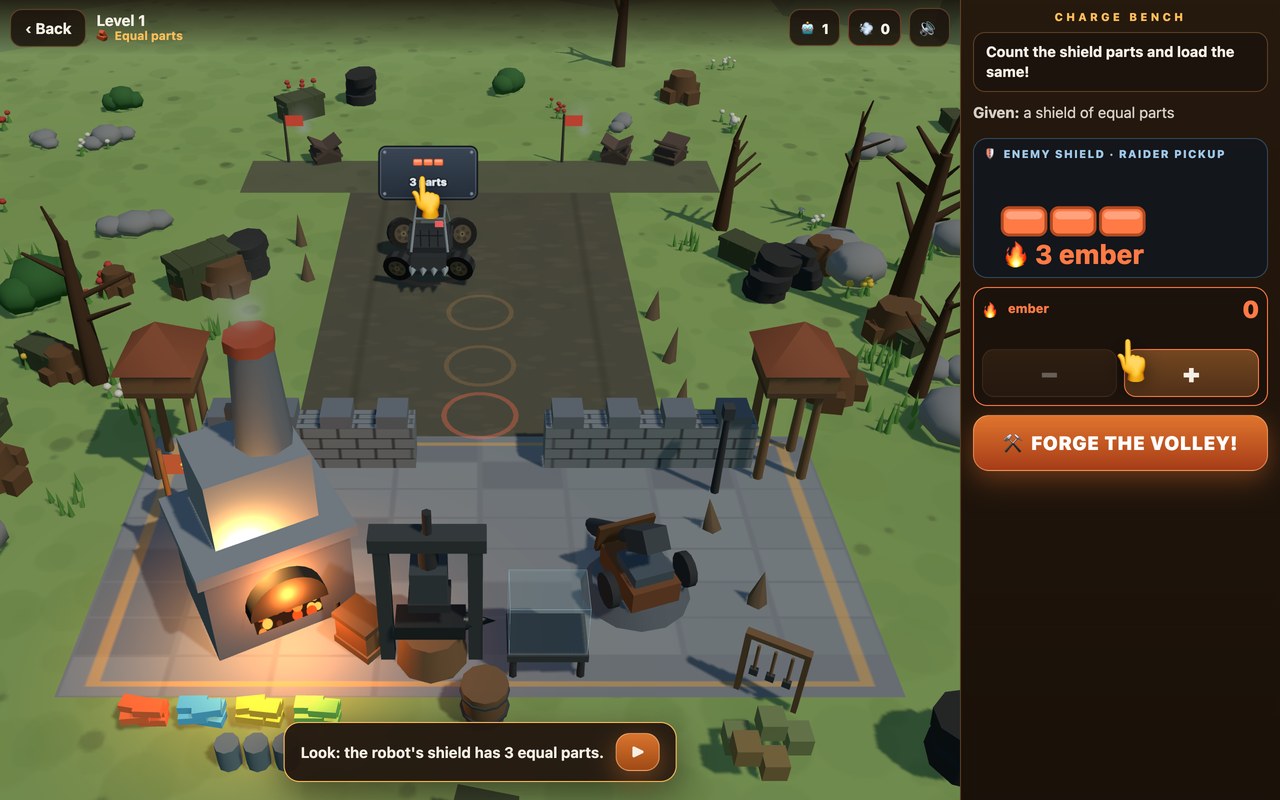
The game above is not decoration for the text — it drills the exact moves described here. The child stands at a cannon, a star cruiser slides out of the clouds, and glowing rings turn around its shield: exactly as many rings as the shield number has zeros. Every pull of the lever adds one ring to the barrel, stretches the beam by one segment, and the sight jumps 10 → 100 → 1000. Equal steps, ten-times growth — a logarithmic scale built by hand.
The 100 levels follow the same sequence as this page:
- levels 1–25 — base-10 logarithms, i.e. counting zeros;
- 26–40 — shields that land between rungs, when the answer is not a whole number;
- 41–55 — powers of two: each click is now a doubling;
- 56–70 — twin guns, where two beams join end to end — that is log x + log y standing in for multiplication;
- 71–80 — the weakener divides the shield by ten, subtracting one step;
- 81–92 — the real-world scales: siren loudness, tremors, star brightness, acidity;
- 93–100 — a growing threat: how many steps are left before the red line.
The word "logarithm" is not spoken until level 20, by which point the child has been counting rings for weeks and the term simply names something familiar. There is no losing and no timer: a miss lights up the gap on the sky ladder and says how many times off the shot was.
How to play
Look at the cruiser and count the rings around its shield. Pull the lever that many times — each click grows the beam one step and the sight number gains a zero. When the green column on the sky ladder reaches the orange shield mark, press FIRE. If the shot falls short or overshoots, nothing bad happens: the gap simply lights up on the ladder, a voice says how many times off it was, and the child tries again. There is no losing, no timer and no punishment for exploring. The first levels are guided step by step with voice, subtitles and a pulsing highlight of exactly the thing to touch next.
What your child learns
Orders of magnitude and place value (a zero means ten times more), reading big numbers up to billions, the idea of a logarithmic scale as a real ladder with equal steps, powers of two and doublings, adding orders instead of multiplying numbers, subtracting an order by dividing by ten, and where such scales live in the real world — loudness, tremors, star brightness, acidity.
The science behind the games
Every Dad4Kids game is built on one simple truth: children want to play, not study — so we turn learning into a game worth replaying. The method draws on peer-reviewed research in game-based learning, motivation, and how memory works.
- Tokac et al. (2019). Effects of game-based learning on students' mathematics achievement: A meta-analysis. Journal of Computer Assisted Learning.
- Alotaibi (2024). Game-based learning in early childhood education: a systematic review and meta-analysis. Frontiers in Psychology.
- Lampropoulos & Sidiropoulos (2024). Impact of gamification on students' learning outcomes and academic performance: a meta-analysis. Education Sciences.
- Taylor & Boyer (2019). Play-based learning: evidence-based research to improve children's learning experiences. Early Childhood Education Journal.
- Gottfried (1990). Academic intrinsic motivation in young elementary school children. Journal of Educational Psychology.
- Yang et al. (2018). Enhancing learning and retrieval of new information: a review of the forward testing effect. npj Science of Learning.
FAQ
What is a logarithm in simple terms?
A logarithm answers «how many times was this number multiplied by itself?» In base 10 that is just the count of zeros: a thousand has three zeros, so log101000 = 3.
What are the main properties of logarithms?
Five: the product rule (log(xy) = log x + log y), the quotient rule (log(x/y) = log x − log y), the power rule (log xn = n · log x), the anchor values logaa = 1 and loga1 = 0, and the change-of-base formula. The first three do most of the work.
Why does the product rule work?
Because zeros stack when you multiply. 100 has two zeros, 1000 has three, and their product 100,000 has five — and 2 + 3 = 5. A logarithm counts those steps, so the steps add.
Can you take the logarithm of zero or a negative number?
No. Multiplying a positive base by itself never produces zero or a negative result, so only positive numbers can sit inside a logarithm.
Isn't this too advanced for a young child?
The formal topic belongs to high-school algebra, but the underlying idea — how many times you multiplied, how many zeros a number has — lands much earlier. That is why the first twenty levels only ask the child to count rings, and the vocabulary arrives afterwards.
Is the game free?
Yes — free, no ads, and it runs straight in the browser on a tablet, phone or computer with nothing to install.
More free games for kids
By Evgeny Arsentiev, PhD · Last updated: September 2026