
Pythagorean Theorem and Trigonometry — Explained, With a Free Game 10+
 New from Dad4Kids
Clean YouTube for kids
For families with traditional values, hand-picked by parents.
Open →
The Pythagorean theorem says that in a right triangle the square of the hypotenuse equals the sum of the squares of the two legs: a² + b² = c². With legs of 3 and 4, c² = 9 + 16 = 25, so the hypotenuse is 5.
The hypotenuse is the longest side, the one facing the right angle; the legs are the two sides that form it. The theorem holds only in a right triangle — one angle of exactly 90°. Below: how to find any missing side, the proof you can literally watch (the squares are cut apart and rebuilt), the triples worth memorising, and how the same triangle leads on to sine, cosine and tangent.
What the Pythagorean theorem says
In a right triangle — a triangle with one angle of exactly 90° — the two sides that form the right angle are called the legs (a and b), and the side opposite it is the hypotenuse (c). The hypotenuse is always the longest side. The theorem states:
a² + b² = c²
The word "squared" is literal. Build a square on each of the three sides. The square standing on the hypotenuse has exactly the same area as the two smaller squares added together. The theorem is not a spell to memorise — it is a statement about areas, and that is the easiest way to see it.
The proof you can watch: cut the squares apart
Most pages state the formula and move on. Areas, though, can be seen. Take the square built on the longer leg and slice it with two straight cuts through its centre: one parallel to the hypotenuse, one at right angles to it. That leaves four pieces. Slide those four pieces, together with the whole square built on the shorter leg, onto the square on the hypotenuse — and they fill it exactly. No gaps, no overlaps, nothing left over.
Nothing was added and nothing was thrown away, so the areas must be equal: a² + b² = c². This is Perigal's dissection, published by Henry Perigal in 1891, and it is the reason the theorem is true rather than merely stated. In the game above the child watches it happen: the squares appear on the sides, get cut, and travel into place while the arithmetic runs alongside — 144 + 256 = 400.
How to find the hypotenuse
- Square each leg: a × a and b × b.
- Add the two results — that is c².
- Take the square root: c = √(a² + b²).
- Legs 3 and 4: 9 + 16 = 25 → c = 5.
- Legs 6 and 8: 36 + 64 = 100 → c = 10.
- Legs 5 and 12: 25 + 144 = 169 → c = 13.
- Legs 2 and 3: 4 + 9 = 13 → c = √13 ≈ 3.6. Most answers are not whole numbers, and that is perfectly normal.
Quick sanity check: the hypotenuse must come out longer than either leg, but shorter than the two legs added together. If it does not, a step went wrong.
How to find a missing leg
When the hypotenuse and one leg are known, rearrange the formula: a² = c² − b², so a = √(c² − b²).
- c = 13, b = 5: 169 − 25 = 144 → a = 12.
- c = 10, b = 6: 100 − 36 = 64 → a = 8.
- c = 25, b = 7: 625 − 49 = 576 → a = 24.
The classic mistake is subtracting the wrong way round. You always take the square of a leg away from the square of the hypotenuse, never the reverse — the hypotenuse is the biggest square, so it is the one being emptied.
Pythagorean triples
A Pythagorean triple is a set of three whole numbers that fits the theorem exactly. They turn up in textbook questions constantly, so they are worth recognising on sight:
- 3, 4, 5 — and every multiple: 6, 8, 10; 9, 12, 15; 30, 40, 50;
- 5, 12, 13;
- 8, 15, 17;
- 7, 24, 25.
Spotting a triple turns a square-root problem into instant recall: two sides of 9 and 12 mean the third is 15, no calculator needed.
The converse: testing for a right angle
The theorem also runs backwards. If a² + b² = c², the triangle is right-angled. That gives you a way to check a corner with nothing but a tape measure — measure the three sides and try the sum.
- Sides 6, 8, 10: 36 + 64 = 100 = 10² → right-angled.
- Sides 5, 6, 8: 25 + 36 = 61, but 8² = 64 → not right-angled; the angle is slightly wider than 90°.
Always test the longest side, because that is the only one that could be the hypotenuse.
Where the theorem is actually used
The Pythagorean theorem is how you measure a distance you cannot walk along. Go 300 m east and 400 m north, and the straight line home is 500 m. On a coordinate grid it becomes the distance formula — the distance between two points is nothing more than the hypotenuse of a right triangle whose legs are the differences in x and in y.
Builders square up foundations with the 3-4-5 rule: mark 3 units along one wall, 4 along the other, and adjust until the diagonal reads exactly 5. A television's "55-inch" size is the diagonal of a right triangle whose legs are the width and the height. Ladders, ramps, roof rafters, flight paths and navigation fixes all come down to the same calculation.
From sides to angles: sine, cosine and tangent
Pythagoras connects sides to sides. The next step is connecting sides to angles, and that is trigonometry. For an acute angle in a right triangle:
- sine = opposite ÷ hypotenuse;
- cosine = adjacent ÷ hypotenuse;
- tangent = opposite ÷ adjacent.
Those three sentences are what SOH-CAH-TOA stands for. The key idea is that each ratio depends only on the size of the angle, never on how big the triangle is: every triangle with a 30° angle has a sine of 0.5, whether it is drawn on paper or measured across a valley. So one angle plus one side is enough to recover the rest — which is exactly how a rangefinder, a theodolite or an artillery sight works.
A 20 m ray leaving the ground at 30°? The target height is 20 × 0.5 = 10 m. And the identity sin²α + cos²α = 1, which looks like a new rule, is simply the Pythagorean theorem written for a triangle whose hypotenuse is 1.
Mistakes worth avoiding
- Using the theorem on a triangle that has no right angle. It only holds at 90°; other triangles need the law of cosines.
- Forgetting the square root. a² + b² gives you c², not c.
- Adding the sides instead of the squares: 3 + 4 is 7, but the hypotenuse is 5.
- Treating the longest side as a leg. The hypotenuse is always opposite the right angle.
Practising it: the game above
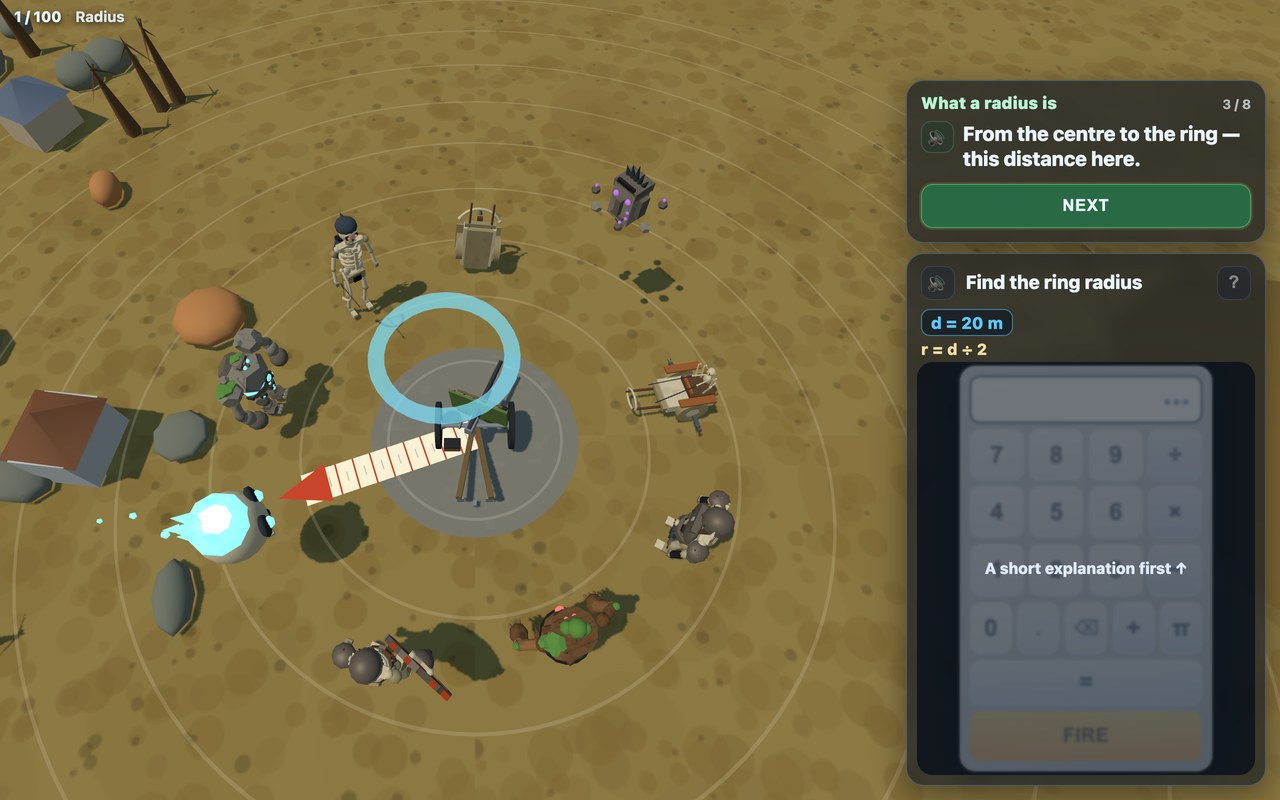
The page you are on has the theorem as a playable trainer, free and with no sign-up. Every answer is a shot: name the missing side and the gun fires exactly that far, so a wrong number is not a red cross but a shell landing visibly short or long.
There are 350 levels in seven chapters of fifty. Chapter one is the Pythagorean theorem itself — hypotenuse, legs, the reverse question, the cut-and-move proof, and a table of squares that reads both ways. Only then do angles appear: sine as height, cosine as range, tangent as the aiming rule, cotangent as the "where do I stand" question, and a final chapter of mixed combat tasks where the child has to decide which tool the situation calls for. Every task and explanation is spoken aloud in English and subtitled, so a child who is still a slow reader is not shut out.
How to play
Look at the triangle in the world: which sides are known and which one is missing. Use the table of squares or the gunner's tablet, work the number out, and type it in. A correct answer fires and hits; a wrong one shows where the shell went, so the missing step is visible, and you try again.
What your child learns
Seven chapters of 50 levels each — 350 in all. Chapter one is the Pythagorean theorem: the hypotenuse and the legs, with a proof you can watch, no angles at all. Then the ratios of sides, sine as height, cosine as range, tangent as the aiming rule, cotangent as the reverse question, and a final chapter of mixed combat tasks. Every task is spoken aloud in English and subtitled.
The science behind the games
Every Dad4Kids game is built on one simple truth: children want to play, not study — so we turn learning into a game worth replaying. The method draws on peer-reviewed research in game-based learning, motivation, and how memory works.
- Tokac et al. (2019). Effects of game-based learning on students' mathematics achievement: A meta-analysis. Journal of Computer Assisted Learning.
- McLaren et al. (2017). A computer-based game that promotes mathematics learning more than a conventional approach. International Journal of Game-Based Learning.
- Deng et al. (2020). Digital game-based learning in a Shanghai primary-school mathematics class: a case study. Journal of Computer Assisted Learning.
- Alotaibi (2024). Game-based learning in early childhood education: a systematic review and meta-analysis. Frontiers in Psychology.
- Lampropoulos & Sidiropoulos (2024). Impact of gamification on students' learning outcomes and academic performance: a meta-analysis. Education Sciences.
- Taylor & Boyer (2019). Play-based learning: evidence-based research to improve children's learning experiences. Early Childhood Education Journal.
FAQ
What is the Pythagorean theorem?
In a right triangle, the square of the hypotenuse equals the sum of the squares of the two legs: a² + b² = c². It works only when one angle is exactly 90°.
How do you find the hypotenuse?
Square both legs, add them, and take the square root: c = √(a² + b²). Legs of 3 and 4 give 9 + 16 = 25, so c = 5.
How do you find a missing leg?
Subtract the known leg's square from the hypotenuse's square, then take the root: a = √(c² − b²). With c = 13 and b = 5 you get √144 = 12.
How is the Pythagorean theorem proved?
The clearest proof is by dissection. Cut the square on the longer leg into four pieces with two lines through its centre; those four pieces plus the square on the shorter leg fill the square on the hypotenuse exactly. Equal areas, so a² + b² = c². The game shows this proof in motion.
What is a Pythagorean triple?
Three whole numbers that satisfy the theorem exactly: 3-4-5, 5-12-13, 8-15-17, 7-24-25 and all their multiples. Recognising them saves you a square root.
Does the theorem work in any triangle?
No — only in right-angled ones. For other triangles you need the law of cosines, which adds a correction term for the angle.
Is the game free?
Yes. It runs in the browser on a tablet, phone or computer, with no ads, no downloads and no sign-up, and all 350 levels are open.
More free games for kids

By Evgeny Arsentiev, PhD · Last updated: September 2026