
Word Ladder Game for Kids — Play Online 7+
 New from Dad4Kids
Clean YouTube for kids
For families with traditional values, hand-picked by parents.
Open →
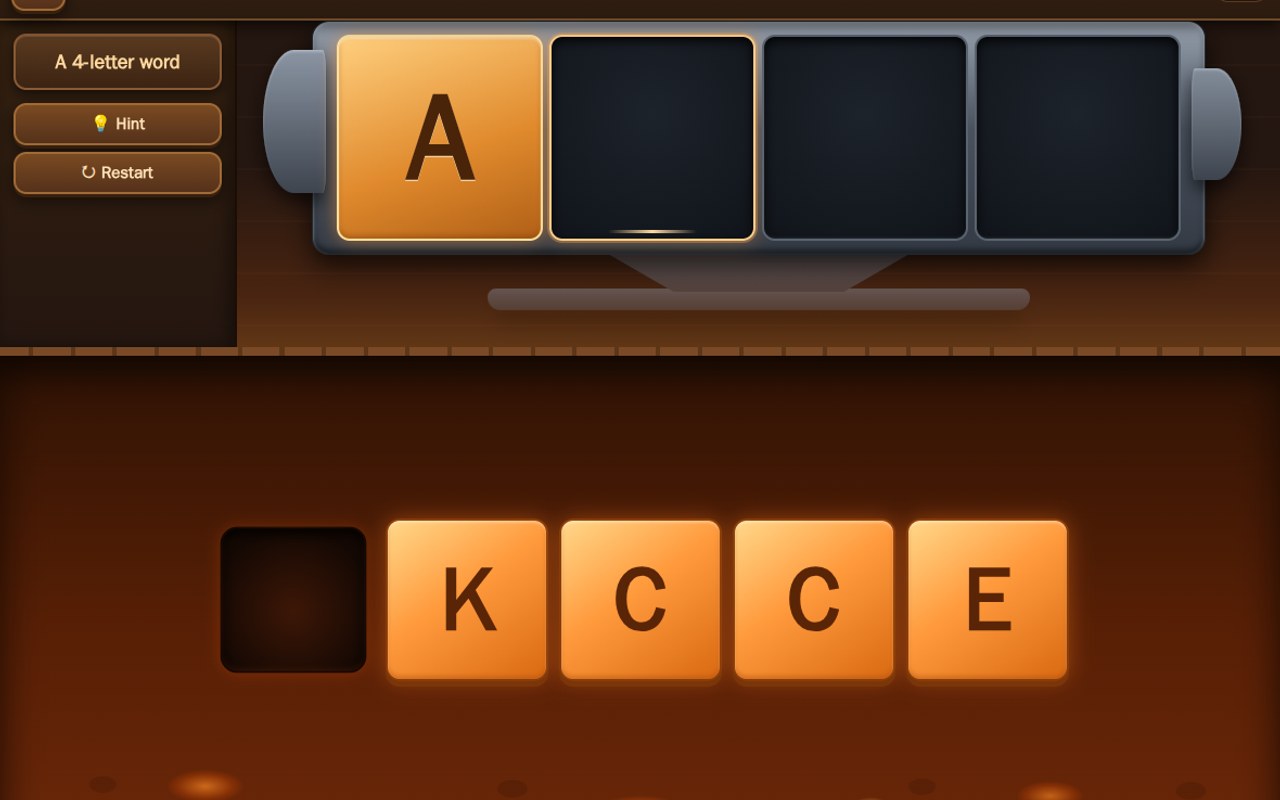
A word ladder game is the classic Lewis Carroll puzzle: turn one word into another by changing a single letter at a time, and every rung in between has to be a real word too — cat → cot → cow. Here the ladder climbs an actual mountain at sunrise, one stone step per word, with a flag waiting at the goal.
200 levels in nine chapters, from three-letter two-step climbs to five-letter five-step ones, each with exactly one solution — the shortest path a solver can find, so a lucky guess never skips ahead and the right move is always the only move.
How to play
Tap a letter cell on the current step — it starts as a dotted copy of the word below it — then pick a letter from the full keyboard. Every wrong try gets a plain reason instead of the answer: the letter didn't change, too many letters changed, that word doesn't exist, it's already on the ladder, or it's real but leads nowhere the goal can still be reached from. Three misses in a row lock the step until a hint is taken; the hint lights up which letter to change first, and only then, if asked again, what to change it to.
The very first level is a voiced lesson right on the live ladder, guiding one tap at a time before the child climbs alone.
What your child learns
A word ladder forces close attention to spelling: only one letter may move, so the child has to hold the whole word's shape in mind and test single substitutions against it. The dead-end diagnosis — a real word that still can't reach the goal in the steps left — adds a layer of planning ahead, the same look-before-you-leap thinking that shortest-path puzzles train in general, here dressed as vocabulary practice.
The science behind the games
Every Dad4Kids game is built on one simple truth: children want to play, not study — so we turn learning into a game worth replaying. The method draws on peer-reviewed research in game-based learning, motivation, and how memory works.
- Ehri et al. (2001). Systematic phonics instruction helps students learn to read: evidence from the National Reading Panel's meta-analysis. Review of Educational Research.
- Ehri (2020). The science of learning to read words: a case for systematic phonics instruction. Reading Research Quarterly.
- Tokac et al. (2019). Effects of game-based learning on students' mathematics achievement: A meta-analysis. Journal of Computer Assisted Learning.
- Alotaibi (2024). Game-based learning in early childhood education: a systematic review and meta-analysis. Frontiers in Psychology.
- Lampropoulos & Sidiropoulos (2024). Impact of gamification on students' learning outcomes and academic performance: a meta-analysis. Education Sciences.
- Taylor & Boyer (2019). Play-based learning: evidence-based research to improve children's learning experiences. Early Childhood Education Journal.
FAQ
What is a word ladder?
A puzzle where a start word turns into a goal word one letter at a time, and every word in between — every rung of the ladder — has to be a real word too.
Does it show the answer?
No. A wrong guess only explains what's wrong with it — wrong length, no letter changed, too many changed, not a real word, already used, or a dead end — never the word that would actually work.
What age is this for?
The three-letter two-step chapter with a voiced lesson suits a reader from about six; the five-letter chapters near the end are a real challenge for confident spellers of 9–11.
Is every ladder solvable?
Yes — all 200 levels are checked by an independent solver: each has exactly one shortest path from start to goal, so there's never more than one right way up.
More free games for kids
By Evgeny Arsentiev, PhD · Last updated: September 2026