
Car Math Games: Solve It and Your Car Fires 7+
 New from Dad4Kids
Clean YouTube for kids
For families with traditional values, hand-picked by parents.
Open →
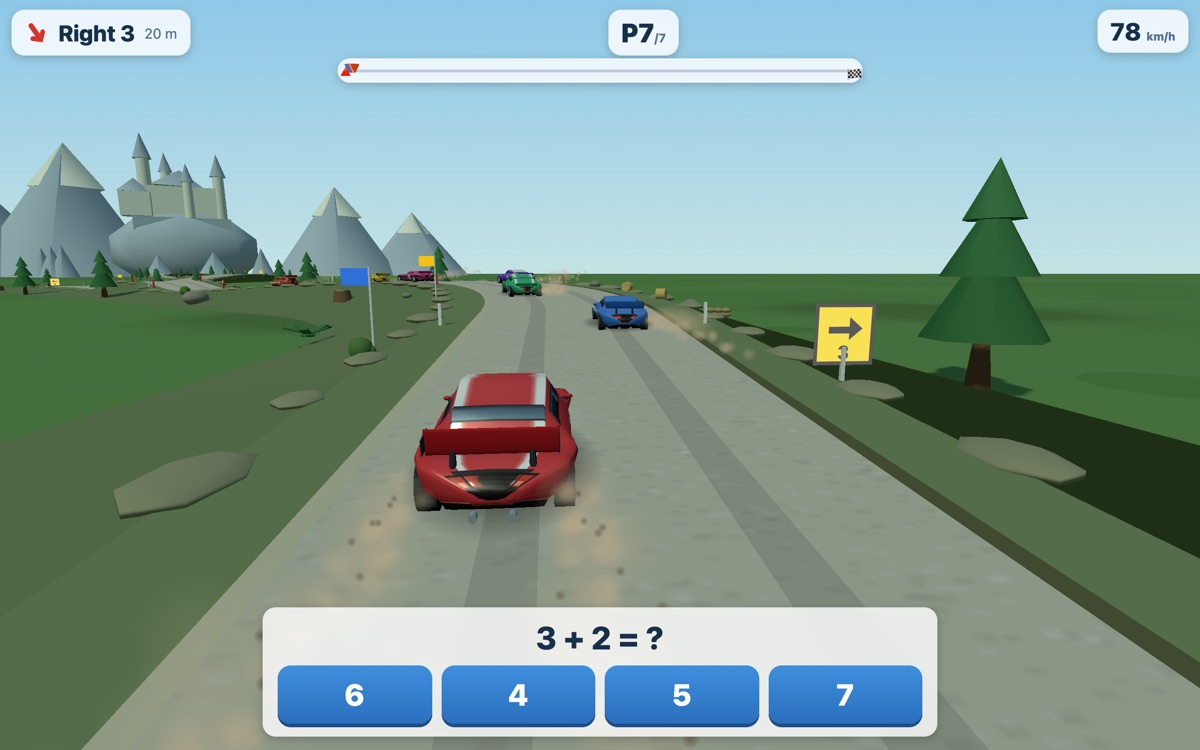
Road Arena is one of those car math games built as a running battle: a squad of rival cars rides ahead of you, and every correct answer is a volley. Your car aims and fires on its own — the child never steers and never shoots. Break the squad and you surge forward; on the horizon the next squad appears, and the chase starts again.
The questions are on a timer, so this doubles as a timed math game: a bar above the problem drains while you think. Answer wrong or let the time run out, and the nearest rival fires back — sparks on your hood and one segment of health gone. Three or four mistakes are survivable; the race is lost only if you run out of health before the finish line.
How to play
Press Play, pick a wasteland and a race. Read the problem at the bottom and tap the answer — the turret turns to the nearest rival and opens fire. Cars take several hits: first dents and sparks, then smoke, then flames, then the wreck tumbles off the road. When a squad is finished your car gets a speed boost and closes on the next one.
Nothing to dodge, nothing to aim. The whole game is one tap per question.
What your child learns
One unbroken ladder across 150 races — no age brackets. The timer starts generous and tightens as the ladder climbs, which is what turns arithmetic into fluency: the child stops counting on fingers because the squad is pulling away.
The science behind the games
Every Dad4Kids game is built on one simple truth: children want to play, not study — so we turn learning into a game worth replaying. The method draws on peer-reviewed research in game-based learning, motivation, and how memory works.
- Tokac et al. (2019). Effects of game-based learning on students' mathematics achievement: A meta-analysis. Journal of Computer Assisted Learning.
- Alotaibi (2024). Game-based learning in early childhood education: a systematic review and meta-analysis. Frontiers in Psychology.
- Lampropoulos & Sidiropoulos (2024). Impact of gamification on students' learning outcomes and academic performance: a meta-analysis. Education Sciences.
- Taylor & Boyer (2019). Play-based learning: evidence-based research to improve children's learning experiences. Early Childhood Education Journal.
- Gottfried (1990). Academic intrinsic motivation in young elementary school children. Journal of Educational Psychology.
- Yang et al. (2018). Enhancing learning and retrieval of new information: a review of the forward testing effect. npj Science of Learning.
FAQ
What are car math games?
Car math games put arithmetic behind the wheel: instead of a worksheet, the answer does something. Here every correct answer fires your car's gun at a rival, and a wrong one lets the rivals fire back. The maths is ordinary practice; the car is what makes a child want a second round.
Does my child need to drive or aim?
No. The car steers, holds the road and aims by itself — that is deliberate. The only input in the whole game is choosing an answer, so a child who is slow with a mouse is not punished for it.
Is this a timed math game?
Yes. A bar above the question drains while the child thinks, and running out counts the same as a wrong answer. Early races give plenty of time; later ones tighten it, which is how quick recall is built without a stopwatch on the table.
What happens when the answer is wrong?
The nearest rival fires back: the screen shakes, sparks hit your hood and one segment of health is lost. Nothing restarts and no progress is erased — a child can be wrong several times and still win the race.
Is it free?
Yes — a free racing math game with no ads, no download and no account needed to play, straight in the browser. It runs on a computer or a tablet; a bigger screen makes the road and the rival cars easier to read.
More free games for kids
By Evgeny Arsentiev, PhD · Last updated: September 2026