
Business Game for Kids — Free Venture City 7+
 New from Dad4Kids
Clean YouTube for kids
For families with traditional values, hand-picked by parents.
Open →
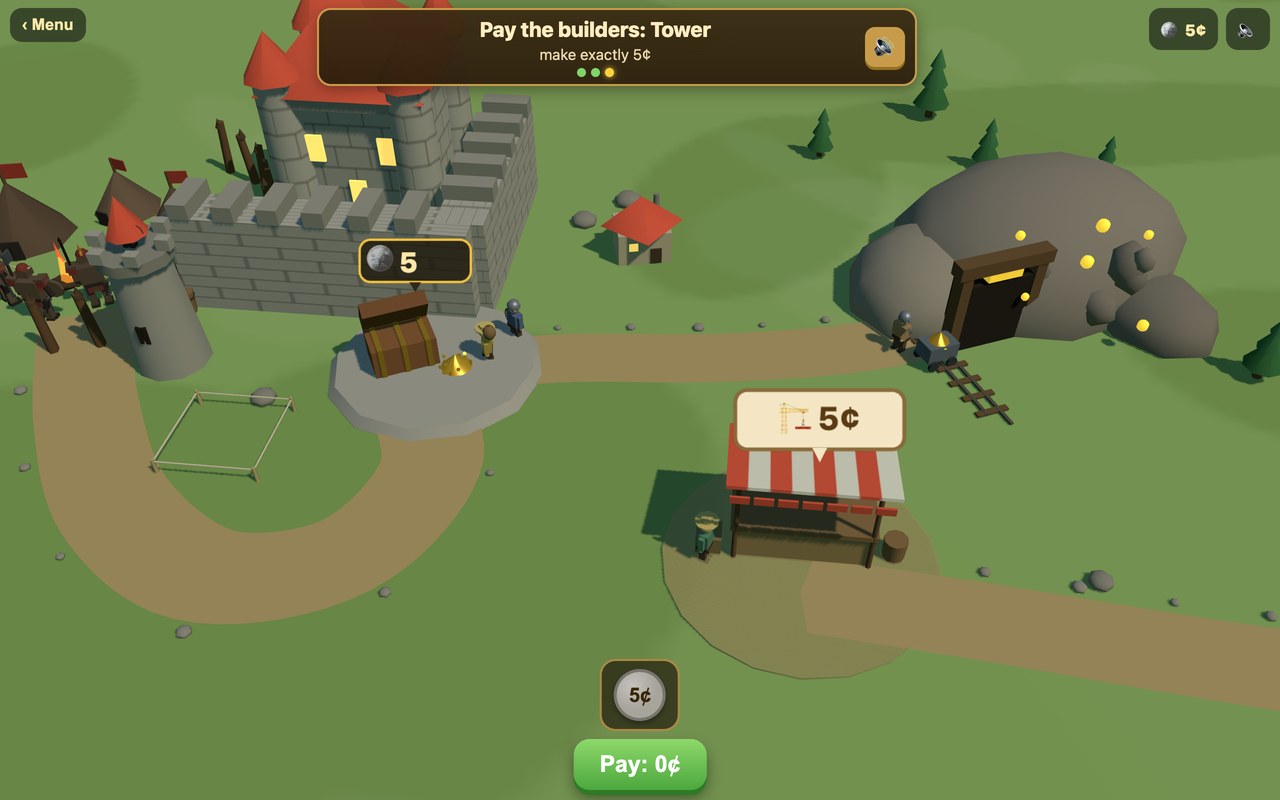
Venture City is one of those business games for kids where a child runs a little market stall using real math. There is no luck, no dice and no chance cards: money appears only when the numbers add up. Step by step the child works out the price, the revenue (price × how many sold), the profit (what is left after costs) and the rent to pay — and sees straight away whether the stall made money or lost it.
Every level is a small, honest business decision worked out on the calculator, and the game shows exactly why the result happened. As the child grows the stall across 500 levels in 15 chapters, the math grows too — from counting money and giving change to prices, profit, comparing costs and simple budgeting — so business turns into arithmetic a child can actually see.
How to play
Read the situation, tap the numbers into the built-in calculator, and work out the answer step by step: set the price, add up the revenue, subtract the costs to find the profit, and cover the rent. Type your answer and the game checks it — if it is off, it shows what really happened so you can fix it and try again. Get the money right and the stall grows into the next level.
What your child learns
Money math through a real (safe) business: counting money and change, price and cost, revenue = price × quantity, profit = revenue − costs, covering rent and fixed costs, comparing prices, simple budgeting, and the big idea that revenue is not the same as profit. The built-in calculator makes the arithmetic visible, so kids learn how a small business actually makes — or loses — money.
The science behind the games
Every Dad4Kids game is built on one simple truth: children want to play, not study — so we turn learning into a game worth replaying. The method draws on peer-reviewed research in game-based learning, motivation, and how memory works.
- Tokac et al. (2019). Effects of game-based learning on students' mathematics achievement: A meta-analysis. Journal of Computer Assisted Learning.
- Alotaibi (2024). Game-based learning in early childhood education: a systematic review and meta-analysis. Frontiers in Psychology.
- Lampropoulos & Sidiropoulos (2024). Impact of gamification on students' learning outcomes and academic performance: a meta-analysis. Education Sciences.
- Taylor & Boyer (2019). Play-based learning: evidence-based research to improve children's learning experiences. Early Childhood Education Journal.
- Gottfried (1990). Academic intrinsic motivation in young elementary school children. Journal of Educational Psychology.
- Yang et al. (2018). Enhancing learning and retrieval of new information: a review of the forward testing effect. npj Science of Learning.
FAQ
What does my child actually learn?
Real money math on a tiny business: setting a price, adding up revenue, subtracting costs to find profit, covering the rent and keeping a simple budget — all worked out on the built-in calculator.
Is it a get-rich game with luck?
No. There are no dice or chance cards — money only appears when the numbers add up. A price below cost loses money on every sale, so the child has to reason with real arithmetic, not luck.
What is the best way to teach kids about money?
Make money concrete and let children make real decisions with visible consequences. Start with counting and change, then prices and profit. Venture City does exactly that — every answer is worked out on the calculator and moves real numbers, so kids see how earning, spending and saving connect.
What age is it for?
From about 7. Early levels are counting money and simple prices; later chapters add profit, comparing costs and budgeting, so the game grows with the child across 500 levels.
More free games for kids
By Evgeny Arsentiev, PhD · Last updated: September 2026