
Circumference of a Circle: Formula, Pi and Worked Examples 8+
 New from Dad4Kids
Clean YouTube for kids
For families with traditional values, hand-picked by parents.
Open →
The circumference of a circle is the distance all the way around its edge, and you find it with C = 2 × π × r — or, written with the diameter, C = π × d. For a circle with a radius of 10 cm that is 2 × 10 × 3.14 = 62.8 cm.
Its twin formula is the area of a circle, A = π × r² — the same circle has an area of 10 × 10 × 3.14 = 314 cm². The two get mixed up constantly, so hold on to the difference: circumference is the line around the edge, measured in centimetres; area is everything inside, measured in square centimetres. Below: radius and diameter, where π actually comes from, both formulas with examples, and how to work backwards from a circumference or an area to the radius.
Radius and diameter
A circle is the line whose every point sits the same distance from the centre; the flat region inside it is the disc. That is why the two questions differ: you measure the circumference of the line and the area of what it encloses.
- The radius (r) runs from the centre out to the edge.
- The diameter (d) runs straight through the centre from edge to edge — the longest line you can draw inside a circle. It is exactly two radii: d = 2r, so r = d ÷ 2.
Every circle formula starts from the radius, so this is the step to get right. Radius 15 cm means diameter 30 cm; diameter 30 cm means radius 15 cm.
What pi actually is
π (pi) is how many times longer the edge of a circle is than its diameter. It is the same number for every circle in existence — a coin, a wheel, a planet. In school we use π ≈ 3.14; the exact value is a never-ending decimal, 3.14159265…
You can see it in about a minute. Wrap a piece of string around a jar lid, straighten the string out, then lay the lid's diameter along it. The diameter fits three times and a little bit more. That "three and a bit" is π. Nothing mysterious — it is just the ratio C ÷ d, and it never changes.
Rearrange that sentence and you already have the formula: if C ÷ d = π, then C = π × d.
The circumference formula, step by step
Both versions say the same thing, because the diameter is two radii:
C = 2 × π × r or C = π × d
- Radius 10 cm → d = 20 cm → C = 20 × 3.14 = 62.8 cm.
- Radius 25 m → d = 50 m → C = 50 × 3.14 = 157 m.
- Diameter 7 cm → C = 7 × 3.14 = 21.98 cm (no need to find the radius first).
The order never changes: get to the diameter, then multiply by π. The most common slip is multiplying the radius by π, which produces exactly half the right answer.
The area of a circle
A = π × r² — multiply the radius by itself, then by π.
- Radius 10 cm: 10 × 10 = 100, 100 × 3.14 = 314 cm².
- Radius 3 m: 3 × 3 = 9, 9 × 3.14 = 28.26 m².
- Diameter 12 cm: first r = 6, then 6 × 6 × 3.14 = 113.04 cm².
Why the radius is squared is easy to show: cut a square whose side equals the radius, and that square fits into the circle three times and a bit — π times, again. A square's area is r × r, so the circle's area is π × r × r.
An area answer always carries square units: cm², m², km². If your answer is in plain centimetres, you have found a length, not an area.
Working backwards
- Circumference → radius: r = C ÷ π ÷ 2. Example: 62.8 ÷ 3.14 = 20 (that is the diameter) → 20 ÷ 2 = 10.
- Area → radius: A ÷ π = r², then ask which number times itself gives that. Example: 314 ÷ 3.14 = 100, and 10 × 10 = 100, so r = 10.
- Diameter → area: three steps — halve the diameter, square the radius, multiply by π.
Mistakes to watch for
- π times the radius. Half the correct circumference. There is no formula that reads C = π × r on its own.
- Stopping at the diameter. 10 → 20 is not the circumference yet; the × π is still owed.
- Swapping circumference and area. 2πr is the edge; πr² is the filling. The units tell you which one you actually computed.
- Dropping π from the area. r × r on its own is the area of a square, not a circle.
- Reading the diameter as the radius. Every later step is correct and the answer is still twice (or four times) too big.
Practise it: the Circle Defense game
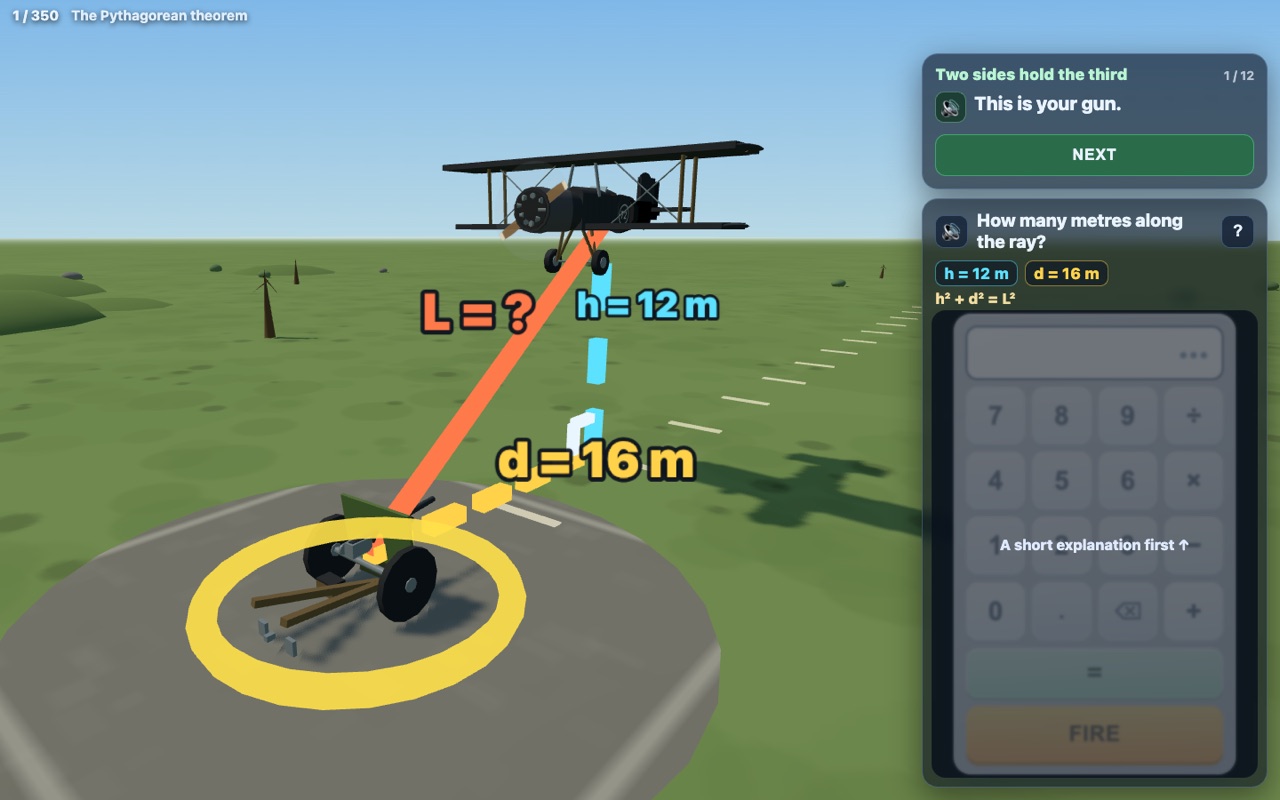
A formula sticks when it does something. In the game above a single gun stands in the middle of the field, a horde closes in as a ring and halts, and a measuring tape unrolls from the barrel with a mark at every metre — that is the radius, visible in the world rather than printed in a box. The child works the answer out on a calculator with a dedicated π key, so nobody types 3.14 by hand and the display keeps showing the actual formula ("20 × π").
Whatever number is entered becomes the radius of the ring of fire. Get it right and the fire lands on the horde; get it wrong and the ring falls short or overshoots, and the game names the missing step — "you stopped at the diameter", "you multiplied the radius by π instead of the diameter". Across 100 levels all eight question types appear: diameter → radius, radius → diameter, circumference, area, and the three reverse questions, finishing with two rings at once when there is only enough charge for one. Every question and explanation is spoken aloud in English and shown as text at the same time.
How to play
Look at the measuring tape in the world: it is labelled in metres, and that is the radius. Work it out on the calculator on the right: radius × 2 = diameter, diameter × π = circumference. The π key is already there — nobody types 3.14 by hand. Enter the answer and press FIRE: a correct number fires a volley all around, a wrong one brings a step-by-step explanation and another try.
What your child learns
What a circle, a radius and a diameter are — shown in the world, not defined in words; why the diameter is exactly two radii; where the number π comes from and how it turns the diameter into the circumference; the area of a circle as radius × radius × π; and the reverse questions — find the radius from the circumference or from the area. 100 levels with gentle growth, plain-English explanations and full voice-over with subtitles.
The science behind the games
Every Dad4Kids game is built on one simple truth: children want to play, not study — so we turn learning into a game worth replaying. The method draws on peer-reviewed research in game-based learning, motivation, and how memory works.
- Tokac et al. (2019). Effects of game-based learning on students' mathematics achievement: A meta-analysis. Journal of Computer Assisted Learning.
- McLaren et al. (2017). A computer-based game that promotes mathematics learning more than a conventional approach. International Journal of Game-Based Learning.
- Deng et al. (2020). Digital game-based learning in a Shanghai primary-school mathematics class: a case study. Journal of Computer Assisted Learning.
- Alotaibi (2024). Game-based learning in early childhood education: a systematic review and meta-analysis. Frontiers in Psychology.
- Lampropoulos & Sidiropoulos (2024). Impact of gamification on students' learning outcomes and academic performance: a meta-analysis. Education Sciences.
- Taylor & Boyer (2019). Play-based learning: evidence-based research to improve children's learning experiences. Early Childhood Education Journal.
FAQ
What is the formula for the circumference of a circle?
C = 2 × π × r, or C = π × d — the two are identical because the diameter is two radii. With a radius of 10 cm: 2 × 10 × 3.14 = 62.8 cm.
What is the difference between circumference and area?
The circumference is the line around the edge (C = 2πr) and is measured in units of length. The area is everything inside (A = πr²) and is measured in square units such as cm² or m².
What is pi in simple terms?
Pi is how many times the diameter fits around the edge of a circle — about 3.14 times, for every circle there is. Wrap string around a lid and lay the diameter along it: three times and a bit.
How do I find the radius from the circumference?
Divide by π and then by 2: r = C ÷ π ÷ 2. For example, 62.8 ÷ 3.14 = 20, and 20 ÷ 2 = 10.
What age is the game for?
Around 8 and up. It introduces every word from scratch — circle, radius, diameter, pi — shows each one in the world before naming it, and never asks a child to type 3.14 by hand.
More free games for kids
By Evgeny Arsentiev, PhD · Last updated: July 2026