
Multiplication Games for Kids — Free Math Artillery 7+
 New from Dad4Kids
Clean YouTube for kids
For families with traditional values, hand-picked by parents.
Open →
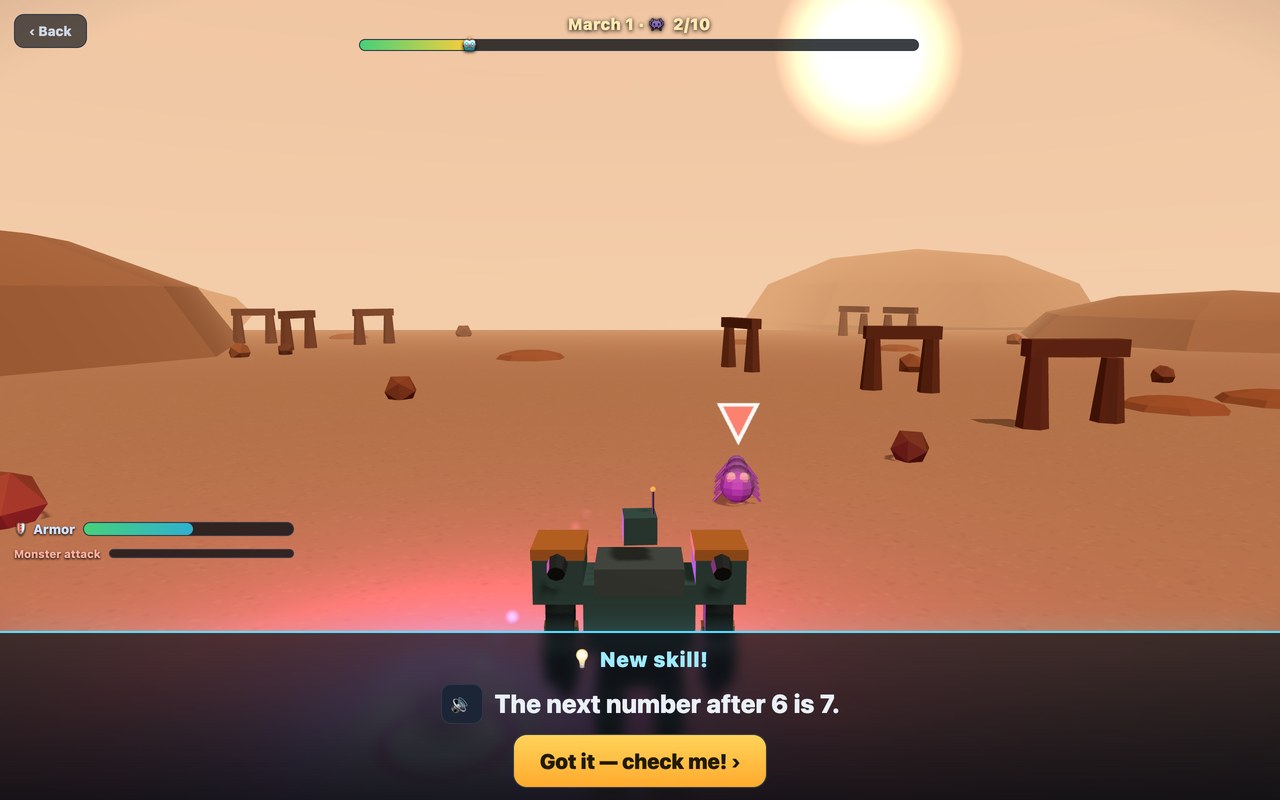
Math Artillery is one of those multiplication games where the times tables are real battle calculations. On a hostile alien planet, giant robots march toward your base, each with a glowing toughness number overhead — 6, 8, 16, 24… There is no blind fire button: the cannons shoot exactly as many shells as your child loads.
Multiplication is equal groups
Each mission gives you several cannons, and every cannon must be loaded with the same number of shells. Four cannons with four shells each — the game shows both 4 × 4 = 16 and 4 + 4 + 4 + 4 = 16. Fire! If total damage matches the robot's toughness exactly, you get a spectacular explosion and a Perfect Calculation. Too little — the robot keeps marching, and the game gently shows what's left and how to fix it. Too much — the robot is destroyed, but shells are wasted and the score drops.
From 2×5 to multiplication secrets
The campaign starts with easy facts on 2, 5 and 10, shows on the battlefield why 2 × 5 and 5 × 2 deal the same damage, then opens sectors with 3, 4, 6, 7, 8 and 9 cannons. Special missions unlock the engineering panel: 7 × 4 splits into 5 × 4 plus 2 × 4, and 8 × 6 is computed as 10 × 6 minus 2 × 6 — solutions like these earn engineer's medals.
A battle where thinking wins
Scout robots, heavy walkers and huge bosses with rotating laser arms advance slowly enough to think, but the base shield adds just the right pressure. Once a fact is mastered hands-on, quick-load mode lets kids answer faster and faster.
How to play
Look at the number above the robot — that's the damage you need. Drag shells into the cannons (or tap “+1 to each”) until every cannon holds the same number. Check the equation, e.g. 4 × 4 = 16, and hit FIRE! An exact volley destroys the robot; too little leaves it marching; too much wastes ammo.
What your child learns
The meaning of multiplication through equal groups, the link between multiplication and repeated addition, the commutative property (2 × 5 = 5 × 2), times tables 2–10, and decomposition strategies: 7 × 4 = 5 × 4 + 2 × 4, 9 × 6 = 10 × 6 − 6.
The science behind the games
Every Dad4Kids game is built on one simple truth: children want to play, not study — so we turn learning into a game worth replaying. The method draws on peer-reviewed research in game-based learning, motivation, and how memory works.
- Tokac et al. (2019). Effects of game-based learning on students' mathematics achievement: A meta-analysis. Journal of Computer Assisted Learning.
- Alotaibi (2024). Game-based learning in early childhood education: a systematic review and meta-analysis. Frontiers in Psychology.
- Lampropoulos & Sidiropoulos (2024). Impact of gamification on students' learning outcomes and academic performance: a meta-analysis. Education Sciences.
- Taylor & Boyer (2019). Play-based learning: evidence-based research to improve children's learning experiences. Early Childhood Education Journal.
- Gottfried (1990). Academic intrinsic motivation in young elementary school children. Journal of Educational Psychology.
- Yang et al. (2018). Enhancing learning and retrieval of new information: a review of the forward testing effect. npj Science of Learning.
FAQ
What age is it for?
From about age 7, when children first meet multiplication. The opening missions explain equal groups from scratch, so confident six-year-olds can play too.
How is it better than drilling flash cards?
The child doesn't recall a memorised answer — they build it by hand, loading equal groups of shells and watching 4 × 4 become 16 points of damage. Understanding comes before speed.
What happens after a mistake?
Nothing harsh: the game shows how much toughness the robot has left and hints at the fix — for example, adding one more shell to every cannon.
Is it free?
Yes — completely free, no ads, no purchases, right in the browser on a tablet, phone or computer.
More free games for kids
By Evgeny Arsentiev, PhD · Last updated: September 2026