
Coordinate Grid — Free Grid Artillery Game for Kids 7+
 New from Dad4Kids
Clean YouTube for kids
For families with traditional values, hand-picked by parents.
Open →
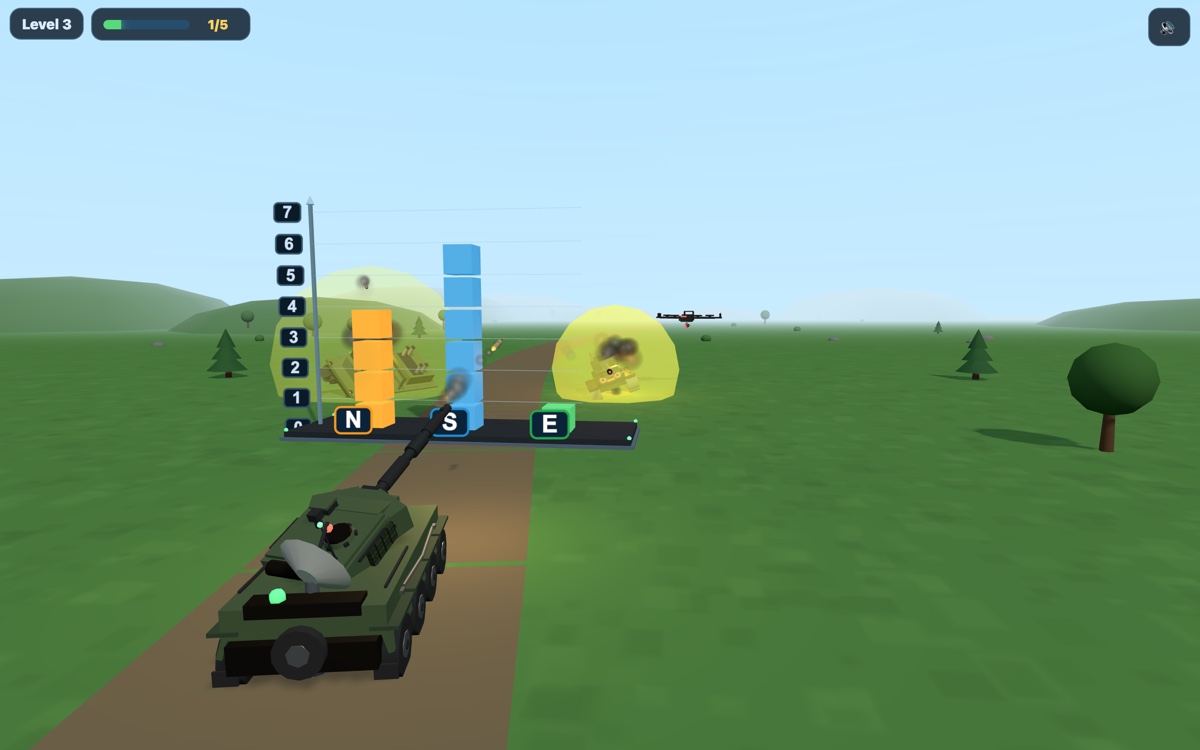
A coordinate grid makes sense the moment it is used to hit something. In Grid Artillery the target sits on the grid, your child reads off the point and calls the coordinates, and the battery fires there — right point, direct hit; wrong point, a crater somewhere else.
One axis at a time
The x axis alone first, then y, then ordered pairs where the order matters and (3, 5) is not (5, 3). After that the grid grows: minus on the left, all four quadrants, and eventually a third number for height, (x; y; z).
Nothing to dodge
The enemy only advances when your child answers, so a slow, careful reading of the grid is rewarded rather than punished. Every new idea is explained in plain words and checked before it counts.
Free, in the browser
No download, no account, no ads. Every question is read aloud, and progress is saved on the device.
Free math games by grade
- math games for kindergarten — counting to 5 and up, an elf archer that adapts to your child
- math games for 1st graders — adding and subtracting to 20 in a 3D knight adventure
- math games for 2nd graders — adding, subtracting and first times tables in a moon-base defence
- math games for 3rd graders — short word problems, add and subtract past 100, first division
- math games for 4th graders — multi-digit multiplication, factors, multiples and equivalent fractions
- math games for 5th graders — decimals, percent, area and perimeter, solving for x — it picks by skill
- math games for 6th graders — negative numbers on a depth scale, tenths and rounding
Free math games by skill
- multiplication table game — the whole times table, then division as its reverse
- multiplication facts — one row of the table per chapter until every fact is automatic
- math facts games — fact fluency with a mastery ladder in a walking mech
- counting money — count coins, compare prices, give change, keep the treasury
- telling time — read the clock, measure durations, plan a railway timetable
- measuring length — ruler, scales, measuring jug and unit conversion
How to play
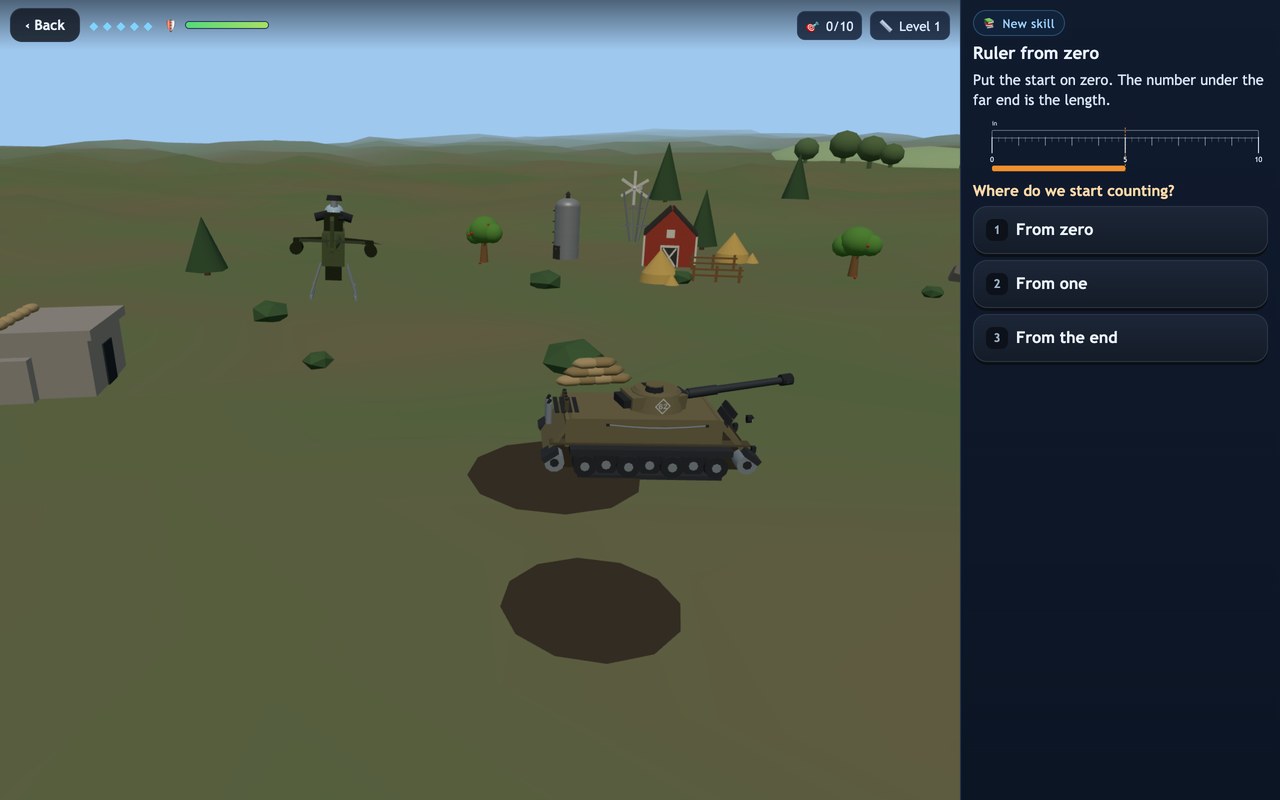
Look at the battlefield: the active tank is marked with a red arrow and always stands exactly on a grid crossing. Read its X on the bottom scale and its Y on the side scale. Set both numbers on the right panel — tap the mini-map or use the big + / − buttons — check the aim readout, and press FIRE. A hit destroys the tank; a miss leaves a crater and a hint like “more to the right, lower”. Destroy the whole wave before any tank reaches the sandbag wall. No misses — three stars!
What your child learns
Reading and plotting points on the coordinate plane: X and Y axes, the origin, coordinates of a point (x; y), negative numbers on axes, all four quadrants and coordinate signs, predicting a moving point’s future position (adding to a coordinate), and the midpoint of a segment. Aligned with grade 4–6 geometry: coordinate grids, integers and the coordinate plane.
The science behind the games
Every Dad4Kids game is built on one simple truth: children want to play, not study — so we turn learning into a game worth replaying. The method draws on peer-reviewed research in game-based learning, motivation, and how memory works.
- Tokac et al. (2019). Effects of game-based learning on students' mathematics achievement: A meta-analysis. Journal of Computer Assisted Learning.
- Alotaibi (2024). Game-based learning in early childhood education: a systematic review and meta-analysis. Frontiers in Psychology.
- Lampropoulos & Sidiropoulos (2024). Impact of gamification on students' learning outcomes and academic performance: a meta-analysis. Education Sciences.
- Taylor & Boyer (2019). Play-based learning: evidence-based research to improve children's learning experiences. Early Childhood Education Journal.
- Gottfried (1990). Academic intrinsic motivation in young elementary school children. Journal of Educational Psychology.
- Yang et al. (2018). Enhancing learning and retrieval of new information: a review of the forward testing effect. npj Science of Learning.
FAQ
What age is Grid Artillery for?
Ages 7–12. Early chapters only ask the child to read one number on the X axis of a tiny 5×5 grid; four quadrants, negative numbers and target leading arrive much later, each with its own tutorial.
Does it really teach the coordinate plane?
Yes — it is the whole game. Every shot requires reading a point’s coordinates off labeled axes and entering them as (x; y). Negative coordinates, quadrants, prediction and midpoints each get dedicated chapters with voice-guided tutorials.
Is it scary? There are tanks and explosions.
It is kid-safe: cartoon low-poly vehicles, no people, and the tension is gentle — tanks crawl slowly and pause on grid points, so the child always has time. Misses give a helpful hint instead of a penalty.
What happens if a tank reaches the fortress?
The level simply restarts with an encouraging message — no lost progress. Tanks move slowly and the voice nudges the child if they are stuck, so breaches are rare.
Is the game free?
Yes — free, no ads, right in the browser on a tablet or computer. Works in landscape and portrait.
More free games for kids
By Evgeny Arsentiev, PhD · Last updated: September 2026