
Math Games for 2nd Graders — Free Moon Base Defence 7+
 New from Dad4Kids
Clean YouTube for kids
For families with traditional values, hand-picked by parents.
Open →
Math games for 2nd graders have to start where second grade actually starts — adding and subtracting past ten — and then carry on. Moon Base does both. Monsters run, crawl, hop and fly at your base from every side, and the only thing that stops them is a correct answer: it charges the cannons and fires at the closest one. Thinking time is always safe — the enemies only advance when you answer.
Ten zones your child unlocks one at a time
The campaign runs ten zones of ten defences, and each one opens only when the one before it is cleared — so nobody is dropped into work they are not ready for. Zone 1 is adding to 10, then subtracting to 10, then adding and subtracting to 20, then counting to 100: the second-grade core. After that the same campaign keeps going into multiplying by 2–5 and 6–9, division, mixed operations where you have to read the sign before you act, and numbers up to 1000 — so the game still has room in third and fourth grade.
Five kinds of question, so nothing turns into a reflex
Calculate, fill the missing number in the box, a short word problem about the monsters, compare two blasts (they can be equal), and a two-step chain where you do the first step before the second. Each zone opens with a plain-words explanation before the first question — past ten we count in two hops, 8 plus 5 is first 8 plus 2 and then 3 more — and a wrong answer is walked back through the step that got lost.
Free in the browser
No download, no account, no ads. Every question is read aloud.
More free math games for kids
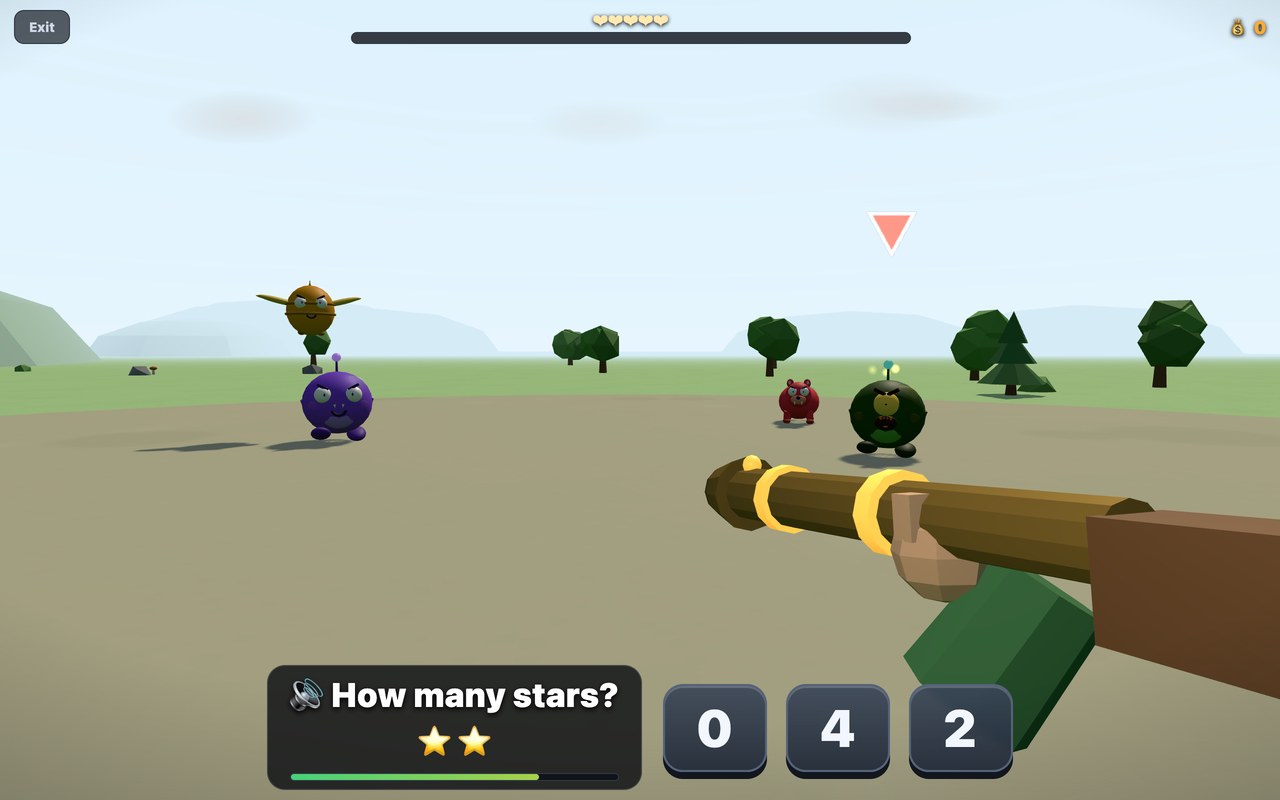
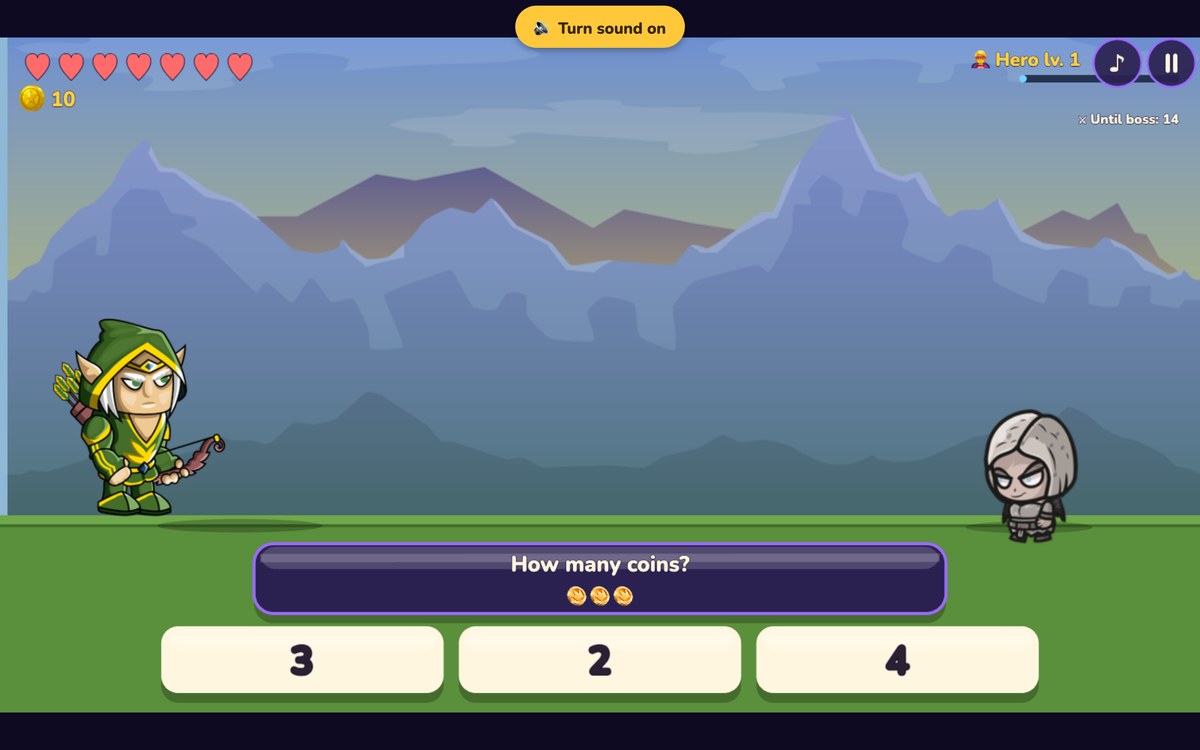
- math games for kindergarten — counting to 5 and up, an elf archer that adapts to your child
- math games for 1st graders — adding and subtracting to 20 in a 3D knight adventure
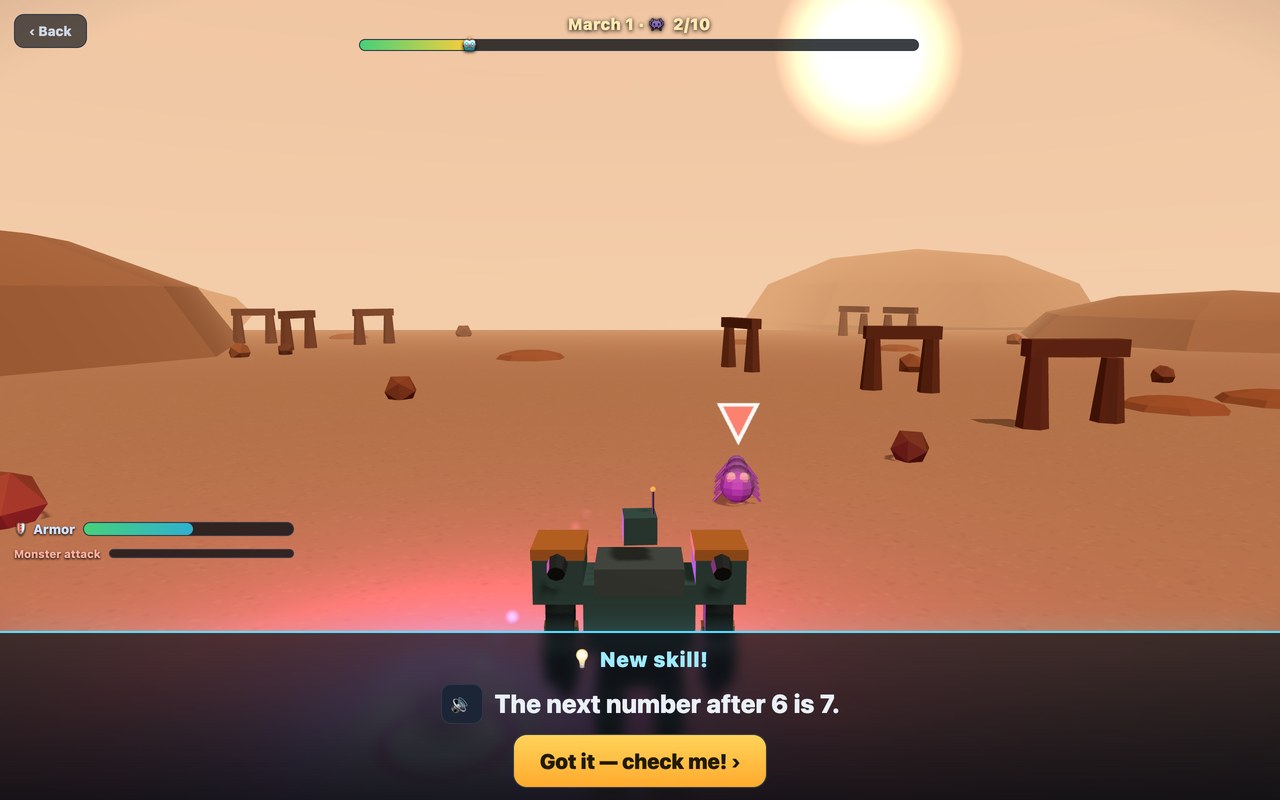
- math facts games — fact fluency with a mastery ladder in a walking mech
- multiplication table game — the whole times table, then division as its reverse
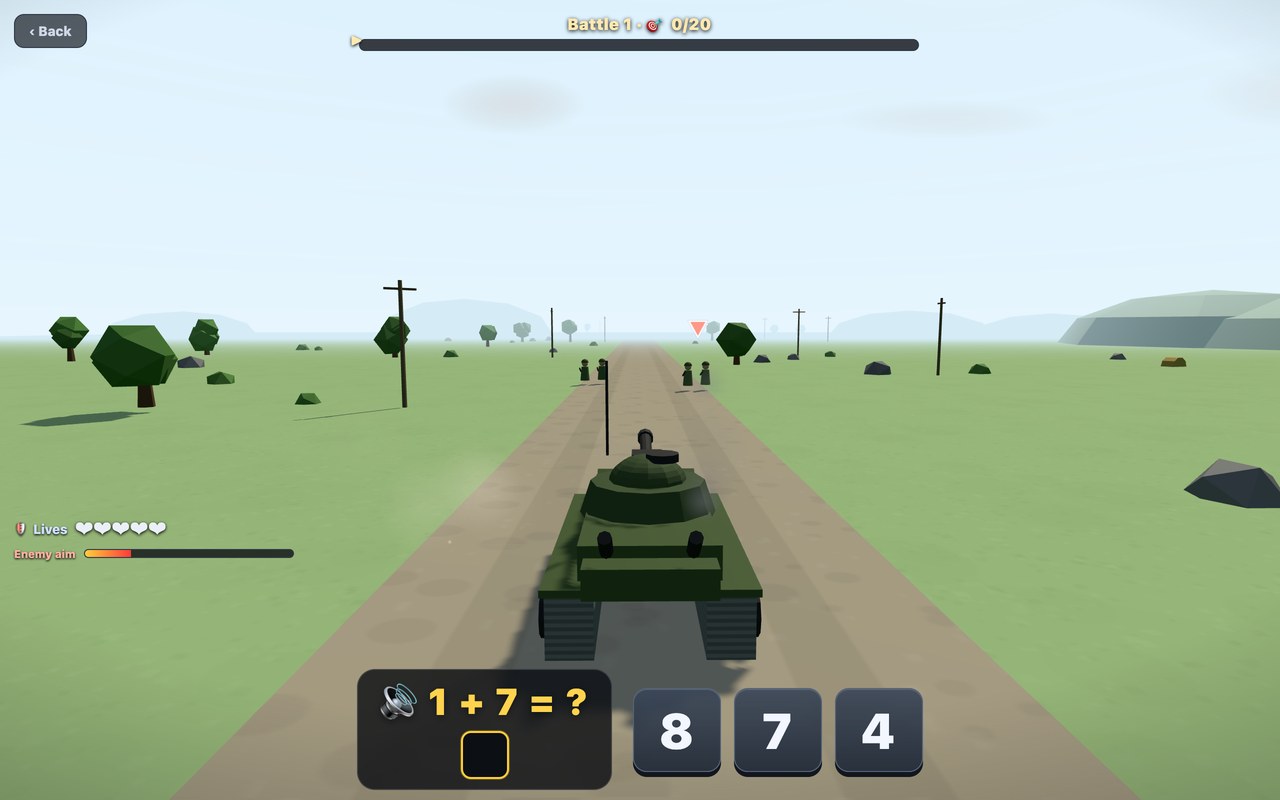
- multiplication practice games — aim the artillery by picking the right product
How to play
A math problem appears with four answers — tap the correct one to fire. The right answer charges the base guns and a turret blasts the marked monster; a wrong answer lets the monster spit back and damage your dome. Tap the 🔊 speaker to hear the problem read aloud. Clear a super problem (⭐) to earn a special weapon — orbital strike, shockwave or a shield drone. Survive every wave and the boss to win the defense and up to 3 stars, then progress through 10 stations, each with a new planet, a new weapon, and harder math.
What your child learns
Grade 1–4 math facts: addition and subtraction to 10, 20, 100 and 1000; multiplication facts (×2–5 and ×6–9) and division facts; simple two-step order-of-operations chains (e.g. 3 × 4 + 2); and mental-math speed and confidence — answers are read aloud, and "almost right" distractors (±1, ±10) reward real calculation over guessing.
The science behind the games
Every Dad4Kids game is built on one simple truth: children want to play, not study — so we turn learning into a game worth replaying. The method draws on peer-reviewed research in game-based learning, motivation, and how memory works.
- Tokac et al. (2019). Effects of game-based learning on students' mathematics achievement: A meta-analysis. Journal of Computer Assisted Learning.
- Alotaibi (2024). Game-based learning in early childhood education: a systematic review and meta-analysis. Frontiers in Psychology.
- Lampropoulos & Sidiropoulos (2024). Impact of gamification on students' learning outcomes and academic performance: a meta-analysis. Education Sciences.
- Taylor & Boyer (2019). Play-based learning: evidence-based research to improve children's learning experiences. Early Childhood Education Journal.
- Gottfried (1990). Academic intrinsic motivation in young elementary school children. Journal of Educational Psychology.
- Yang et al. (2018). Enhancing learning and retrieval of new information: a review of the forward testing effect. npj Science of Learning.
FAQ
What ages is Moon Base for?
It's built for kids in grades 1–4 (roughly ages 6–10). Early stations use simple addition and subtraction; later ones move up to multiplication, division, and two-step problems, so it grows with your child.
Is it free? Do I need to install anything?
Yes, it's completely free and runs right in your browser — no download, no signup.
Is it too fast or stressful for young kids?
No. There's no time penalty for thinking — monsters only fight back when an answer is wrong. Kids can take as long as they need to work out each problem.
What math does it cover?
Addition and subtraction up to 1000, multiplication and division facts, and simple order-of-operations chains — all the core math facts for grades 1–4.
Does it read the problems out loud?
Yes. Each problem is spoken in English (tap the 🔊 button to hear it again), which helps early readers and reinforces the numbers.
More free games for kids
By Evgeny Arsentiev, PhD · Last updated: September 2026