
Times Tables Game for Kids — Free Bigfoot Arena 7+
 New from Dad4Kids
Clean YouTube for kids
For families with traditional values, hand-picked by parents.
Open →
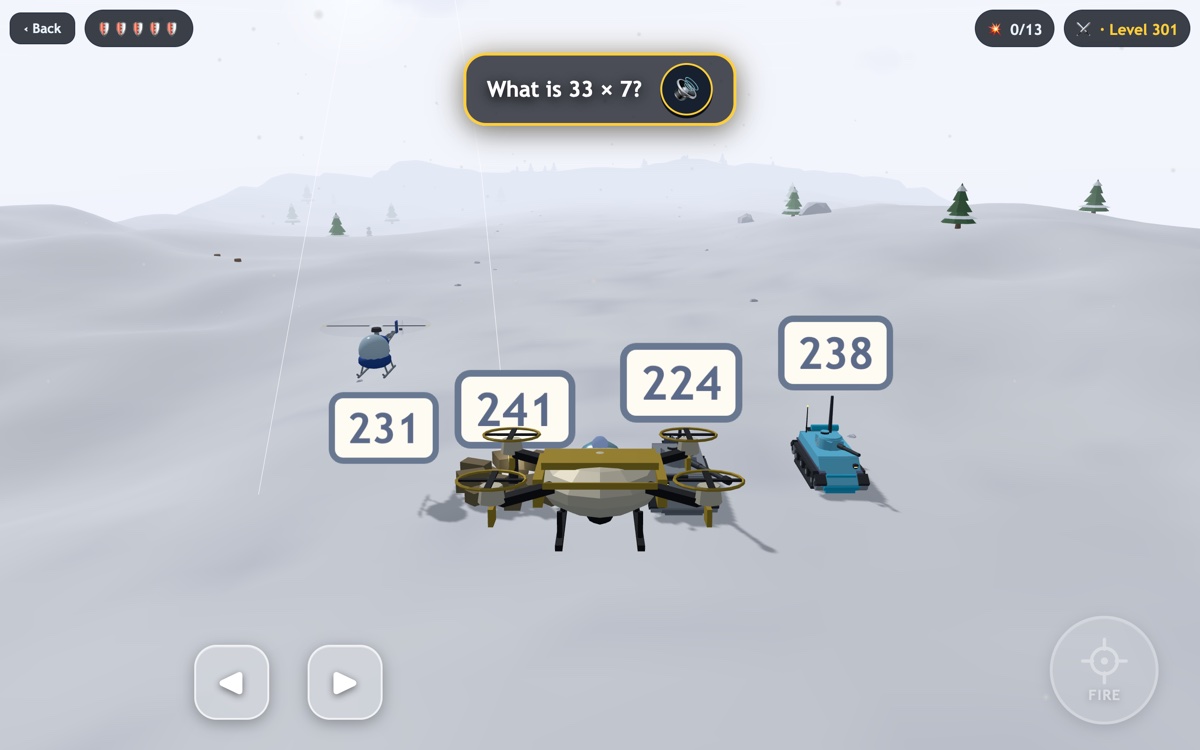
Bigfoot Arena turns times tables practice into a demolition derby. The child drives a huge menacing monster truck — giant tires, visible suspension springs, horns and burning torches — across a post-apocalyptic arena where robot cars race around with big numbers painted on their roofs. A problem flashes up: 7 x 8 = ? or 56 / 7 = ? Chase down the car carrying the right answer and crush it flat.
A correct crush is gloriously physical: the car flattens, wheels and springs fly, combo grows. A wrong crush just fizzles — the car steams and drives away, the problem stays. Every 25th level is an armored champion boss that must be crushed several times. Twenty arenas: scrapyard, rusted port, night stadium under floodlights, frozen wasteland, volcano.
How to play
Steer with arrows or on-screen buttons, hit turbo, jump the ramps. Listen to the problem read aloud, spot the car with the right number, hunt it down. Crushes earn bolts for the skin garage — skull headlights, flames, chrome. The first ten levels quietly tune difficulty; support mode gives fewer, slower cars.
What your child learns
Multiplication and division as one connected system, exactly like the school progression: x2 and /2 together, then x3//3 up to x9//9, squares, the fact family link (a x b = c means c / a = b), mixed neighbors, and full mixed exams. Division is always exact, distractors are pedagogic (neighboring table results, digit swaps), and a parent panel tracks all 16 fact families.
The science behind the games
Every Dad4Kids game is built on one simple truth: children want to play, not study — so we turn learning into a game worth replaying. The method draws on peer-reviewed research in game-based learning, motivation, and how memory works.
- Tokac et al. (2019). Effects of game-based learning on students' mathematics achievement: A meta-analysis. Journal of Computer Assisted Learning.
- Alotaibi (2024). Game-based learning in early childhood education: a systematic review and meta-analysis. Frontiers in Psychology.
- Lampropoulos & Sidiropoulos (2024). Impact of gamification on students' learning outcomes and academic performance: a meta-analysis. Education Sciences.
- Taylor & Boyer (2019). Play-based learning: evidence-based research to improve children's learning experiences. Early Childhood Education Journal.
- Gottfried (1990). Academic intrinsic motivation in young elementary school children. Journal of Educational Psychology.
- Yang et al. (2018). Enhancing learning and retrieval of new information: a review of the forward testing effect. npj Science of Learning.
FAQ
Is crushing cars too violent?
The victim cars are driverless robot buggies; a crush pops them into springs and bolts like a toy. Wrong answers are never punished — the car just squeaks and escapes.
Does my child need to know tables first?
No. Region 1 starts with x2 and /2 only, spoken aloud, with three slow cars. The campaign builds the whole table family by family, exactly like classroom order.
More free games for kids
By Evgeny Arsentiev, PhD · Last updated: September 2026