
Multiplication Table Game — Free Divide & Conquer 7+
 New from Dad4Kids
Clean YouTube for kids
For families with traditional values, hand-picked by parents.
Open →
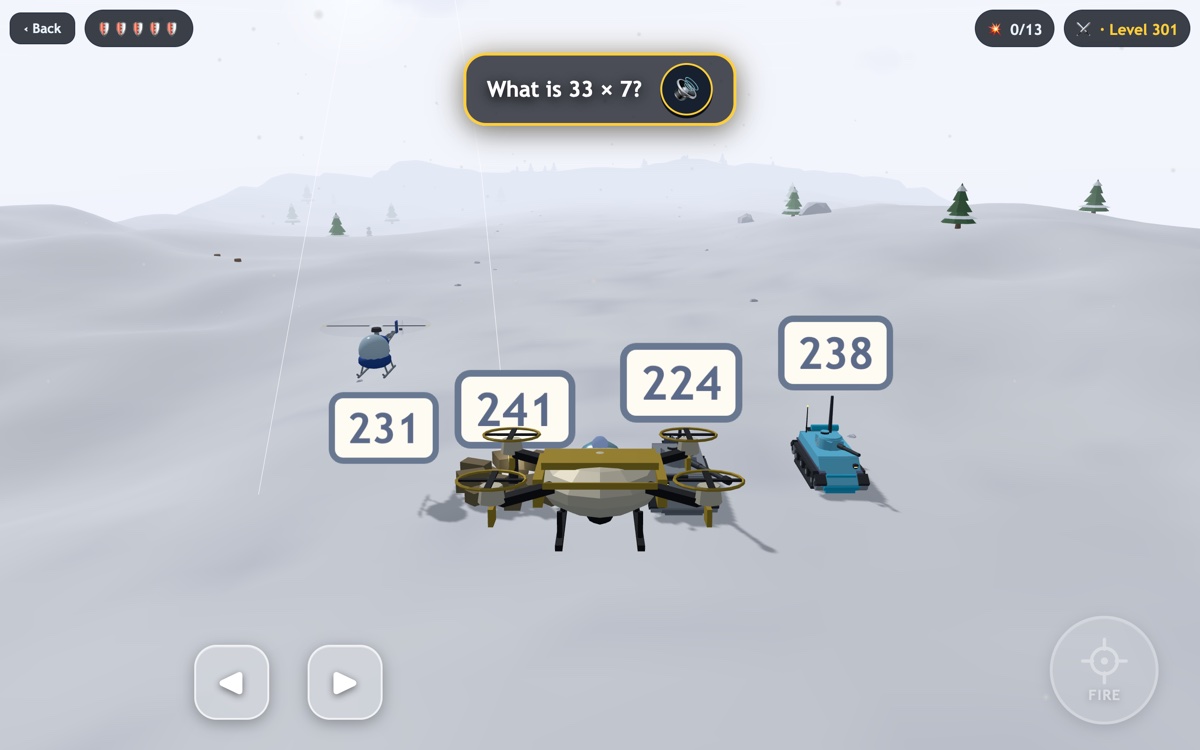
A multiplication table game should show a child why the table works, not just test it. Divide & Conquer lines the answer up on screen: an army of chrome robots marches on the shield wall in neat columns, so many columns and so many robots deep. Multiply the two numbers, type the answer on the charge console and press FIRE — with the right charge every cannon puts exactly one shell into every robot of its column and the whole formation goes down at once. The product is the number of robots your child can literally count.
One row of the table per chapter, 500 levels
The row of 2 first, then 5, then 10, with a mixed review of the easy rows; then 3 and 4; then 6, 7, 8 and 9; then the whole table shuffled. A fact never repeats twice in a row, and each chapter keeps the full row open — never one lonely example.
Then the same formation, backwards
From level 331 the identical formation asks how many shells go to EACH cannon, so division is learned as the reverse of a fact your child already owns (56 ÷ 7 = 8). The last chapters step past the table with second factors of 11 to 20.
Wrong answers cost nothing but a heart
A wrong charge is a misfire: the cannons sputter, the robots volley the shield, one heart goes. Hearts are only ever spent on maths mistakes, never on reflexes. Every third squad is a red one with a harder fact, and every tenth level ends with a boss whose armour code is one more table fact. Free, no ads, no download.
More free math games for kids
- math games for kindergarten — counting to 5 and up, an elf archer that adapts to your child
- math games for 1st graders — adding and subtracting to 20 in a 3D knight adventure
- math games for 2nd graders — adding, subtracting and first times tables in a moon-base defence
- math facts games — fact fluency with a mastery ladder in a walking mech
- multiplication practice games — aim the artillery by picking the right product
How to play
Look at the formation: how many columns, and how many robots in each. Multiply, type the product on the keypad and hit FIRE. From level 331 the same formation asks the question backwards — how many shells for EACH cannon — so division is learned as the inverse of a fact the child already knows. Spend coins in the Arsenal on new cannons: Tesla towers, plasma batteries, railguns and photon arrays hit harder, so elites fall in one volley and bosses lose armor faster.
What your child learns
The full times tables across 500 levels, one row per chapter and never the same fact twice in a row: first the row of 2, then 5, then 10 with a mixed review of the easy rows; then 3 and 4; then 6, 7, 8 and 9; then the whole table shuffled. From level 331 division arrives as the reverse of the very same formation (56 ÷ 7 = 8), and the last chapters step beyond the table with second factors of 11 to 20. Because the answer is literally the number of robots on screen, the child sees WHY multiplication works — it counts equal groups all at once.
The science behind the games
Every Dad4Kids game is built on one simple truth: children want to play, not study — so we turn learning into a game worth replaying. The method draws on peer-reviewed research in game-based learning, motivation, and how memory works.
- Tokac et al. (2019). Effects of game-based learning on students' mathematics achievement: A meta-analysis. Journal of Computer Assisted Learning.
- Alotaibi (2024). Game-based learning in early childhood education: a systematic review and meta-analysis. Frontiers in Psychology.
- Lampropoulos & Sidiropoulos (2024). Impact of gamification on students' learning outcomes and academic performance: a meta-analysis. Education Sciences.
- Taylor & Boyer (2019). Play-based learning: evidence-based research to improve children's learning experiences. Early Childhood Education Journal.
- Gottfried (1990). Academic intrinsic motivation in young elementary school children. Journal of Educational Psychology.
- Yang et al. (2018). Enhancing learning and retrieval of new information: a review of the forward testing effect. npj Science of Learning.
FAQ
Is the game scary?
The robots are shiny cartoon machines, and the world around them is deliberately bright — sunny valleys, golden canyons, snow peaks and lavender fields. Destroyed robots pop apart into springs and plates with electric sparks; there are no people and no blood.
What if the child doesn't know the times tables yet?
The first chapters use small formations that can simply be counted on screen: 2 columns of 5 robots is ten. Counting turns into multiplying by itself — that is the point of the game. A new row of the table is introduced only after the previous one has been trained.
Does the same problem keep repeating?
No. The generator never gives the same fact twice in a row, and it rotates through every fact available in the chapter before any of them can come back.
More free games for kids
By Evgeny Arsentiev, PhD · Last updated: September 2026