
Multiplication Facts — Free True Aim Artillery Game 7+
 New from Dad4Kids
Clean YouTube for kids
For families with traditional values, hand-picked by parents.
Open →
A child does not learn multiplication facts from a shuffled deck — they learn one row at a time, until that row is automatic. True Aim is built exactly around that: chapter by chapter it takes the 2s, then the 5s and 10s, everything up to 5×5, then the 3s and 4s, then the hard end — 9s, 6s, 8s and finally the 7s.
The right product is the shot
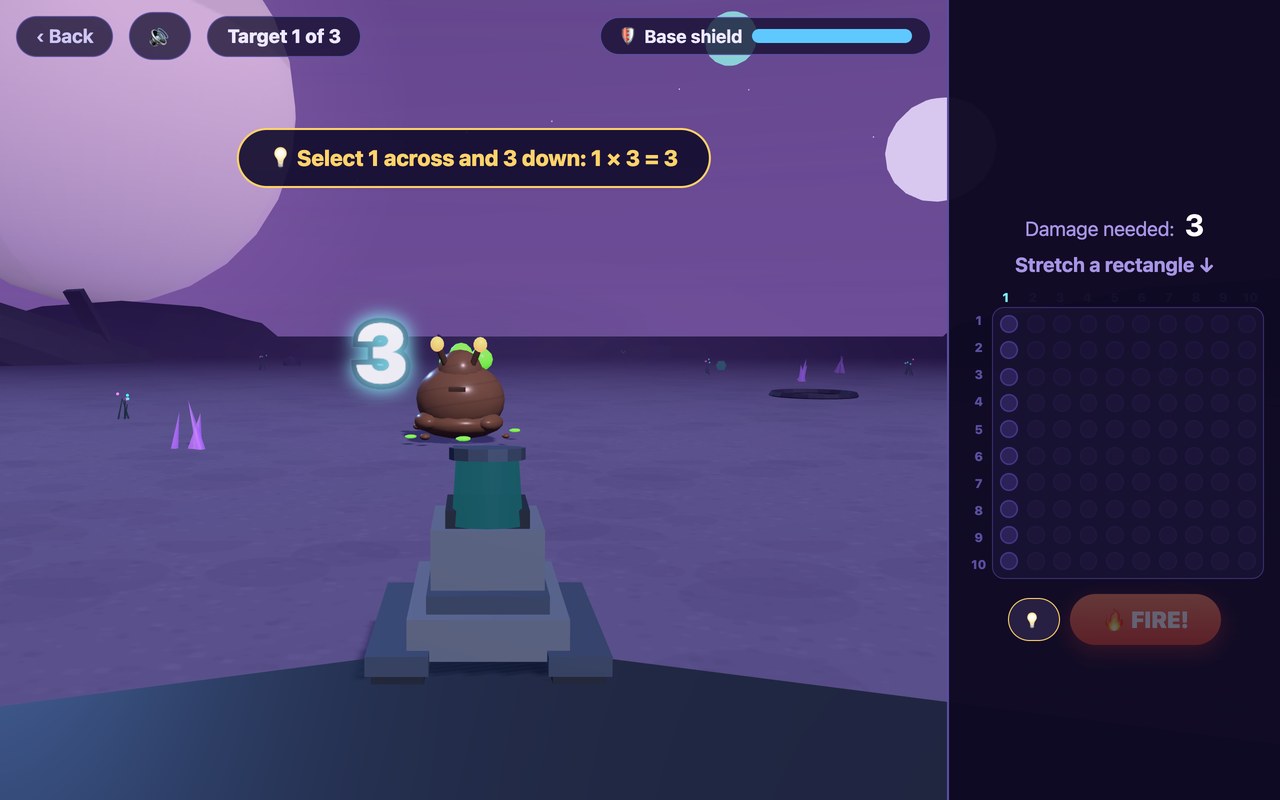
Naming the correct product is what lays the gun and fires it; there is no separate shoot button and nothing to dodge. A wrong answer is a miss — one heart, no drama — and the fact comes back later in the same chapter.
500 levels, no fact twice in a row
Each chapter keeps the whole row in play rather than drilling one lonely example, a fact never repeats immediately, and every tenth level is a boss whose armour code is one more fact from the row your child just learned.
Free, in the browser
No download, no account, no ads. Every question is read aloud, and progress is saved on the device.
Free math games by grade
- math games for kindergarten — counting to 5 and up, an elf archer that adapts to your child
- math games for 1st graders — adding and subtracting to 20 in a 3D knight adventure
- math games for 2nd graders — adding, subtracting and first times tables in a moon-base defence
- math games for 3rd graders — short word problems, add and subtract past 100, first division
- math games for 4th graders — multi-digit multiplication, factors, multiples and equivalent fractions
- math games for 5th graders — decimals, percent, area and perimeter, solving for x — it picks by skill
- math games for 6th graders — negative numbers on a depth scale, tenths and rounding
Free math games by skill
- multiplication table game — the whole times table, then division as its reverse
- math facts games — fact fluency with a mastery ladder in a walking mech
- counting money — count coins, compare prices, give change, keep the treasury
- telling time — read the clock, measure durations, plan a railway timetable
- measuring length — ruler, scales, measuring jug and unit conversion
- coordinate grid — read a grid point, then fire at (x, y) — all four quadrants
How to play
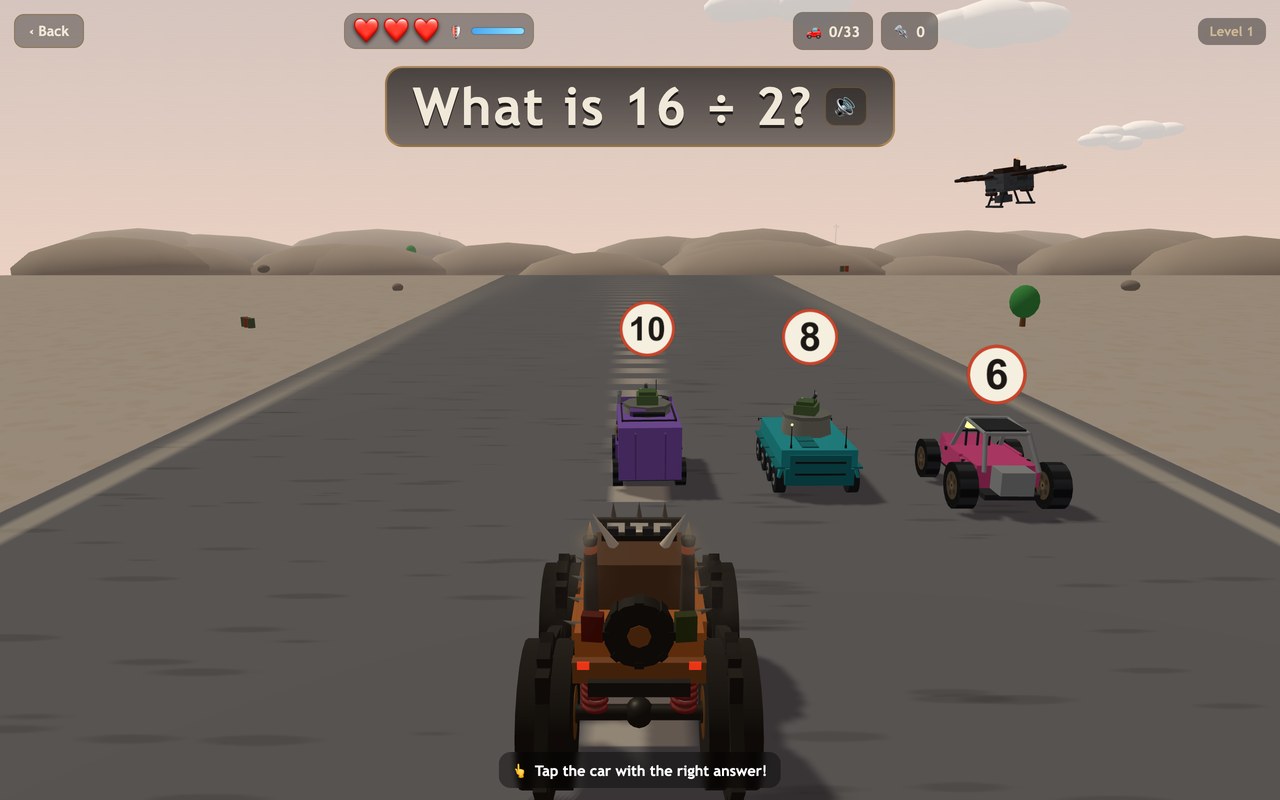
Watch the target marker over the nearest enemy and read the problem at the bottom. Four answers = four cells; tap the right one and the howitzer lands a shell on the target, with a green dashed flash around the cell. If a vehicle reaches the guns, the crew stops it point-blank but the battery loses a heart. Clear all enemies before five breaches — bosses arrive on every tenth level.
What your child learns
The grid mechanic makes place value physical: tens are rows, units are columns. The curriculum climbs from addition and subtraction within 20, through two-digit sums, to the multiplication table and division across 500 levels — and because the answer is always a cell from 1 to 100, children internalise the number line and times table layout. Red bonus problems are one band harder.
The science behind the games
Every Dad4Kids game is built on one simple truth: children want to play, not study — so we turn learning into a game worth replaying. The method draws on peer-reviewed research in game-based learning, motivation, and how memory works.
- Tokac et al. (2019). Effects of game-based learning on students' mathematics achievement: A meta-analysis. Journal of Computer Assisted Learning.
- Alotaibi (2024). Game-based learning in early childhood education: a systematic review and meta-analysis. Frontiers in Psychology.
- Lampropoulos & Sidiropoulos (2024). Impact of gamification on students' learning outcomes and academic performance: a meta-analysis. Education Sciences.
- Taylor & Boyer (2019). Play-based learning: evidence-based research to improve children's learning experiences. Early Childhood Education Journal.
- Gottfried (1990). Academic intrinsic motivation in young elementary school children. Journal of Educational Psychology.
- Yang et al. (2018). Enhancing learning and retrieval of new information: a review of the forward testing effect. npj Science of Learning.
FAQ
Is it violent?
It is a cartoon low-poly battle: vehicles pop apart, turrets tumble, no people are shown being hurt — crews are abstracted away. Wrong answers never destroy anything of the child's; they just cost time while the column advances.
Why don't I see the grid?
That is the point: the field looks like a clean, beautiful landscape. The grid exists in the child's head — the dashed cell outline flashes only for a moment where the shell lands, reinforcing the mental map without cluttering the scene.
More free games for kids
By Evgeny Arsentiev, PhD · Last updated: September 2026