
Measuring Length — Free Supply Command Game for Kids 6+
 New from Dad4Kids
Clean YouTube for kids
For families with traditional values, hand-picked by parents.
Open →
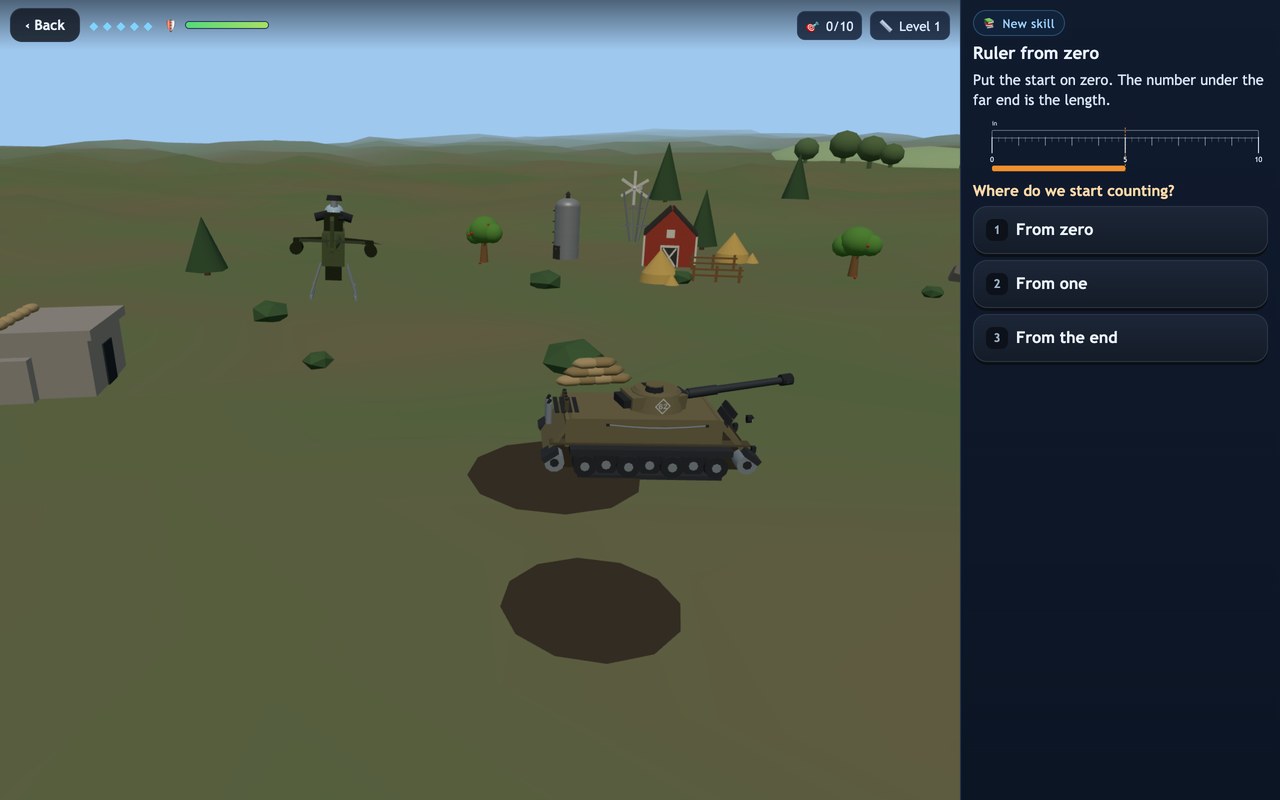
Measuring length is the first measurement a child meets, and the one that teaches all the others: line the object up with zero, read the mark, name the unit. Supply Command puts a real ruler and a tape measure on screen and asks for the reading before anything can be loaded onto the convoy.
Then everything else you can measure
Centimetres and metres first, and converting between them; then scales in grams and kilograms, measuring jugs in millilitres and litres, the clock, the thermometer (including below zero), the perimeter of a fence, the load a bridge will take, and speed as distance over time. 500 levels across 25 chapters.
Every mission is a word problem
Questions come as supply orders — «the speed is 30 km per hour; in 2 hours do we cover 60 km?» — so measuring is never separated from the reason for measuring.
Free, in the browser
No download, no account, no ads. Every question is read aloud, and progress is saved on the device.
Free math games by grade
- math games for kindergarten — counting to 5 and up, an elf archer that adapts to your child
- math games for 1st graders — adding and subtracting to 20 in a 3D knight adventure
- math games for 2nd graders — adding, subtracting and first times tables in a moon-base defence
- math games for 3rd graders — short word problems, add and subtract past 100, first division
- math games for 4th graders — multi-digit multiplication, factors, multiples and equivalent fractions
- math games for 5th graders — decimals, percent, area and perimeter, solving for x — it picks by skill
- math games for 6th graders — negative numbers on a depth scale, tenths and rounding
Free math games by skill
- multiplication table game — the whole times table, then division as its reverse
- multiplication facts — one row of the table per chapter until every fact is automatic
- math facts games — fact fluency with a mastery ladder in a walking mech
- counting money — count coins, compare prices, give change, keep the treasury
- telling time — read the clock, measure durations, plan a railway timetable
- coordinate grid — read a grid point, then fire at (x, y) — all four quadrants
How to play
Read the radio briefing, then look at the gap in the road and line it up against the meter ruler. Work out how many meters the span is, then build the bridge to match: tap +1 m and +0.5 m to add beams, or type the number straight into the console. Press go and watch the convoy try your bridge. Too short and the vehicle drops into the chasm; too long and it overhangs and the vehicle reverses; exactly right and it drives across to the outpost. A wrong length is a clear, safe setback with a friendly hint, so the child re-measures and tries again. Nail it first try for three stars.
What your child learns
This is a focused length-and-distance measurement course disguised as a convoy game: reading a meter ruler and measuring a span in whole meters; measuring larger distances; finding a missing length by subtraction (finishing a part-built bridge); counting up in tens with five-meter beams; adding two lengths into a single total; estimating a span before you build; and half-meter fractions with precise, exact answers. Along the way the child builds real measurement intuition — comparing lengths, estimating, and checking the answer against what actually happens in the world — instead of memorizing tables.
The science behind the games
Every Dad4Kids game is built on one simple truth: children want to play, not study — so we turn learning into a game worth replaying. The method draws on peer-reviewed research in game-based learning, motivation, and how memory works.
- Tokac et al. (2019). Effects of game-based learning on students' mathematics achievement: A meta-analysis. Journal of Computer Assisted Learning.
- Alotaibi (2024). Game-based learning in early childhood education: a systematic review and meta-analysis. Frontiers in Psychology.
- Lampropoulos & Sidiropoulos (2024). Impact of gamification on students' learning outcomes and academic performance: a meta-analysis. Education Sciences.
- Taylor & Boyer (2019). Play-based learning: evidence-based research to improve children's learning experiences. Early Childhood Education Journal.
- Gottfried (1990). Academic intrinsic motivation in young elementary school children. Journal of Educational Psychology.
- Yang et al. (2018). Enhancing learning and retrieval of new information: a review of the forward testing effect. npj Science of Learning.
FAQ
Does the child actually have to measure?
Yes — every crossing is locked behind a correct length. There are no rewards for random tapping: you measure the gap on the meter ruler and build the bridge to match, and only the right length lets the convoy across.
What ages is it for?
From about 6. It starts with simple whole-meter spans read straight off the ruler and only later introduces adding two distances, five-meter beams and half-meter fractions. Radio briefings are voiced, so heavy reading isn't required early on.
Is it violent?
No. There is no combat — the challenge is getting convoys across broken crossings. A wrong bridge just means a vehicle drops into the chasm or backs off, shown gently, never anything graphic. The focus is measuring, building and supply.
Is it free?
Yes — completely free, no ads and no purchases, right in the browser on a computer or tablet.
More free games for kids
By Evgeny Arsentiev, PhD · Last updated: September 2026